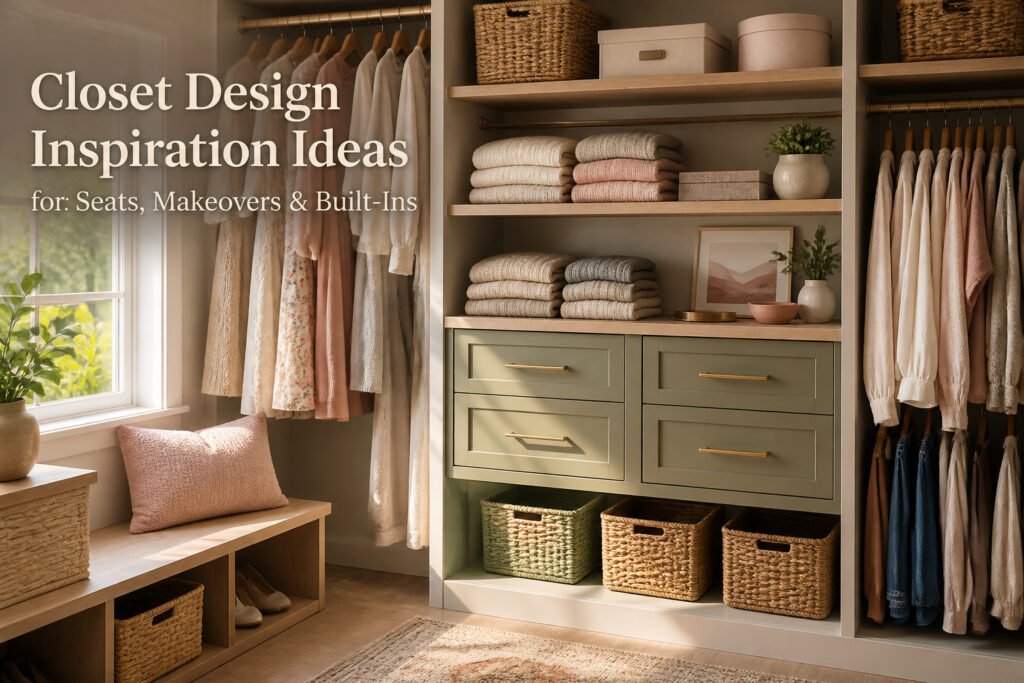
The right closet design inspiration depends on whether you own the walls or answer to a landlord. A $1,700 IKEA PAX overhaul and a $100 Elfa bracket system both work, but only one survives a lease inspection. The sixteenth-inch discrepancy that jams a drawer is why measuring alone can cost $50 before you buy a single shelf.
1. A Seat Inside the Closet
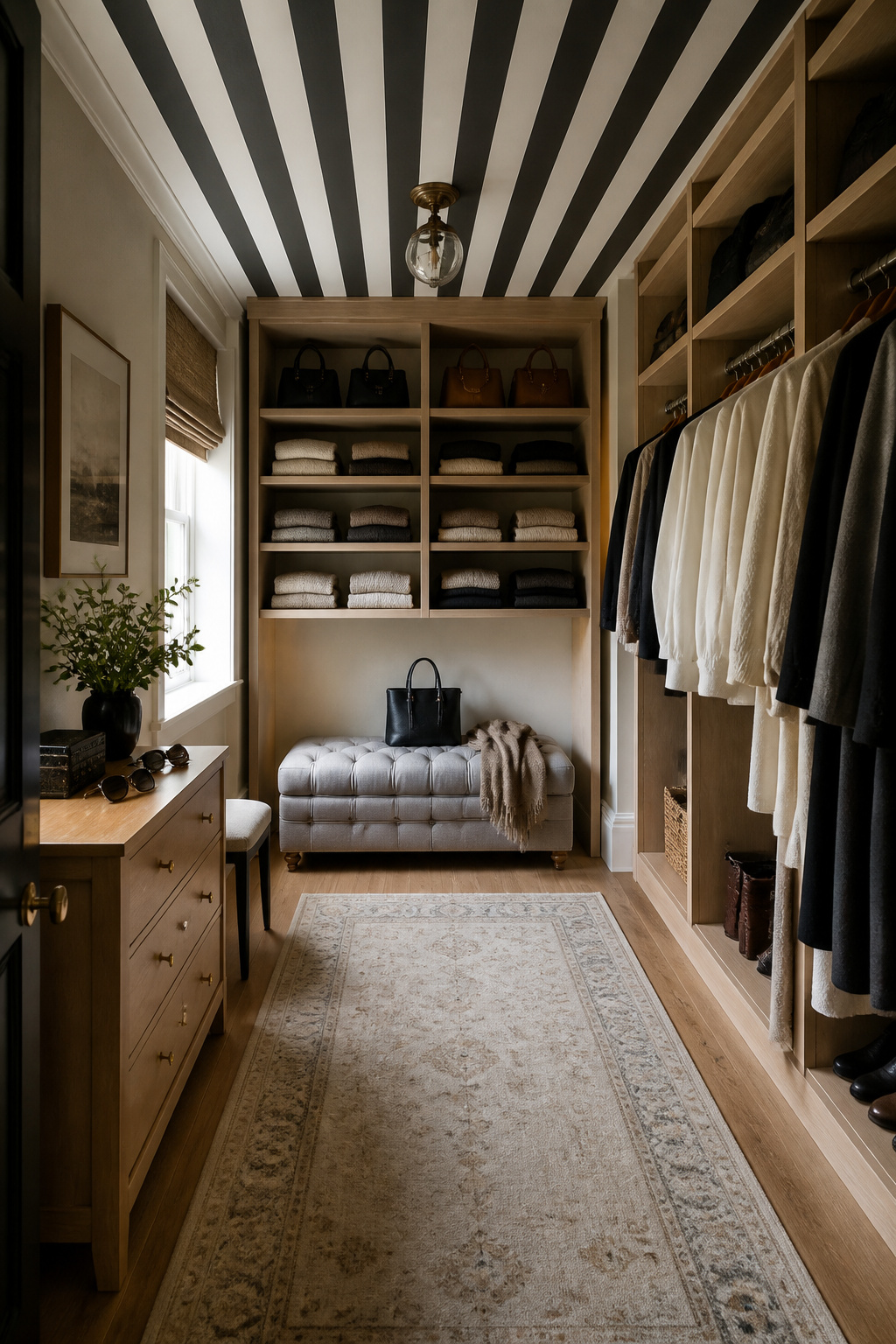
A bench or small chair turns a walk-in closet from storage into a dressing room, and the space it needs is smaller than most people guess. A walk-in can be as small as 3.5 feet deep and 7.5 feet long and still hold a seat against one wall with hanging rods on the other. The luxury is practical: sitting to lace shoes, or to pull on boots without wobbling, or to set down a bag while you change. A tufted ottoman or a narrow upholstered bench works best in tight footprints, since both can tuck under a shelf or slide clear when you need floor space. Windows help if you have them, but the seat matters more; it is the piece that makes you want to stay in the room after you are dressed. I have seen makeovers where a window seat built into the end wall does both jobs at once, and others where a simple stool pulled from another room is enough to change how the space feels. The ceiling is the last place to look for personality if the floor is already claimed; black-and-white striped paper overhead turned one 1940s closet into a room cool enough to linger in.
2. Small Walk-In Makeovers
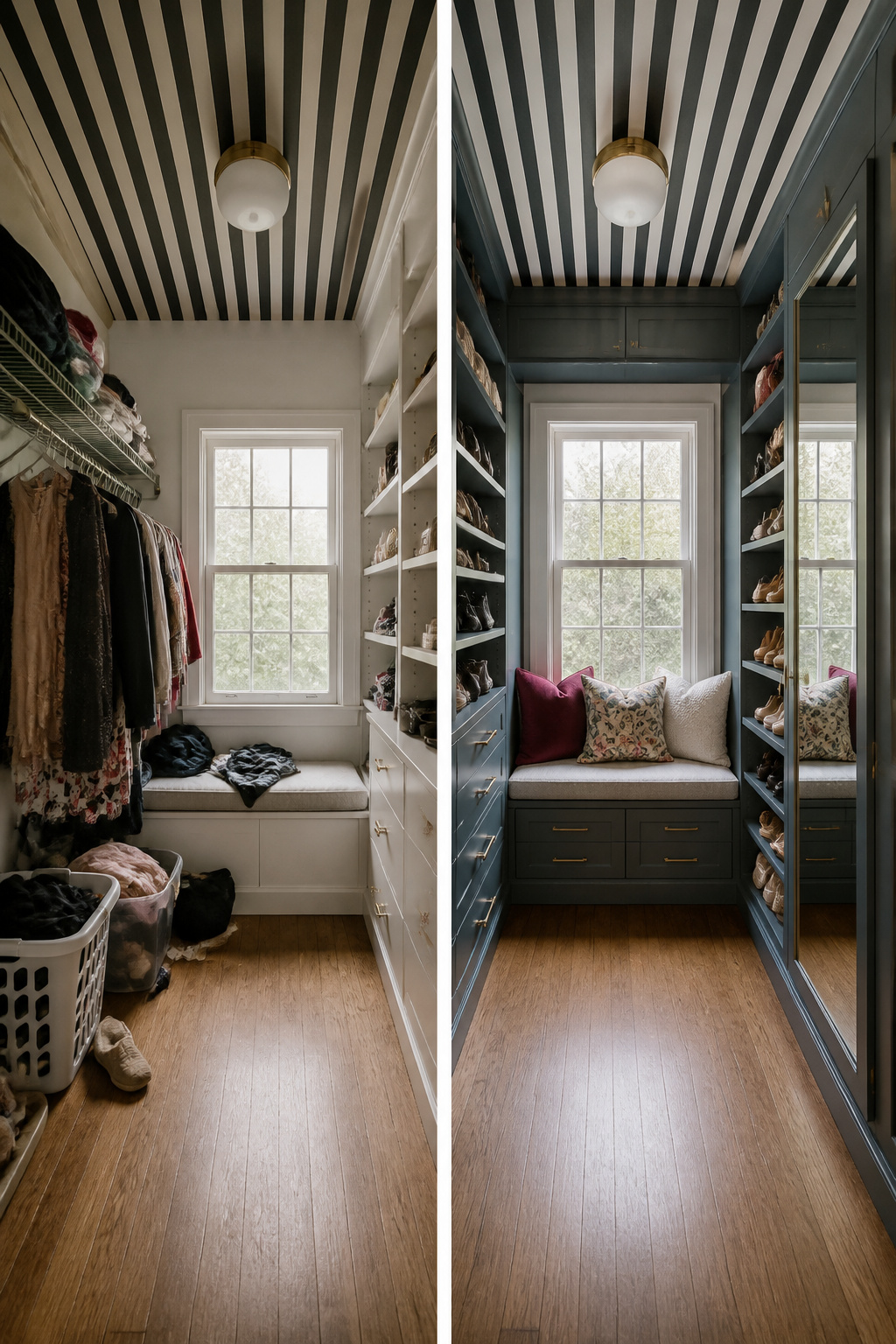
Small walk-in makeovers are where most of us actually live, not the sprawling closets with island benches and chandelier lighting. The IKEA PAX system in one 1940s home started out looking wrong for its era, all modern finish and no character, until paint and hardware pulled it back into line. A moody bluish-gray shade across the whole unit, plus brass hardware, turned it into something that belonged in the house. The ceiling got black-and-white striped wallpaper, a floor-length mirror went up, and a window seat made the closet feel like a room you’d stay in.
That last part matters more than it sounds. Finding your jumping-off point in a small walk-in can be the hardest step, because every wall already has a job and you can’t just clear it all out to rethink. Modular shelves help here. Wire or wood, they let you build around what you actually own rather than fitting your stuff into a fixed system. Shoes and bags get designated spots, and you can shift shelves as habits change without tearing anything out.
Vertical space is the move that costs least and shows most. Built-ins that run floor to ceiling, with rods, shelving, and drawers tailored to what you collect, can push usable storage up by roughly half in the same footprint. The trick is matching the solution to the actual clutter: jewelry drawers if that’s your pile, a pull-out ironing board if you press shirts weekly. Generic systems look tidy in photos and fight you by Tuesday.
3. Built-In Closet Designs

Built-in closets turn the dead space between studs into storage that actually fits your life. The standard reach-in is roughly a 4 ft by 2 ft box with a shelf across the top, which sounds minimal until you frame it out with custom cabinet doors, trim, and a mix of hanging rods, shelves, and maybe a drawer or two. I spent weeks saving built-in wardrobes to a Pinterest board before I understood what pulled me toward the English cottage look: the doors hide the visual noise of clothes so the room stays calm.
Bi-fold doors are the move for smaller closets, especially when sliding doors steal too much wall depth. Modern raised wood panels, accordion styles, or French-style glass bi-folds can become the room’s focal point rather than something you try not to notice. One $550 redo I studied started with wire shelves and clunky bi-folds; the owner swapped in vintage-style wood shelves with black brackets and removed the doors entirely, turning functional storage into open display. That only works if your clothing cooperates with your color scheme. I would need doors on my hanging section, because a wall of mismatched shirts against painted shelving would drive me to distraction. Blue built-ins look stunning in photos, but the mirror and the lighting matter as much as the paint. A mirror at the end of shelving doubles the sense of depth, and a window inside the closet needs a treatment, not just an afterthought.
4. Modular and Adjustable Shelving

Modular shelving is where most closet makeovers actually start, because a system that lets you move a shelf up six inches after you live with it for a month beats one that locks you in forever. The two names that come up everywhere are IKEA PAX and The Container Store’s Elfa, and they serve different kinds of planners.
IKEA PAX runs wide and deep. One walk-in redo I kept returning to used the system to replace wasted overhead space with categorized clothing racks, accessory shelving, under-shelf lighting, and wallpaper that pulled the whole closet together. That particular makeover cost $1,700, which sits at the top of what these projects tend to run. Most modular closet overhauls land somewhere between $100 and $1,700 depending on whether you are adding a single tower or filling a walk-in.
Elfa works thinner and more custom. The Container Store will send someone to measure your space for a $50 fee, applied to unlimited rooms in one visit, and from there you pick components that clip onto wall-mounted standards. The hardware is more visible than PAX’s built-in look, but the adjustability is immediate: no tools to slide a shoe shelf into a sweater slot if your seasons change.
For renters, the wall standards are the sticking point. PAX units stand on the floor like furniture; Elfa needs holes. If your lease is strict, that decides it.
5. Wallpaper and Lighting
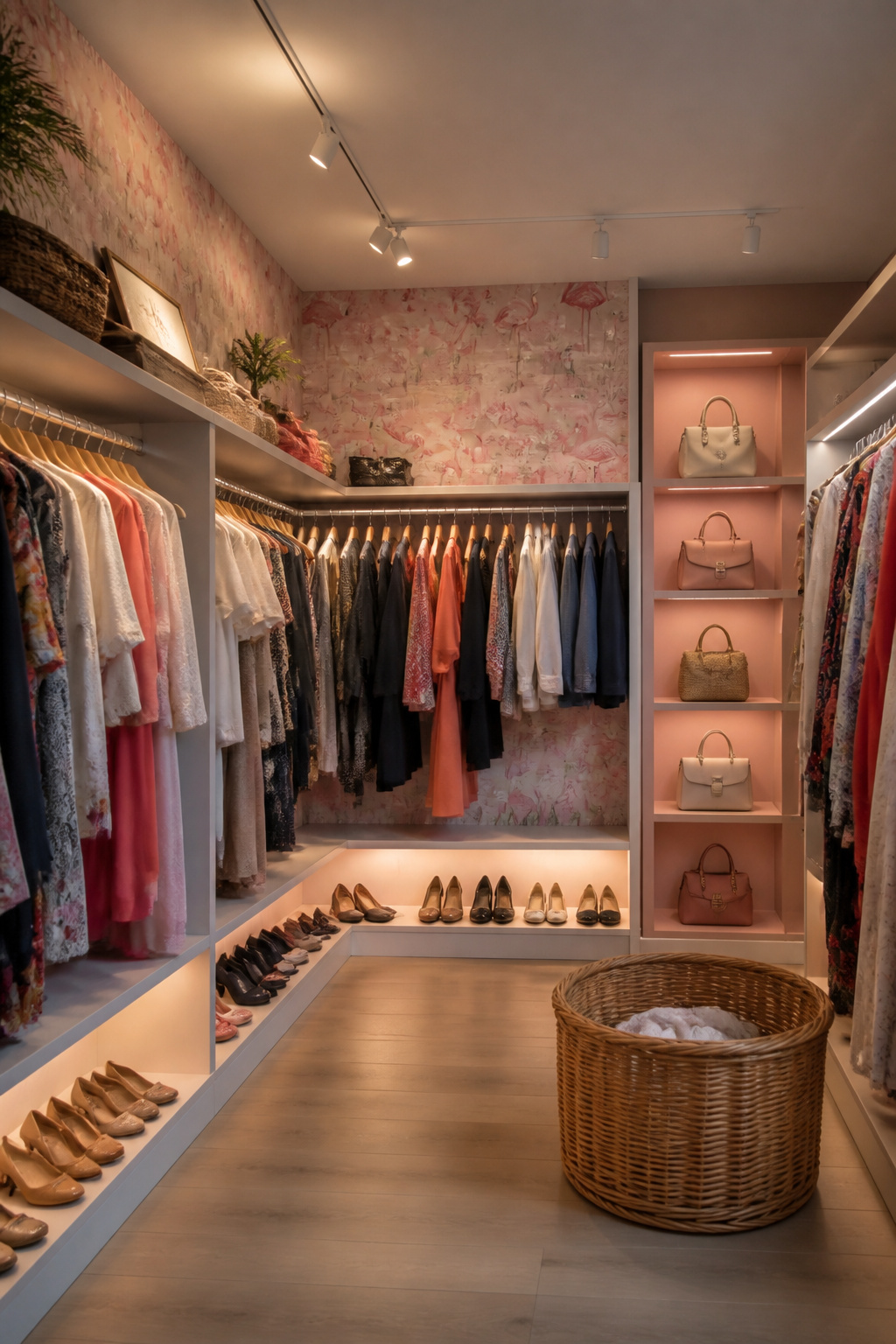
Wallpaper and lighting do the heavy lifting when you want a closet that feels finished without tearing into walls. The IKEA PAX makeover that stuck with me used under-shelf lighting paired with flamingo wallpaper to turn basic storage into something that read as glamorous, not utilitarian. LED track lights spread even light across clothing racks, while a softer recessed light aimed at a shelf of bags or jewelry gives that boutique display effect. In a nursery closet I kept returning to, botanical wallpaper ran across both walls and ceiling, which sounds like too much until you see how the pattern distracted from the standard wire shelving left in place.
Humidity limits your choices more than most people expect. Standard paper-backed wallpaper will bubble in a closet that shares a wall with a bathroom or sits above a crawl space. Vinyl or non-woven substrates hold up better, and peel-and-stick versions let you test the look for a weekend before committing. For lighting, battery-operated LED strips under existing shelves bridge the gap when there is no junction box. The rechargeable ones last roughly six to eight weeks of daily use, and the magnetic mounting means no landlord conversation. If you do have an outlet, plug-in puck lights with a remote dimmer cost less and give you the wattage control that makes task lighting actually useful rather than just bright.
6. Shoe and Accessory Storage
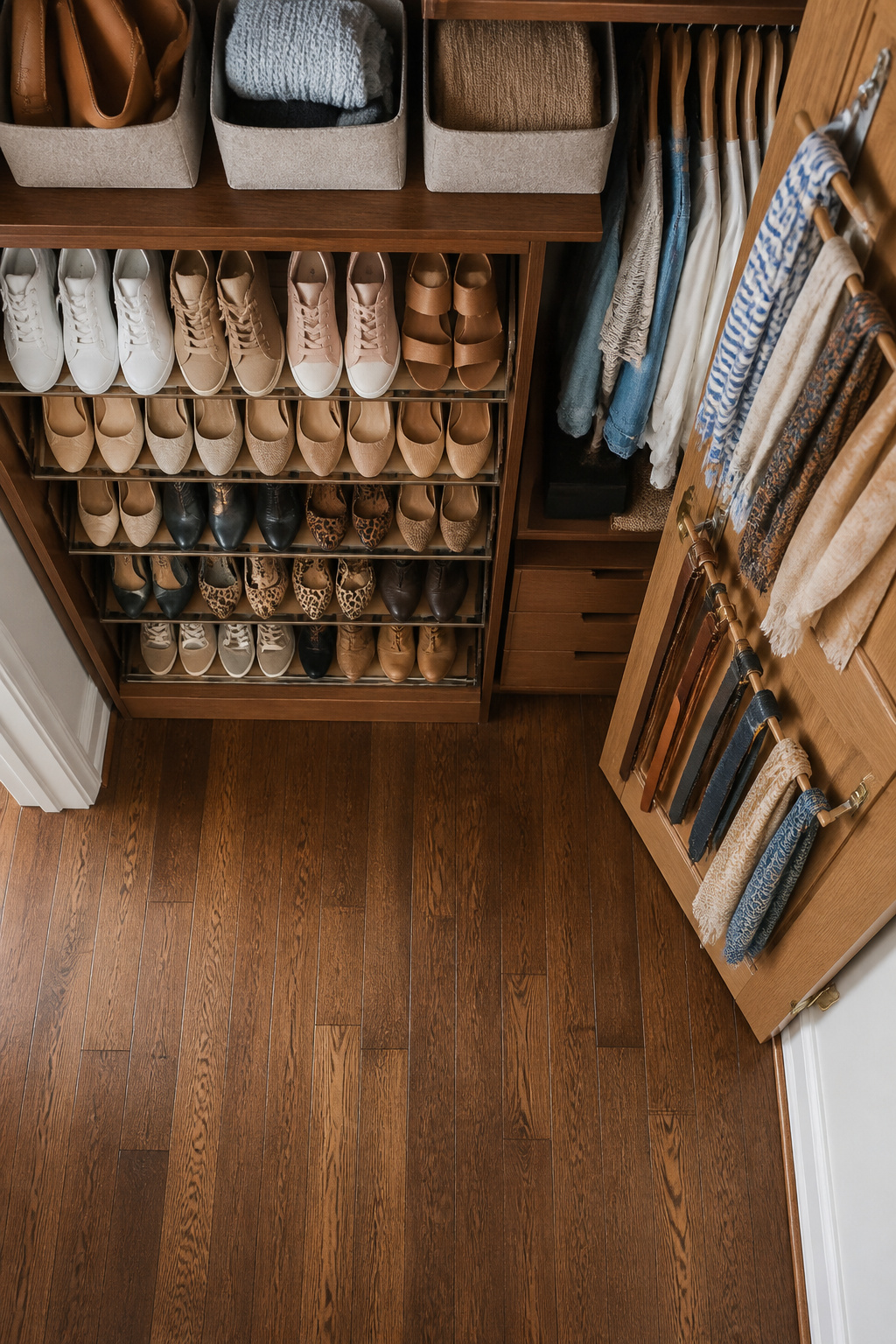
Shoes eat floor space faster than anything else in a closet, which is why I stopped lining mine up on a single flat shelf. A slanted rack with a shoe fence keeps pairs visible and stops the domino effect that sends one heel knocking into the next. ShelfGenie builds these to fit tall boots in the same row as running shoes, so the depth adjusts instead of forcing everything into identical cubbies.
For accessories, the back of a door is dead real estate until you hang an organizer there. The Elfa system I have seen mounted on a black closet door turns that surface into a grid for scarves, belts, or the small bags that slide off hooks. Color-coordinated bins inside keep the visual noise down in a tight footprint.
Clear boxes work if you want the collection out of sight but not out of memory. I label the short side and stack them two deep on existing shelves; the front row lifts out when I need the back. No built-in required, just the shelf you already own cut to a height that fits the box.
Pull-out racks are harder to retrofit into a standard closet unless the side walls have clearance, so I measure the frame first. A rack that extends full depth needs about fourteen inches of open aisle to clear the door swing. Without it, the fixed slanted shelf wins.
7. Mirrors That Open the Space
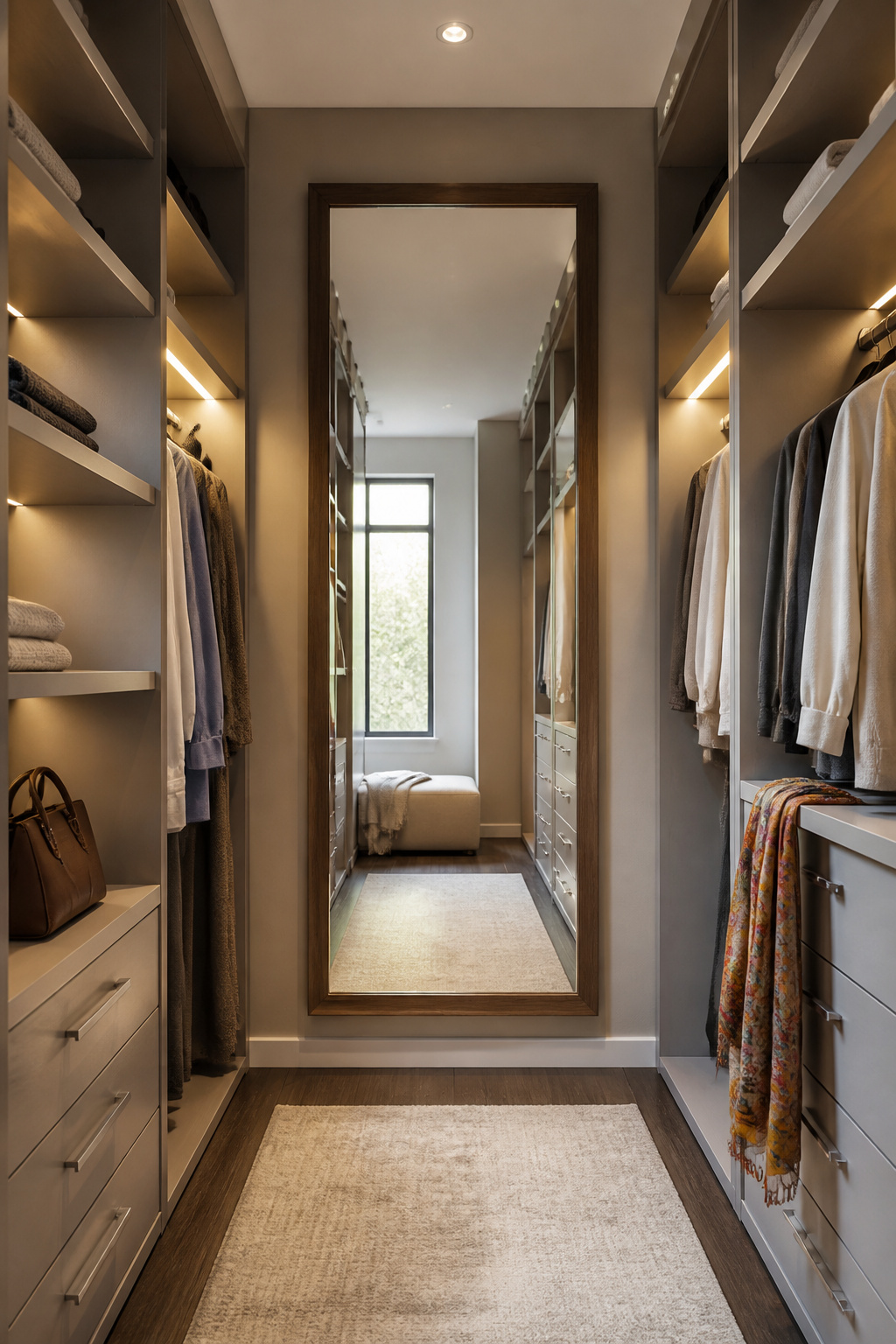
A full-length mirror mounted to the back wall of a narrow walk-in closet doubles the visual depth the moment the door opens. The reflection catches whatever natural or overhead light exists and pushes it back into corners that otherwise read as dead space. In the closet I keep returning to for reference, the mirror sits at the end of the shelving run, framed simply so it reads as architecture rather than an afterthought.
Placement matters more than size. A mirror opposite a window multiplies daylight; a mirror opposite a solid wall only multiplies wall. If the closet has no window, angle the mirror to catch the closet’s own task lighting, whether that’s LED track or a softer recessed fixture over a dressing area. The light source ends up working twice as hard without adding a single watt.
For renters or anyone not ready to hard-mount, leaning an oversized mirror against the back wall achieves nearly the same effect and travels with you. Custom mirrored doors on reach-in closets serve the same purpose, bouncing light while hiding clutter. Either approach runs a few hundred dollars, well inside the weekend-project budget, and both install in an afternoon.
What the Projects Actually Cost
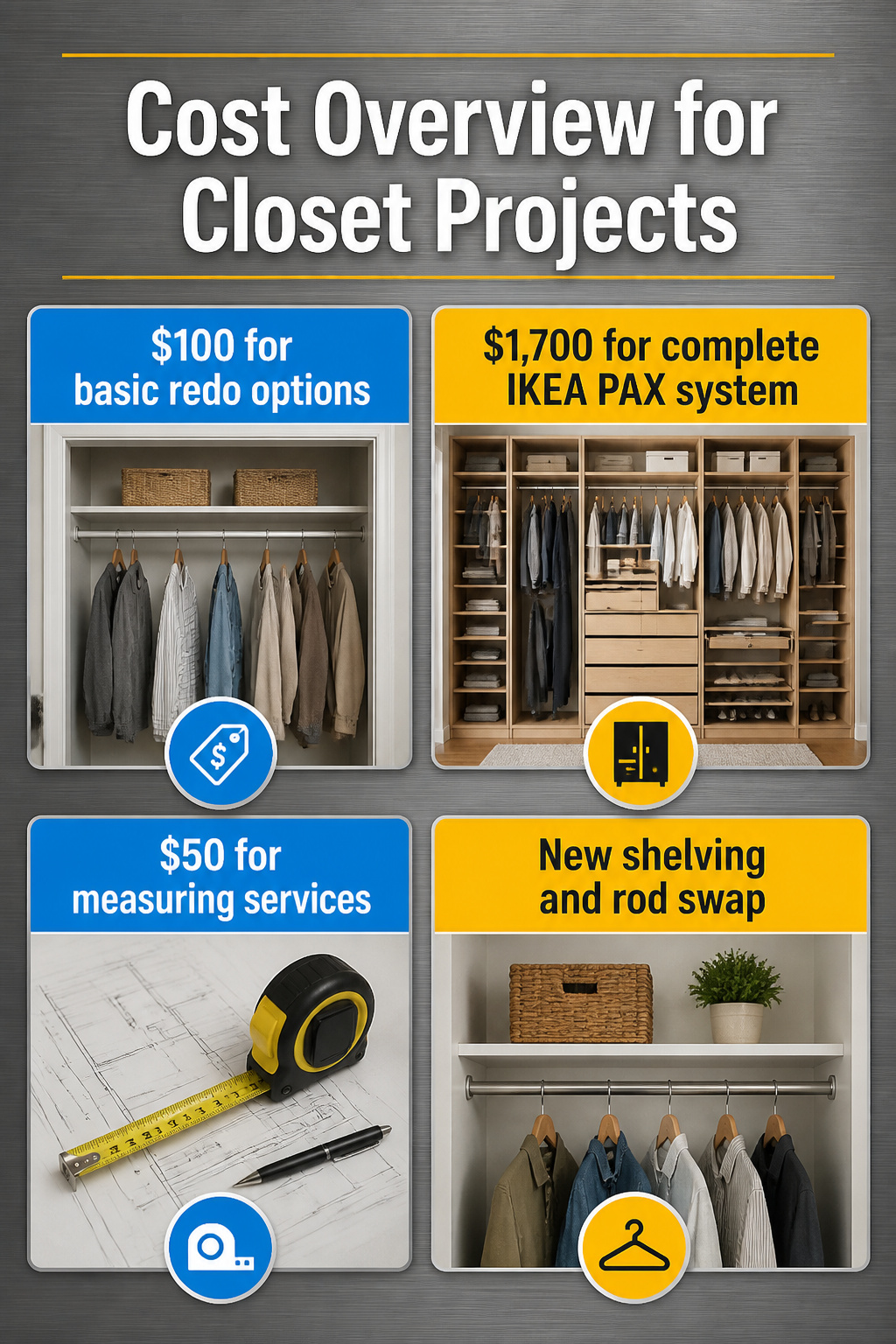
The projects I have actually priced for closet design inspiration land in a $100 to $1,700 range, and that spread tells you most of what you need to know about where to start. A $100 redo gets you new shelving and a rod swap, the kind of thing Apartment Therapy showed with two matching closets turned into varied storage plus a dog nook. The measuring alone can cost you before you buy a single shelf; The Container Store charges $50 for unlimited spaces, due when they show up. My own ceiling came from watching an IKEA PAX system run to $1,700 after panels, drawers, and the interior fittings were added in. That is not the frame price, that is the walked-out total.
Seasonal Rotation Without a Second Closet

The hardest part of a small closet is never the layout; it is what to do with the puffer coat in April. I spent one spring stuffing mine onto the top shelf until the whole rod sagged, then learned that off-season storage belongs in a bin, not on a hanger. A flat under-bed box or the top of a wardrobe works if the closet itself has no floor space. The trick is choosing one container size and sticking to it, so the stack stays stable and you know exactly how much you can keep.
Swapping happens in one batch, not piecemeal. I pull everything out on a Saturday morning, move the incoming season to the rod, and drop the outgoing items into the same bins with a dryer sheet to keep them from smelling stale by October. The whole rotation takes about twenty minutes now that the system exists. What slows it down is sentiment, the sweater you might wear someday. That one goes in the bin last, and usually comes back out first when the weather turns.
When I Call a Pro and When I Stop

A $250 weekend can buy a complete closet redo with dark stained shelving and a far more practical shoe layout, which tells me exactly where the DIY line sits. That project works because it stays inside three boundaries: no electrical, no cuts that have to be precise to the quarter inch, and nothing mounted into structure you can’t patch with spackle later. The moment any of those three show up, the math shifts.
Measuring is where I stop. A pro charges $50 for unlimited spaces, and that fee buys someone who will catch the sixteenth-inch discrepancy that turns a bank of drawers into a drawer that jams. Cutting melamine on a rented saw is one thing; cutting it to fit walls that were never square is another. The same goes for anything that needs power inside the closet. A hanging fixture looks simple until you discover the junction box is three studs off from where the shelf plan needs it.
The $250 figure is the ceiling for a hands-on weekend, not a down payment on something bigger. Go past it and you are usually paying twice: once for the materials you ruin, once for the pro who fixes them.
Two Systems I Have Used
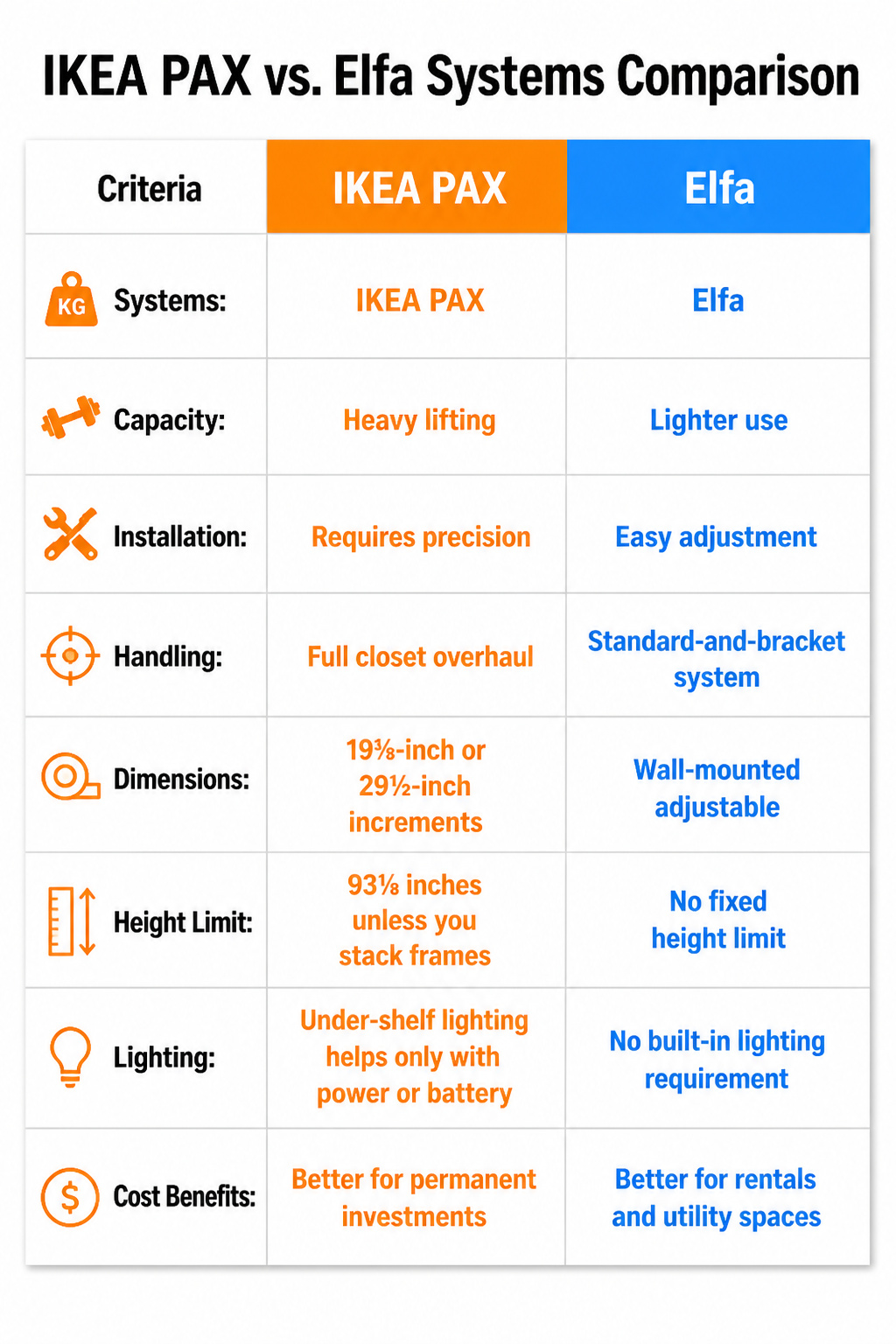
IKEA PAX handles the heavy lifting of a full closet overhaul better than anything else I have priced for a weekend build. The frames come in set widths, so you are working within 19⅝-inch or 29½-inch increments, and the interior fittings, racks, shelves, and pull-out trays, click in after the shell is square. I have used PAX in two walk-ins now, and the place where it frustrates is exactly where Apartment Therapy’s $1,700 makeover found its payoff: that dead zone above the hanging rod. The system tops out at 93⅛ inches unless you stack frames, and the upper shelf sits high enough that you need a step stool for daily use. Under-shelf lighting helps only if you already ran power or hide a battery pack.
The Container Store Elfa lives in my laundry room and a rental closet where I could not drill into walls. Its wall-mounted standard-and-bracket system lets you shift shelf heights without emptying the unit, and the wire shelves ventilate better than PAX’s laminate in damp spaces. What Elfa costs you is the Saturday morning spent leveling the single track that carries the whole load; a half-inch tilt at the top means your baskets slide to one corner. I call a pro for Elfa only if the wall is plaster over lath and I cannot find studs, but for drywall with a stud finder, it is a one-person job.
PAX wins for a permanent walk-in where you own the walls; Elfa wins for rentals, utility spaces, or anywhere the layout might change in two years.
Frequently Asked Questions
How can I maximize space in a small closet?
Push storage upward with floor-to-ceiling built-ins and modular shelving that you can shift as your habits change. Wire or wood modular units let you build around what you actually own rather than forcing your stuff into a fixed layout. The right mix of rods, shelves, and pull-out drawers tailored to your clutter can raise usable storage by about half in the same footprint.
What are some small walk-in closet organization tips?
Start by finding one jumping-off point, since every wall already has a job and you cannot clear everything out to rethink. Modular shelves help because they let you build around your actual wardrobe, with designated spots for shoes and bags that you can move later. A seat, even a simple stool, changes how the space feels and makes you want to stay in the room after you are dressed.
What are the best closet systems for organization?
IKEA PAX and The Container Store’s Elfa are the two systems that come up most often, and they serve different situations. PAX stands on the floor like furniture, works wide and deep, and wins for permanent walk-ins where you own the walls. Elfa mounts to the wall with visible standards and brackets, costs about $50 for professional measuring, and wins for rentals or anywhere the layout might change within a couple of years.