
A traditional style bathroom vanity is built furniture for your bathroom, not a cabinet kit pretending to be one. The catch is that the details that signal real craftsmanship, raised panel doors, dovetail joints, turned legs, also drive the price and the weight. The Jewell 30-inch single runs under twelve hundred reviews with a 4.7-star rating because it keeps the panel doors and soft-close hinges at a scale that fits a guest bath. That is the range where traditional detail meets actual room size.
What Traditional Style Actually Means

A traditional style bathroom vanity announces itself through details that take actual work to produce. Raised panel doors, where the center section sits proud of the frame, signal immediately that this is not a flat-slab contemporary piece. The joinery behind those panels matters too; dovetails or mortise-and-tenon corners hold up against humidity in ways that stapled particle board does not.
Natural materials sit at the center of the look. Solid wood frames, often with visible grain under a stained or painted finish, carry the warmth that laminates try to fake and miss. Decorative hardware, brass or oil-rubbed bronze with backplates and turned shapes, finishes the story the cabinet started.
What separates traditional from transitional is restraint, or the lack of it. Transitional pieces borrow the same roots but pull the ornament back for cleaner sight lines. Contemporary vanities strip it out entirely, trading craft for function. Traditional stays generous with molding, turned legs, and hardware that reads as jewelry rather than utility.
Single Vanities for Small Spaces

A traditional vanity in a guest bath or powder room has to earn its keep in about half the footprint of a primary suite. The practical starting point is 24 inches, and the range runs up through 36 inches before you cross into territory that needs a bigger wall.
The Jewell 30” Single Bathroom Vanity sits where a lot of small-bathroom projects land: compact enough for a tight guest bath, but with a 4.7-star rating from over twelve hundred buyers who seem to have found the same balance. The integrated ceramic countertop and undermount sink keep the surface simple to wipe down, and the soft-close hinges on the cabinet doors prevent the slam you notice most at 2 a.m. when someone else is using the hall bath.
At the other end of the price spectrum, the Alexandra Single Bath Vanity starts at $1,995.00. Vanderloc builds these in the USA and sizes them from 24 inches upward, so the same line that offers a wide primary-suite double also scales down for a single-user space. The question is whether the guest bath justifies the outlay. For a powder room guests see for five minutes, the Jewell’s price and footprint probably win. For a guest bath that doubles as your daily backup, the Alexandra’s construction might earn its keep over the years.
Double Vanities for Shared Bathrooms
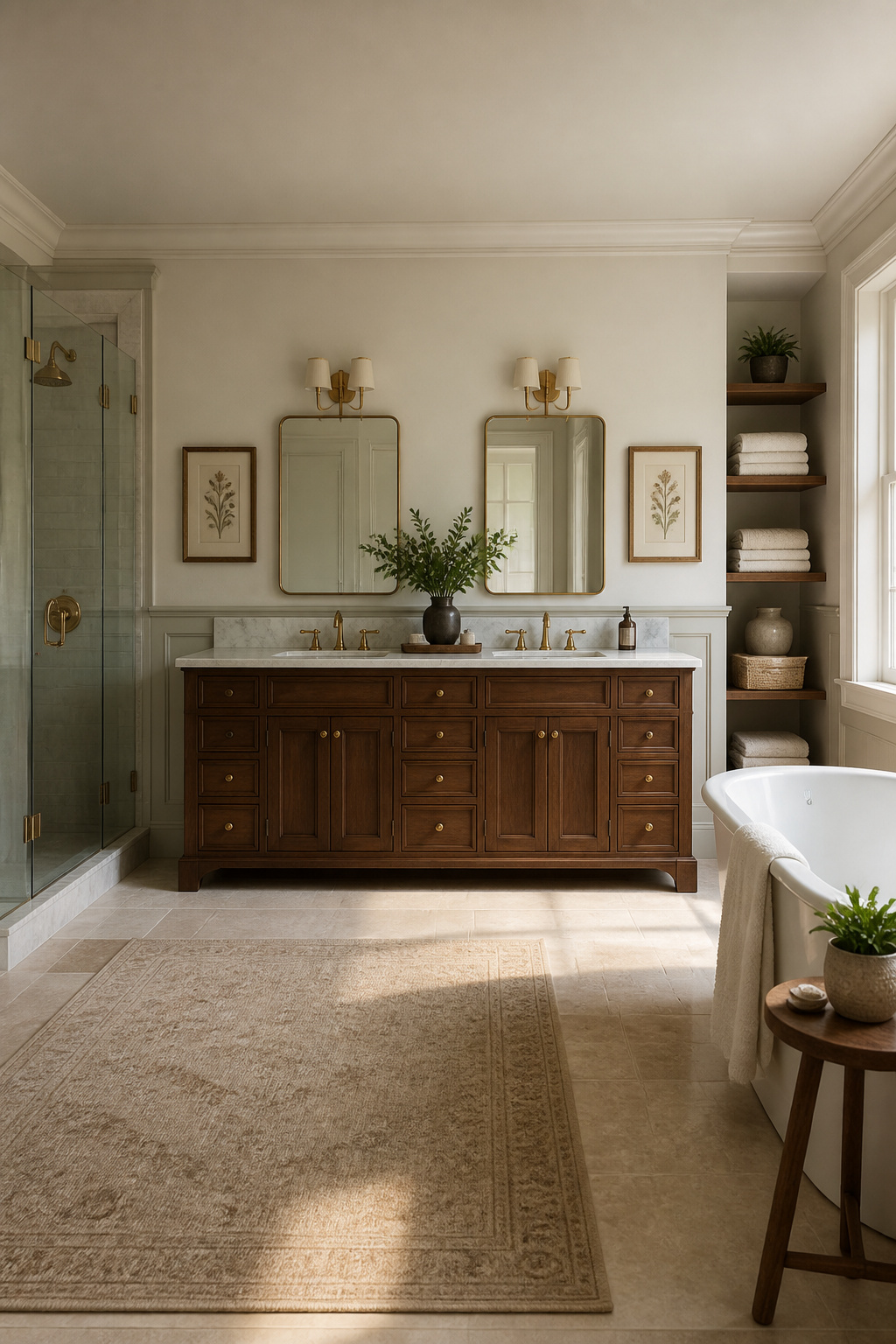
Shared bathrooms are where a traditional style bathroom vanity either earns its keep or becomes a daily traffic jam. Two sinks cut the morning queue, but the width has to actually fit two people standing side by side without elbow wars.
The LeCrieú Double Bath Vanity starts at $4,245.00, which lands in the range of the Pearce double at $4,245.90 and the Heather double at $4,450.85. That price buys you the breathing room of a larger footprint, though in my reading the finish details matter as much as the inches. A traditional piece at this scale can look like furniture or like a cabinet warehouse left it there; the molding and hardware decide which.
For a tighter budget, the Fontane 72-Inch Traditional Bathroom Vanity at $2,921.35 spreads across the same six feet without the four-thousand-dollar sticker. The 72-inch width is the practical ceiling for most standard bathrooms before you are moving plumbing or stealing from a closet. The Elizabethan and Collette also hit that 72-inch mark, both priced at $2,899.93, so the field clusters right around $2,900 for this size.
A double vanity under 60 inches, like the Natalia at 54 inches or the Tansy at 55 inches, saves floor space but the sinks sit close enough that you are sharing more than the mirror. My call: 72 inches is where two users stop negotiating. Anything smaller and one of you ends up brushing teeth in shifts.
Modular Vanities That Fit Odd Spaces

A 55.5-inch single vanity and a 90.25-inch double from the same Pearce line can bookend a bathroom wall without looking like mismatched pieces. That is the point of modular traditional vanities: the manufacturer keeps the raised-panel doors, the turned feet, and the hardware consistent across widths, so you choose the footprint that fits your plumbing and the wall still reads as intentional.
I have stared at enough bathroom layouts to know the 6-inch gap between a standard 60-inch cabinet and a 58-inch alcove is where most weekend projects die. A 55.5-inch base slides in with room for caulk and a breath of trim. The Pasadena at 42 inches or the Heather at 38 inches handle the opposite problem, a single sink squeezed beside a door swing or a towel bar.
The detail that sells the look is the shared door style and finish across every width. You are not settling for a "close enough" match from different collections; the modularity is designed in. The James Martin Chicago double at 60 inches and the Avanity Modero singles at 36, 48, and 60 inches in glossy white work the same way, though the Modero reads more transitional than traditional to my eye.
Countertop options on the Pearce and Patagonia lines let you pick stone or quartz after you have sorted the fit, which matters when you are measuring against a crooked wall or an off-center drain. The cabinet arrives, you shim and level, and the traditional detailing does the work of making it look finished.
Antique White Finishes

Antique white carries a warmth that straight white paint usually misses, and in a traditional vanity that difference matters. The finish sits somewhere between a true cream and a weathered original, with subtle variation that stops it from looking like a fresh coat of appliance paint on a cabinet that deserves more patience.
I spent longer than I expected comparing samples under store lighting and then again at home, because the yellow undertone that reads as "soft" in a fluorescent showroom can turn sour against bathroom tile. A sample board held against your actual wall is the only test that counts. Painted finishes in traditional style tend toward uniform color, and natural wood advertises its grain; antique white does neither, relying instead on gentle distressing at edges and corners to suggest years of use.
The distressing varies enormously by manufacturer. Some vanities look convincingly handled, with wear patterns that follow where hands would actually touch. Others seem machine-sanded in a straight line across every drawer front, which breaks the illusion the same way a too-perfect patina does on reproduction hardware. I would rather buy a piece with no distressing and add my own wear over time than accept distressing that looks stamped from a template.
For renters or anyone who might move the piece, antique white has a practical side: small scratches and water marks blend in rather than screaming for touch-up the way a saturated paint color would. The finish forgives real bathroom life better than high-gloss alternatives, and that forgiveness is part of its traditional character.
Carved Detail Vanities

Real carving on a traditional style bathroom vanity catches light in a way that stamped decoration never manages. I look for edges that vary slightly under my fingertips, evidence a hand-guided tool shaped the wood rather than a press stamping the same profile by the thousand. The Kathryn Collection vanity Birchlane sells gets this right: reeded fronts, rounded corners, and beading that actually interrupts the surface plane, each groove catching shadow differently depending on the time of day.
Hand-turned knobs and dovetail joinery are the companion details worth checking for. Where appliqué decoration sits on top of the surface like a sticker, integral carving wastes no material and survives cleaning without lifting at the edges. The Kennedy Oak vanity uses solid oak trim alongside its veneers, which tells me the maker budgeted for detail where cheaper pieces would route a fake profile and paint over MDF. That multistep oak finish matters too; it lets the grain read through the color, so the carving stays readable even in dim bathroom light.
Stamped work flattens under direct light. Real carving deepens. The difference shows up most when you stand at the vanity’s edge rather than straight on, which is exactly where you’ll be standing every morning.
Marble Countertops

Marble countertops carry the weight of a traditional style bathroom vanity better than almost any other surface. The veining in Carrara marble, specifically, gives that soft gray movement against white that reads as inherited rather than installed yesterday. The Cambridge 43” single bathroom vanity uses it well: a Carrara marble countertop laid over a solid wood base with engineered wood accents, ceramic undermount sink included, and the builder added soft-close door hinges plus nine drawers that actually function. One buyer noted the piece arrives heavy and solid even before the marble top goes on, though she couldn’t figure out how to remove the drawers for cleaning. Plan on needing help with the install, and check whether your faucet and mirror are already purchased because this unit ships without them. A backsplash is provided, which saves one decision. The Natalia 54-inch traditional bathroom vanity runs $2,792.87 if you need the double-bowl width instead, and that price point sits where marble tops start to feel like a genuine investment rather than a surface compromise.
Soft-Close Hardware
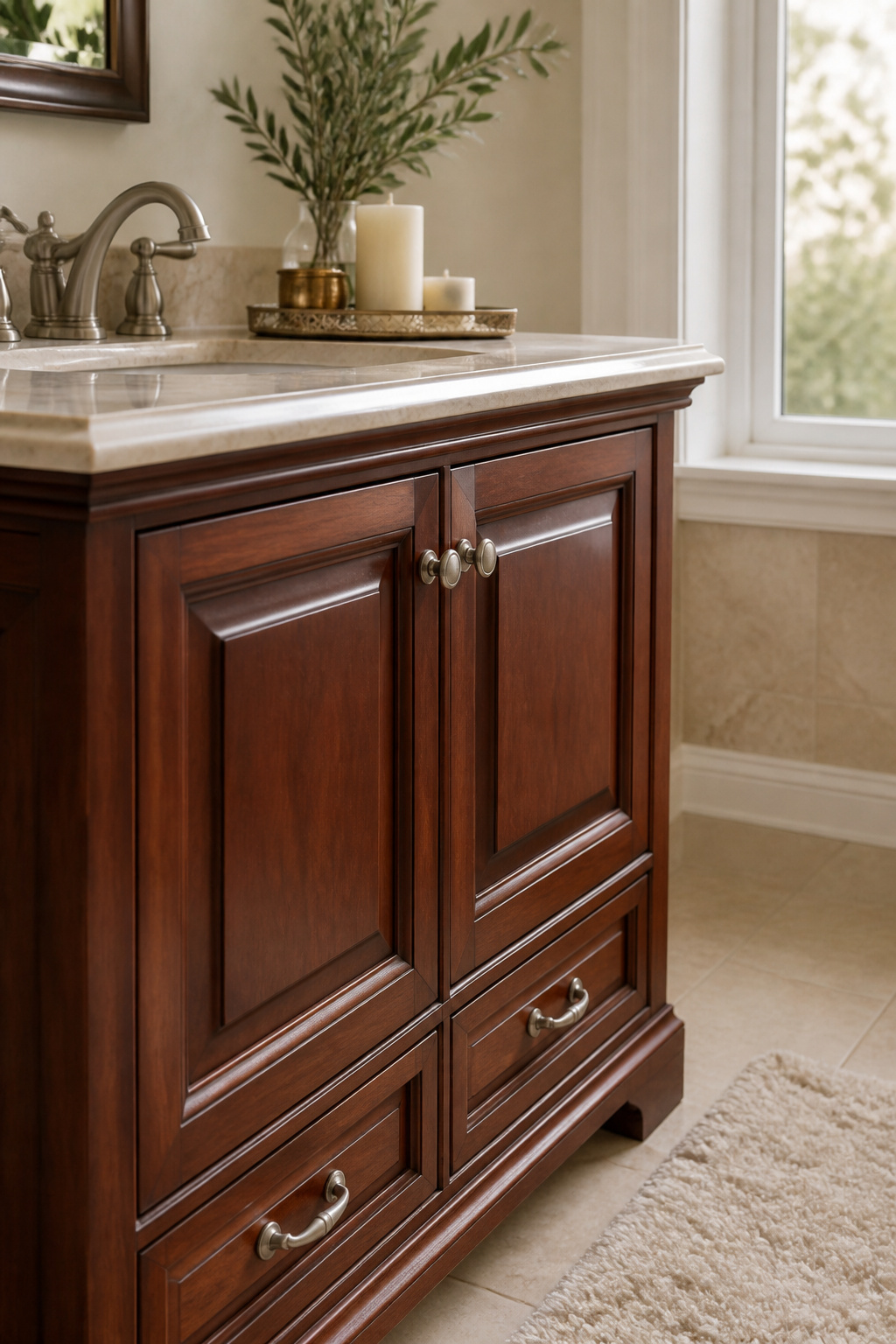
Soft-close hinges and drawer slides have quietly become the standard on most traditional vanities sold today, and after installing a set on a vanity I updated last year, the difference in daily use is hard to ignore. The hardware uses a hydraulic or spring mechanism to catch the door or drawer about two inches from closed, then pull it the rest of the way without a sound. What sold me was not the silence itself but the way it eliminates the small abuses that wear a cabinet down over time: no rattled joints, no chipped paint at the corners, no loosened screws from repeated slamming. For a traditional vanity with raised-panel doors that already carry some visual weight, the soft-close action adds a physical heft that feels appropriate to the style rather than modern for modern’s sake.
The longevity argument matters more than people expect. A bathroom door gets opened and closed dozens of times a week, and each impact sends vibration through the frame. Soft-close hardware absorbs that energy instead of transferring it, which keeps the joinery tight and the finish intact longer. Installation is straightforward on most new vanities but can be fussy as a retrofit, since the hinge cup bore and slide dimensions vary between manufacturers. If you are buying new, specify it upfront; if you are refreshing an existing cabinet, measure the existing bore pattern before ordering replacements. The cost difference runs roughly fifteen to thirty dollars per door against standard hardware, which pays back in reduced wear and in not waking anyone during a midnight bathroom trip.
Wood Types and What the Finish Hides
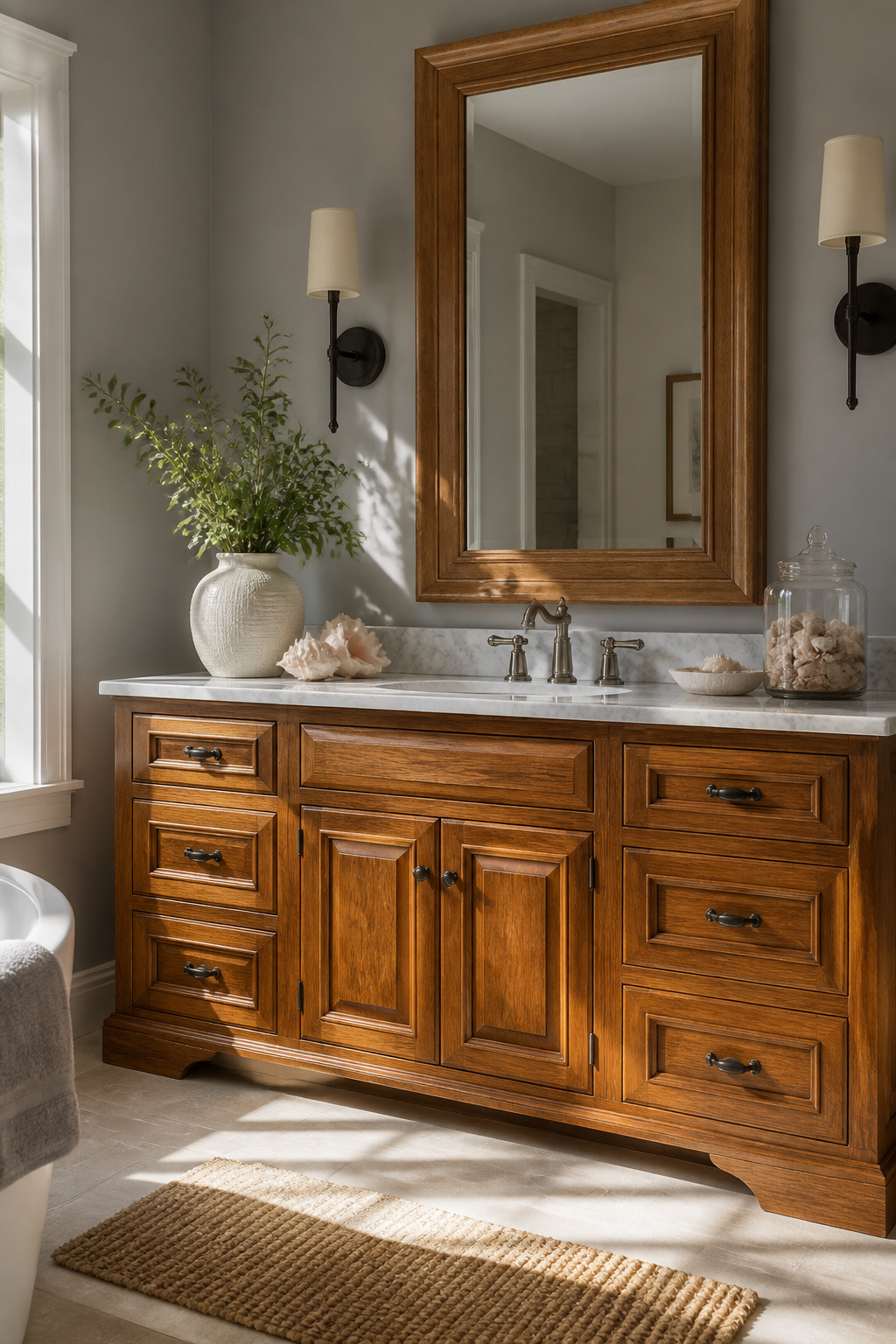
Solid wood and plywood both show up in traditional vanities, but what sits on top matters as much as what is underneath. A natural finish on solid wood drawers lets the grain do the work, and after years of daily use those drawers still look new. Paint or stain can hide cheaper material underneath, so the test is the same in either case: check whether the construction uses veneers over particleboard or actual hardwood beneath the surface.
Oak veneers with solid oak trim go through a multistep finishing process that keeps the grain visible, which is the look most people picture when they want traditional warmth. Powder blue paint on a Carrara marble top works the same room differently, but the wood beneath that paint needs to be solid or plywood to survive bathroom humidity. Feel inside the drawer box; if it is plywood or solid wood, you are getting furniture-grade joinery. If the interior is rough or the grain pattern repeats unnaturally across panels, the finish is doing more hiding than revealing.
A warm oak finish achieved through multiple steps costs more upfront than a single-coat painted option, but the paint will chip and the multistep oak will not. That is the trade to weigh: initial character against how the piece looks after the morning routine has run through it a thousand times.
Sizing Your Vanity to the Room
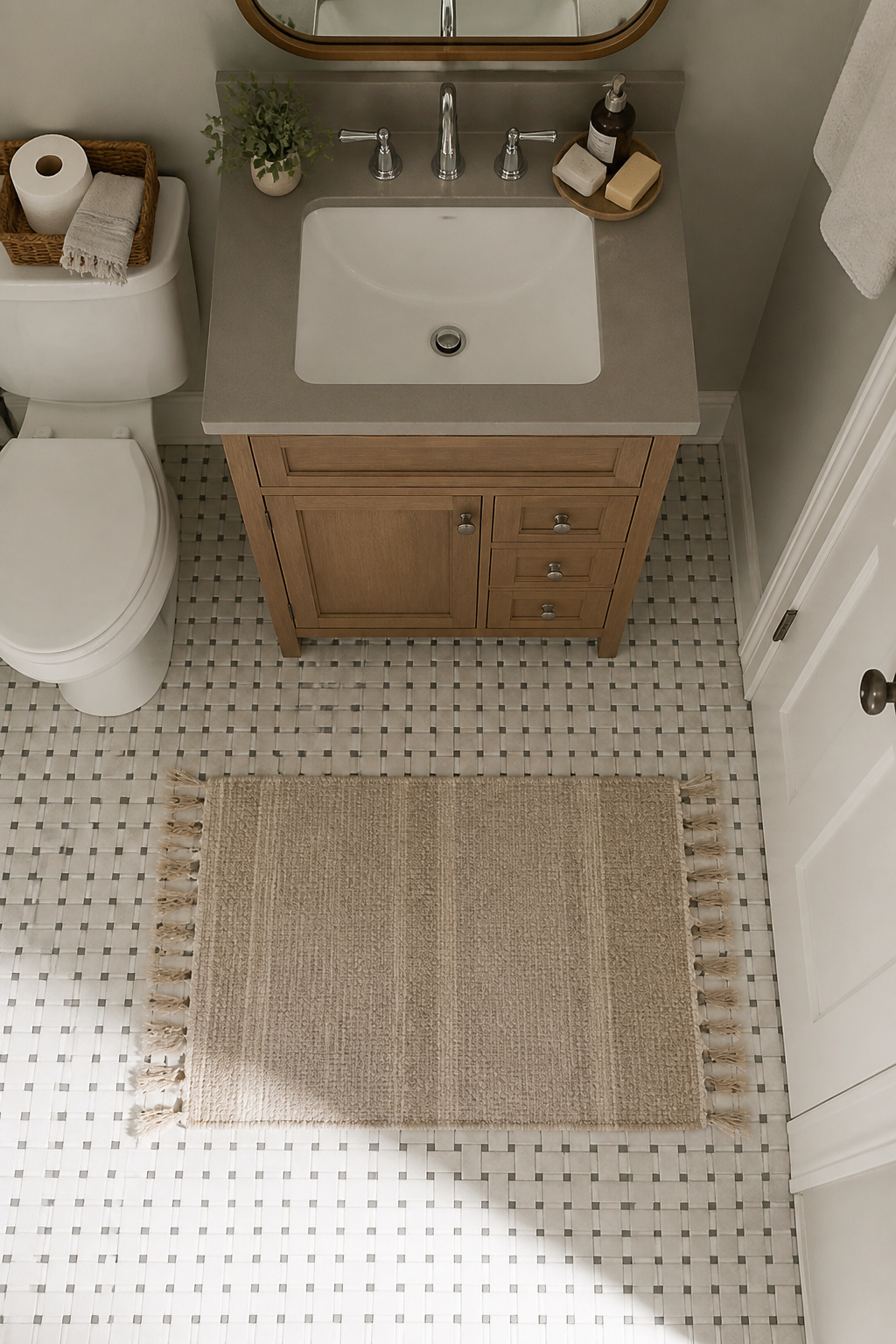
A traditional style bathroom vanity runs from 24 inches to 72 inches wide, and the width you can actually use has almost nothing to do with the wall length. I learned this the hard way in a guest bath where the 36-inch unit I wanted fit the wall perfectly but blocked the door from opening past 70 degrees. The door swing ate 14 inches of usable floor space the moment it moved.
Start your measurement from the center of the existing plumbing rough-in, not the wall edge. Most traditional vanities keep the sink centered, so a 30-inch or 36-inch single unit lines up with standard 16-inch or 20-inch on-center drain locations without moving pipes. A 48-inch or 60-inch double demands two supplies and a wider drain span; if your rough-in was set for a single, that "upgrade" becomes a replumb job.
Traffic paths are the silent killer. A 72-inch double like the Fontane or Elizabethan needs roughly 60 inches of clear floor space in front of it for two people to use the sinks without a shuffle-step dance. In a primary bath that feels generous. In a 5-by-8-foot guest bath, it turns the toilet into an obstacle course.
The 24-inch to 33-inch range, think Roanoke at 28 inches or Spooner at 33, exists for a reason: powder rooms and converted closets where every inch of walkway matters. These still read as traditional because the style lives in the base molding and hardware scale, not the footprint.
Modular widths, 42-inch, 54-inch, 55.5-inch, 58-inch, 76-inch, 84-inch, 90.25-inch, 95-inch, fill the gaps when stock sizes miss your plumbing by six inches either side. They cost more and ship in pieces, but they beat tearing open the wall for a vanity that looks right in the room.
Storage That Works

Drawers in a traditional vanity should earn their space, not just look the part. I learned this after installing a 55-inch double vanity with three soft-close drawers that actually run the full depth, not the decorative false fronts that stop six inches in and leave you with a tilted bin of hair tools. The solid wood frame on that unit held up to daily humidity, but what mattered more was that the drawers swallowed toiletries and styling tools without the morning shuffle.
Concealed cabinet storage behind paneled doors is where traditional design hides its real capacity. Extra bath sheets, tissue boxes, the backup shampoo bottles; that is the daily load, and a cabinet that fits them changes whether your countertop stays clear or becomes a staging area. Check the interior shelf height before you buy. Some traditional vanities keep the exterior proportions correct but split the cabinet into shelves too shallow for a folded towel stack.
The matching finish on storage cabinets or floating shelves extends the same design language through the room, but only if the interior layout actually serves the routine. Warm metal hardware in brushed brass or oil-rubbed bronze completes the look, yet the glide and the shelf depth are what you touch every morning. Soft-close drawer glides are the detail that separates a vanity you tolerate from one that quiets the 6 a.m. routine.
What Customization Actually Costs

The Spooner single at 33 inches starts the range at $1,448.44, while the Heather double at 95 inches runs to $4,450.85, and that gap is mostly width, not finish. What actually moves the number is whether the top is included. The Pasadena single at 42 inches sits at $1,583.03 with a fixed setup; the Pearce single at 55.5 inches jumps to $2,520.62 because you pick the countertop. That choice is where your money goes, not the antique white paint or the brushed nickel pulls.
Hardware swaps are usually free or nominal on these units. The Varna line runs six colors with matching brass or nickel, and the price holds across them. Where you save is skipping the quartz backsplash offer some retailers bundle; where you spend is modular sizing like the Roanoke or Spooner lines that let you add side cabinets later. I would rather put the difference toward a soft-close upgrade, but on most traditional boxes that comes standard now. The real cost decision is single versus double, and whether you need that top included or already have a slab waiting.
Frequently Asked Questions
What is a traditional bathroom vanity?
A traditional bathroom vanity announces itself through raised panel doors, dovetail or mortise-and-tenon joinery, solid wood frames with visible grain, and decorative hardware in brass or oil-rubbed bronze. The style stays generous with molding, turned legs, and hardware that reads as jewelry rather than utility, unlike transitional pieces that pull back the ornament or contemporary vanities that strip it out entirely.
What sizes do traditional bathroom vanities come in?
Traditional bathroom vanities run from 24 inches to 72 inches wide for standard stock sizes, with modular options filling gaps at 28, 33, 36, 42, 48, 54, 55, 55.5, 58, 60, 72, 76, 84, 90.25, and 95 inches. Singles for small spaces start at 24 inches, while doubles for shared bathrooms typically land at 60 to 72 inches before you are moving plumbing or stealing from a closet.
What materials are traditional bathroom vanities made from?
Traditional bathroom vanities center on solid wood frames, often oak with visible grain under stained or painted finishes, plus plywood that survives bathroom humidity better than particleboard. Natural materials extend to Carrara marble countertops, ceramic undermount sinks, and hardware in brass or oil-rubbed bronze with backplates and turned shapes.
How much do traditional bathroom vanities cost?
Prices for traditional bathroom vanities start around $1,400 for compact singles like the Roanoke at 28 inches or Spooner at 33 inches, and run to roughly $4,500 for large doubles like the Heather at 95 inches. The midrange clusters near $2,900 for 72-inch doubles, while modular sizing and countertop choices move the number more than finish or hardware swaps.