
A pretty porch is a room that happens to be outside, not a covered hallway you pass through. The difference is usually the seating: pull it inward, away from the railings, and people stay. I learned this after spending $340 on a conversation pit that looked like a waiting area until I moved the chairs six inches.
Cozy Outdoor Lounge Space
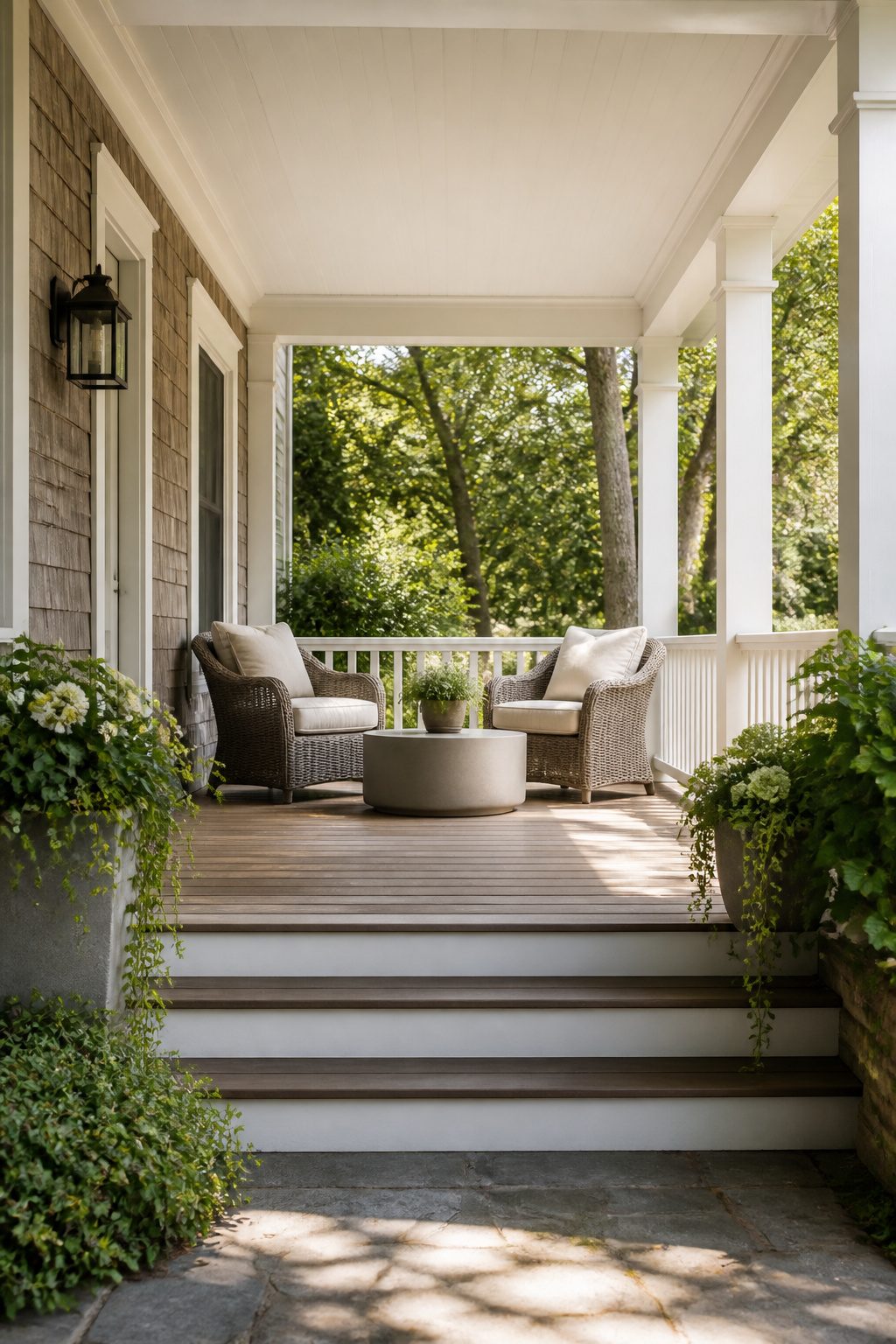
A porch becomes a room when the furniture faces inward, not out. I learned this the hard way after shoving two resin wicker chairs and a concrete-top table against the railings to "maximize space." The setup looked like a waiting area, and nobody sat there. For $340 at Target, I had a conversation pit in name only. The concrete top cracked that first freeze, which taught me to check freeze-thaw ratings on outdoor materials even in mild winters.
The ceiling color mattered more than I expected. I painted it Benjamin Moore Simply White 2143-70 after reading it would brighten the space, but the porch felt flat, like a white box with siding. By the next spring I went back to Haint blue, the pale aqua tradition, and the whole ceiling lifted. Shadows looked softer, the white trim popped, and the space finally felt like a room that happened to be outside. Pull the seating into the center, even if it costs you a foot of walkway. That single move changed how we used the porch more than any paint color did.
Open and Airy Design
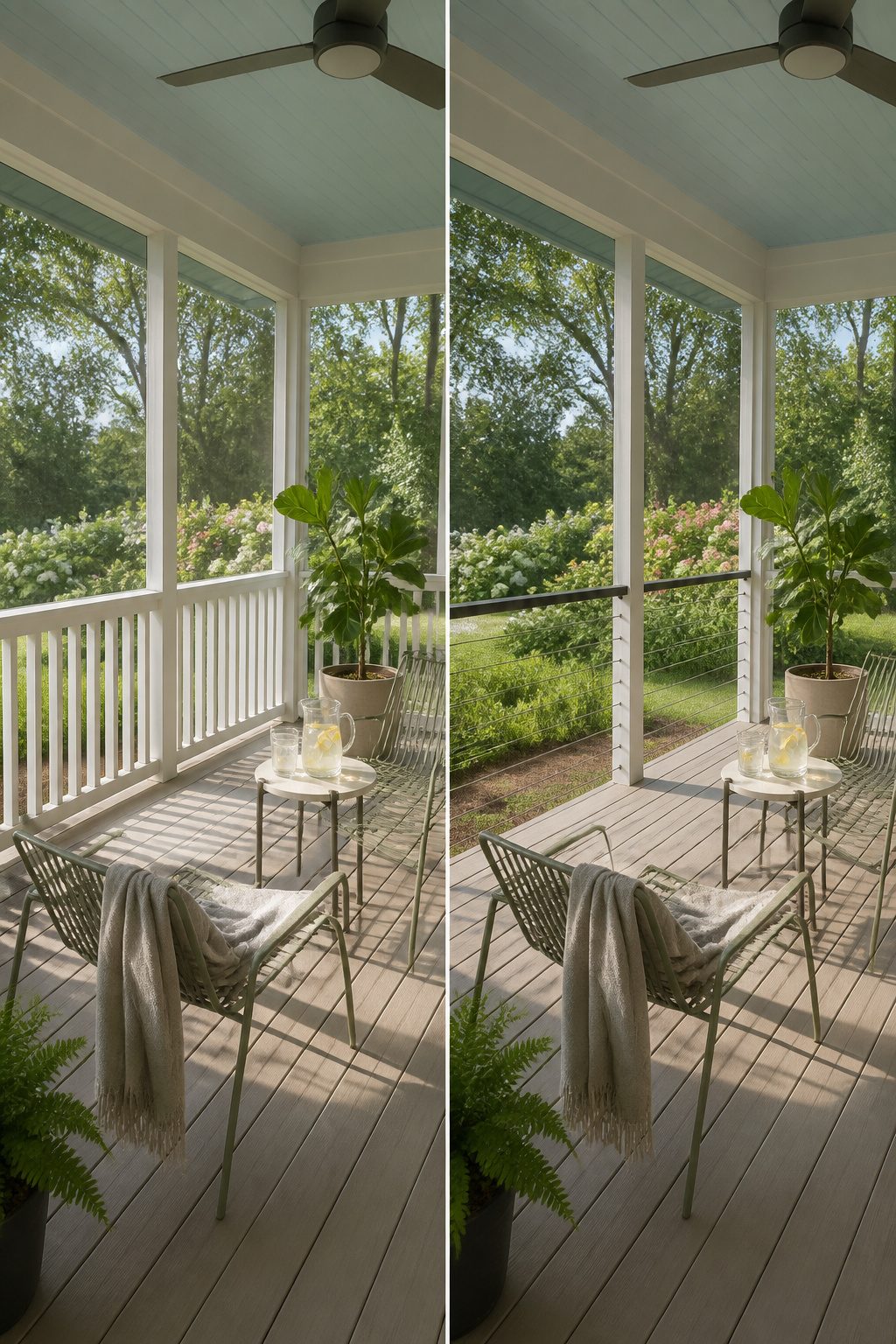
The prettiest porches are the ones you barely notice as structures. Light moves through them, and your eye keeps going to the yard or the street beyond. Heavy spindle balusters on my rental’s porch were doing the opposite, carving the view into thick vertical stripes that made the whole space feel like a cage. I swapped them for cable railings one weekend, and the landlord only asked that I store the originals in the basement so he could reinstall them later. The difference was immediate. Where the spindles had read as a wall, the cables disappeared into peripheral vision.
Furniture carries more visual weight than most people account for. A solid wood Adirondack chair blocks sightlines that a slatted metal café chair leaves open. I learned the harder version of this lesson in 2019, when I screened my porch completely, floor to ceiling, frame to frame. The mosquito relief was real, but the porch became a box. Light flattened, breezes stopped, and I stopped sitting out there.
Last spring I pulled half the screening and replaced it with partial panels set only at seated height, about three feet up from the floor. The upper half stayed open. Cost ran $180 in materials, and the porch breathed again. Mosquitoes still stay low in the hours I actually use the space. The view went back to moving through the room rather than stopping at it.
Romantic Details
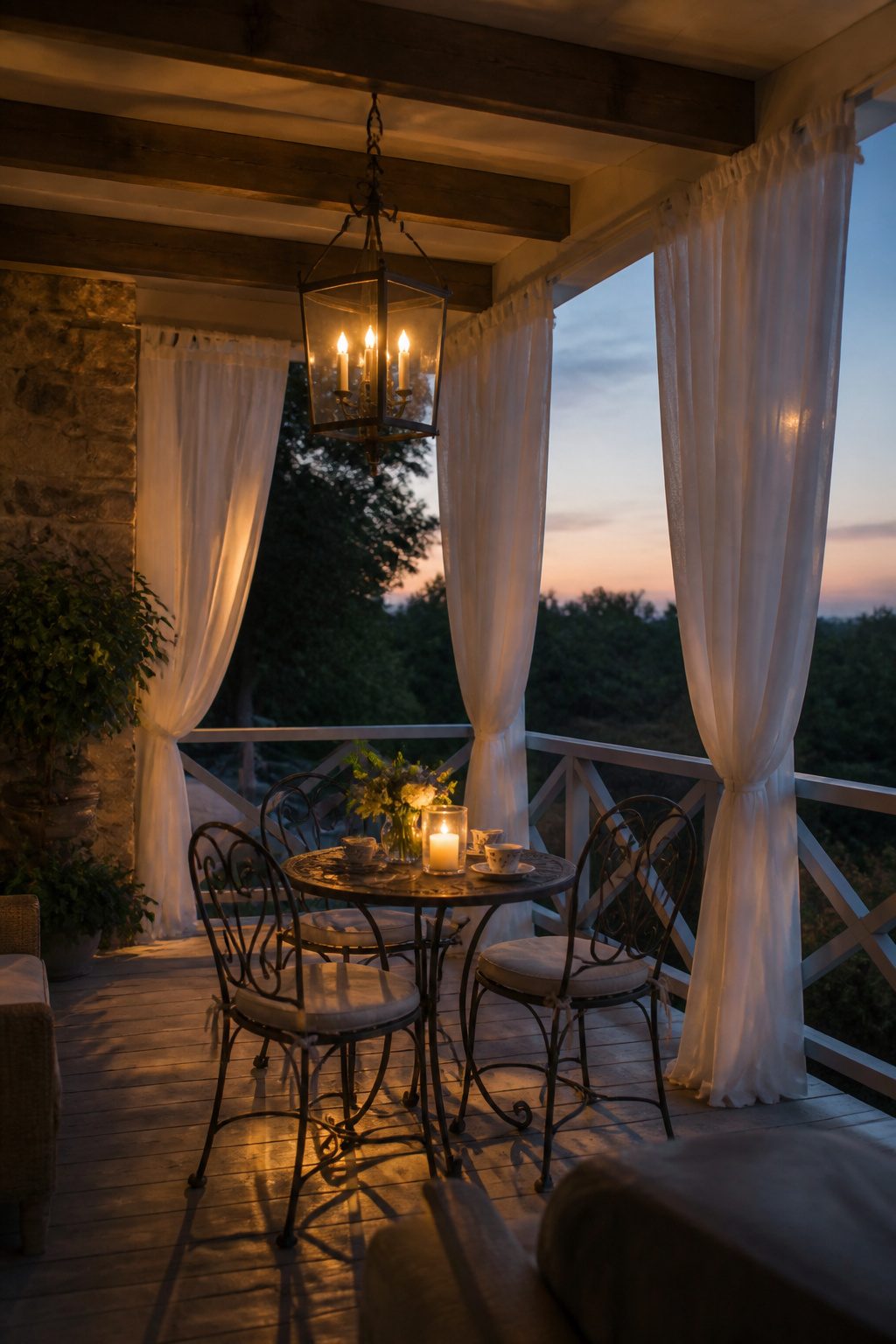
Romantic details on a porch walk a narrow line between charming and cloying, and the mistakes usually show up in year two.
The outdoor chandelier was one of mine. I wired a $38 Home Depot pendant through a galvanized chain, hung it from the ceiling hook, and loved the flicker through the glass on summer evenings. Two seasons later the socket corroded through, and the whole thing went dark. I replaced it with a wet-rated exterior fixture in powder-coated aluminum, which cost more but has outlasted four summers now.
Sheer curtains on tension rods were the other lesson. Standard outdoor fabric grew mildew along the bottom hem by July, no matter how tight the weave looked in the store. Shower-curtain fabric solved that, the kind built for constant moisture. The difference is real, but I still take them down every October. Leaving them up through winter damp is where the trouble starts, and the rods come down in ten minutes anyway.
Fireplace on the Porch
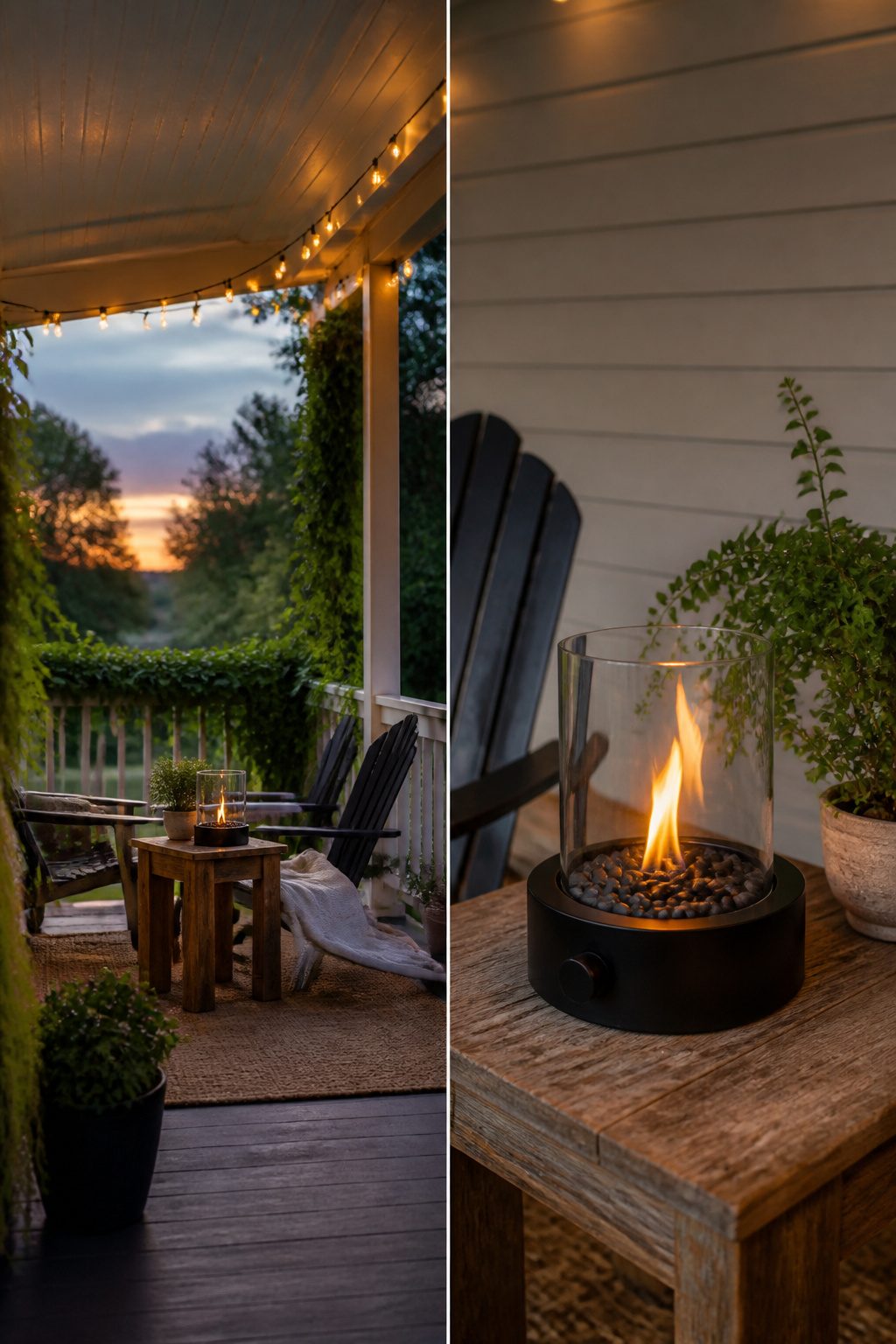
A fixed fireplace on the porch is the one pretty detail I have not pulled off, and after reading through the county code, I know why I stopped looking. Portable propane fire pits run $400 to $1,200 for the decent ones, but my county requires a poured footing, eighteen inches of clearance on all sides, and a chimney chase that needs its own framed enclosure. What the catalogs show as a weekend project actually stretches past a month once the inspector gets involved.
I bought an $89 tabletop propane burner instead. It puts out enough heat for two people on a mild night, stores in the garage when the wind picks up, and never needed a permit. The tradeoff is real: no one gathers around it like they would a hearth, and the flame sits too low to cast much light. For a renter or a first homeowner with a narrow porch, that tradeoff is worth it. A real fireplace needs a foundation that outlives the house, and most of us are not building for the next owner. The chimney chase alone will double your budget before you buy a single brick.
A View From the Porch
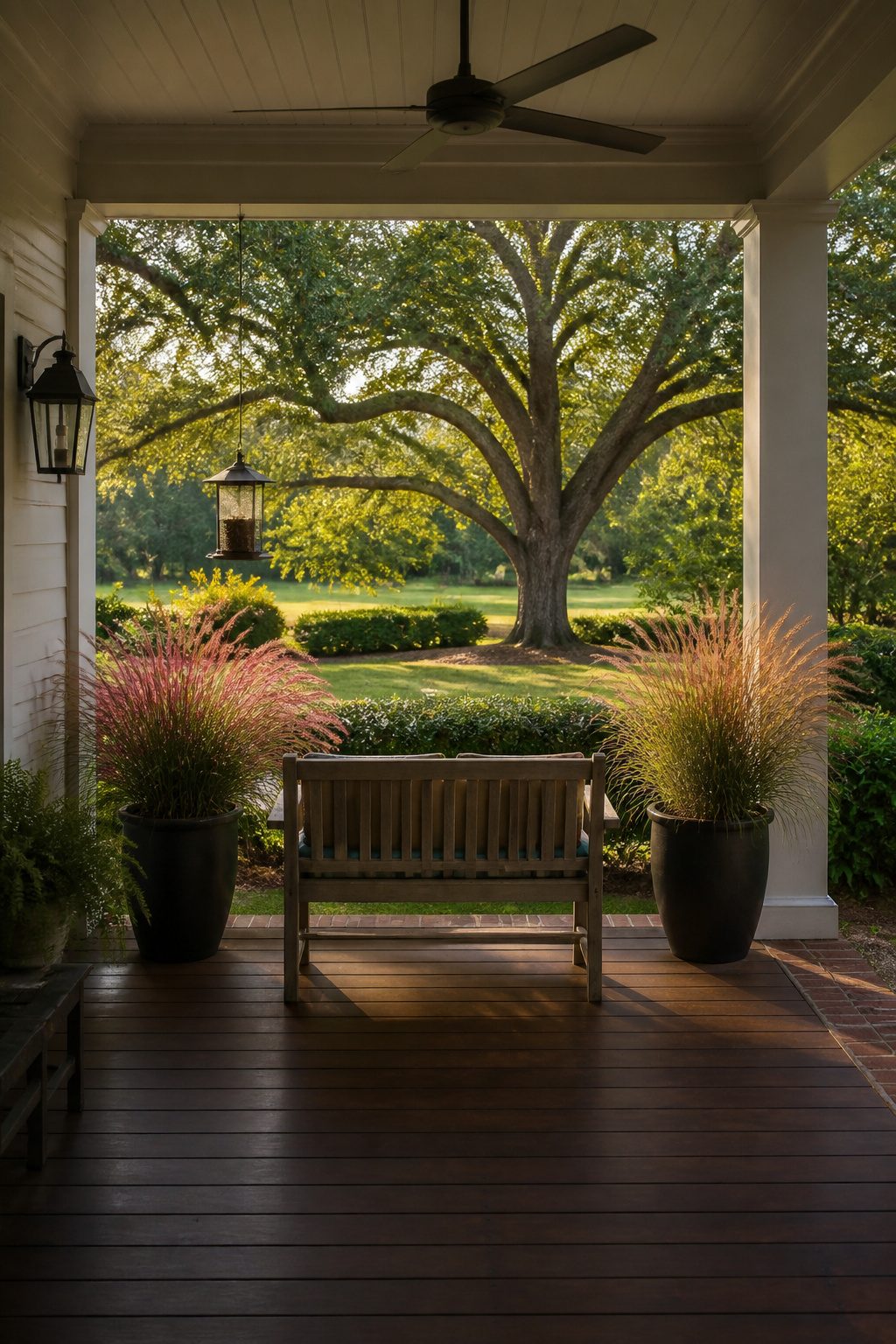
My first porch seating arrangement faced every chair toward the street, which meant guests spent the evening looking at my neighbor’s driveway and the recycling bins beyond it. The oak tree in the side yard, the one actual view worth having, sat completely out of frame. Reorienting one bench and sliding two pots of ornamental grass to flank the trunk took about twenty minutes and cost nothing. The grass was already there, just parked in the wrong spots.
The view from your kitchen window deserves the same attention as the view from the chair. Most mornings you will see this porch from inside, not from it. I check mine while the coffee brews, and a bench facing the right direction turns that glance into something that starts the day better. The oak framing costs the same as the driveway framing: zero. The difference is where you point it.
Southern-Style Wraparound Porches
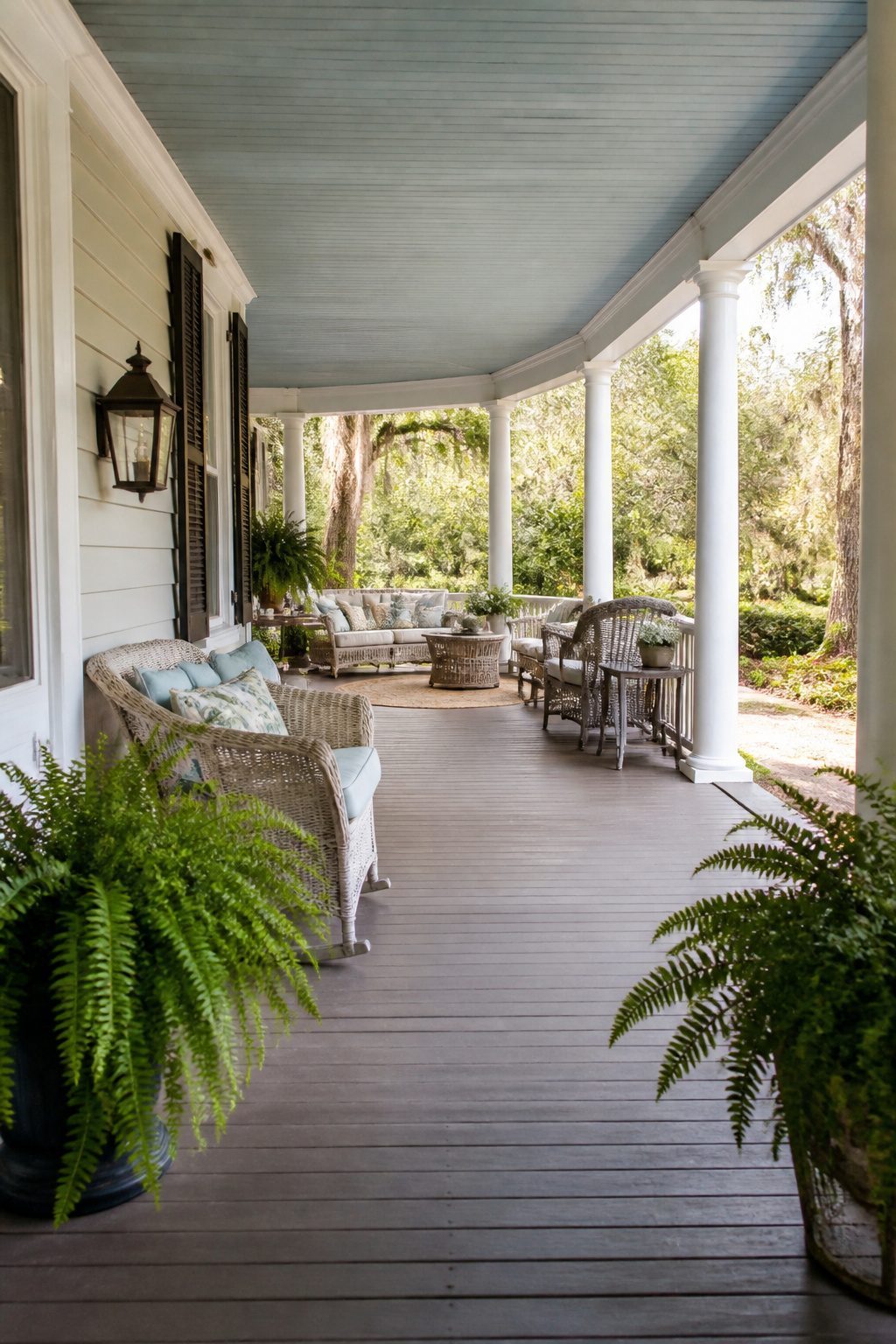
A wraparound porch on a farmhouse in Georgia is a different creature from anything a standard suburban lot will allow, but the parts that matter are smaller than the whole. My parents’ 1912 house sat broadside to the road with a porch that ran the full width and wrapped one corner; the boards were heart pine gone silver-gray, and the whole thing faced southeast into morning shade and afternoon breeze. What I took to my 1986 ranch in Ohio was the logic, not the scale.
Depth is the dimension that translates. Six feet of porch is a covered walkway you pass through; eight feet is a room you stay in. My parents’ porch ran about ten feet deep on the front, but the critical proportion was that the ceiling hung high enough and the fan sat dead center of the usable floor, not the roof outline. On my ranch I had eight feet to work with and I copied that placement exactly: fan centered over where the chairs would sit, not where the builder’s light box had been.
The floor paint came too. Their pine had worn to bare wood in paths and held stain in the protected corners; I mimicked that with porch paint in a gray-brown, full strength at the edges and scuffed thin where traffic would walk. The shallow step down, barely four inches, kept the threshold low and the transition gentle.
What I could not borrow was the orientation. Their porch faced into shade and air movement; mine faced west and baked. The age of the wood mattered too. A century of seasoning made that pine hard and stable; my pressure-treated decking moved seasonally and checked within two years. The scale was gone from the start. A wraparound on a ranch looks like a skirt pinned too wide for the hips. I built a straight front porch with a single return on one side, and that was the honest limit of what the lot and the roofline would bear.
Historic Charleston Piazzas

Charleston piazzas run on the diagonal, the long side of the house rather than the front, and that angle is where the lesson sits. The entry comes from one end only, with the door set at the narrow edge, so the whole porch reads as a room you enter rather than a platform you cross. A screen of plants or a half-wall faces the street, which turns privacy into architecture instead of an afterthought.
I tried the rotation myself in 2021 on a side stoop that was barely six feet deep. The bench had sat straight against the house, and walking past it to the door felt like squeezing through someone else’s living room. I turned it forty-five degrees so one arm pointed toward the entry and the other toward the yard. The path opened up immediately. The same two feet of clearance suddenly let two people pass, or one person with a bag of soil without doing that awkward sideways shuffle.
New construction porches usually run the full width of the facade and sit shallow, maybe four or five feet from door to railing. They photograph wide but function as corridors. The piazza’s narrow depth, sometimes not much more than a good-sized closet, works better because the diagonal bench or pair of chairs faces across the space, not out into the yard. You sit with your back to the wall and your view angled down the length, which makes eight feet feel like enough. On my stoop, the rotated bench let me add a narrow planting ledge behind it against the siding, something that would have blocked the door if everything had stayed square.
Beach House Porches With Swings
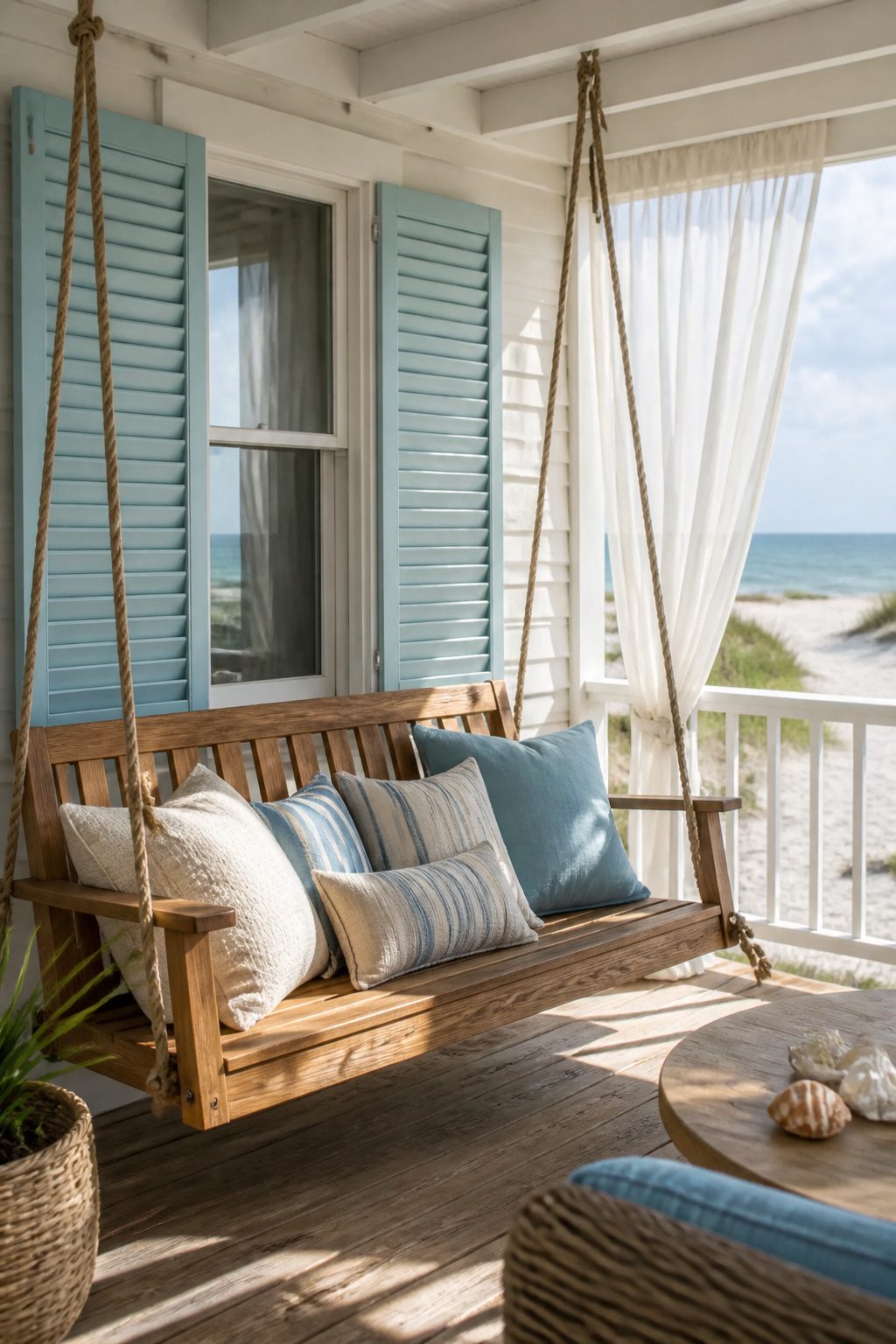
A porch swing is furniture that waves back at you, which is probably why it reads as a gesture more than a chair. I bought mine in 2016 at a Virginia Beach yard sale, a four-foot cedar frame for $60 that the seller had already strung with rope. The hardware looked tired, and by week three the eye bolts pulled clean out of the header. Fourteen dollars at a hardware store for proper lag-thread eye bolts fixed it, and the swing has held since.
Three feet of arc clearance is the measurement that matters. I learned it by bruising my knee on the porch post during a vigorous push, forgetting that a swing travels in an arc, not a straight line. The seat needs room to swing forward and back without meeting woodwork or bone.
The coastal palette of soft blues and whites follows the swing naturally, though it reads differently depending on where you hang it. In the Outer Banks those colors dissolve into sky and salt haze and look inevitable. On my Ohio porch the same tones stand out more deliberately, a borrowed mood that announces itself rather than settling in. Either works, but only one pretends it was always there.
Rustic Farmhouse Porches
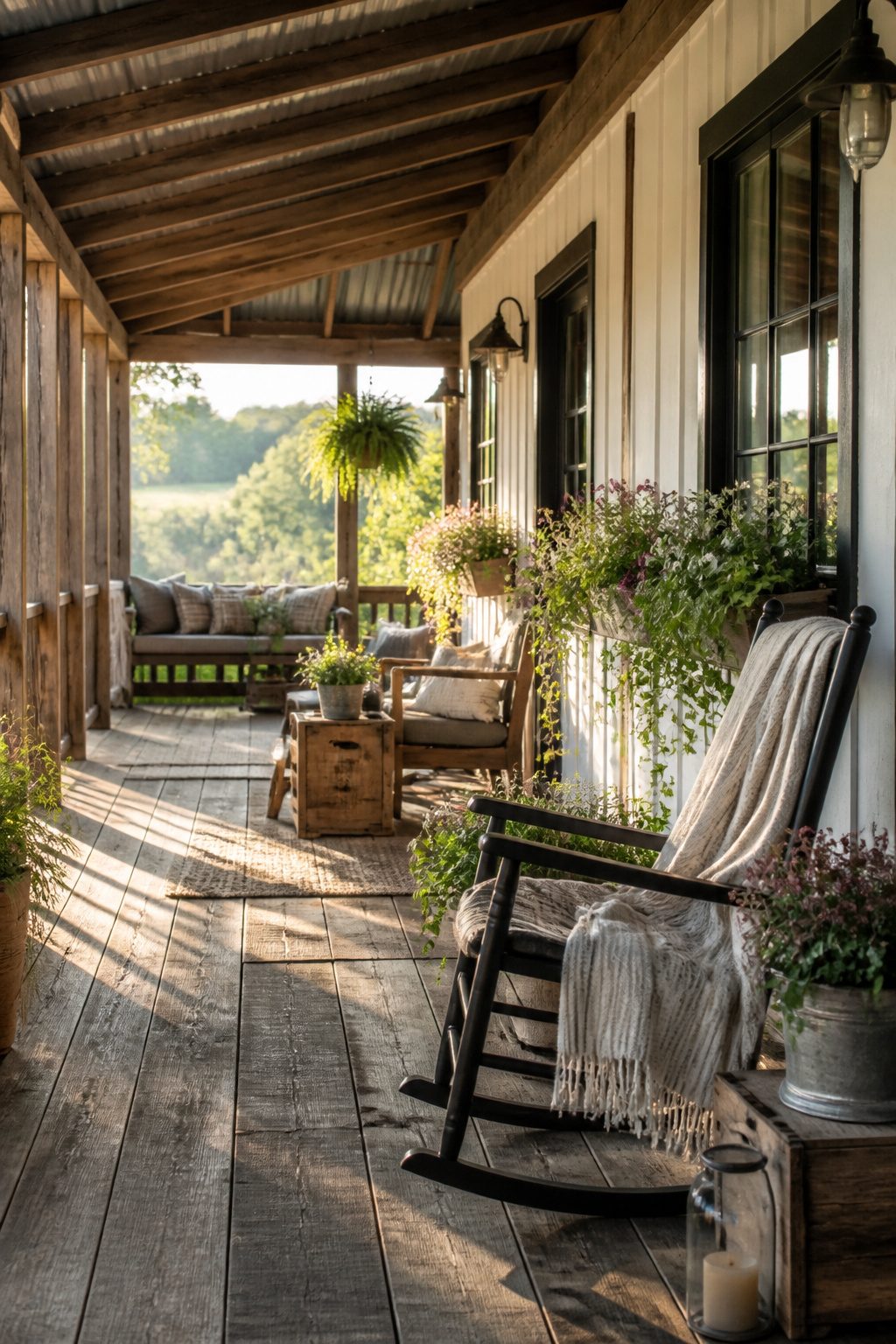
Reclaimed barn wood sounds romantic until you are pulling splinters from your palm and finding a wasp nest the size of a grapefruit in what was supposed to be your header beam. That was my 2018 spring in a nutshell. I had driven three hours for that wood, paid a premium for the story, and spent two weekends wrestling boards that were cupped, nail-scarred, and genuinely unsafe to walk on barefoot.
The look I wanted was specific: galvanized metal accents, boards wide enough to look like old flooring, and no visible fasteners to break the illusion of age. Authentic reclaimed lumber was fighting me on every one of those points. Old boards are rarely wide by modern standards, nail holes are unavoidable, and the metal that comes with them is usually rusted through rather than weathered in that even, silvery way.
I gave up after the wasp incident. New cedar, wire-brushed to raise the grain, then stained with a vinegar-and-steel-wool solution gives me the same visual effect in a weekend. The boards lie flat, the fasteners hide where they should, and the galvanized railings I ordered actually survive a rainstorm. I build the effect now instead of hunting for it, and the porch is better for it.
Seasonal Decorations
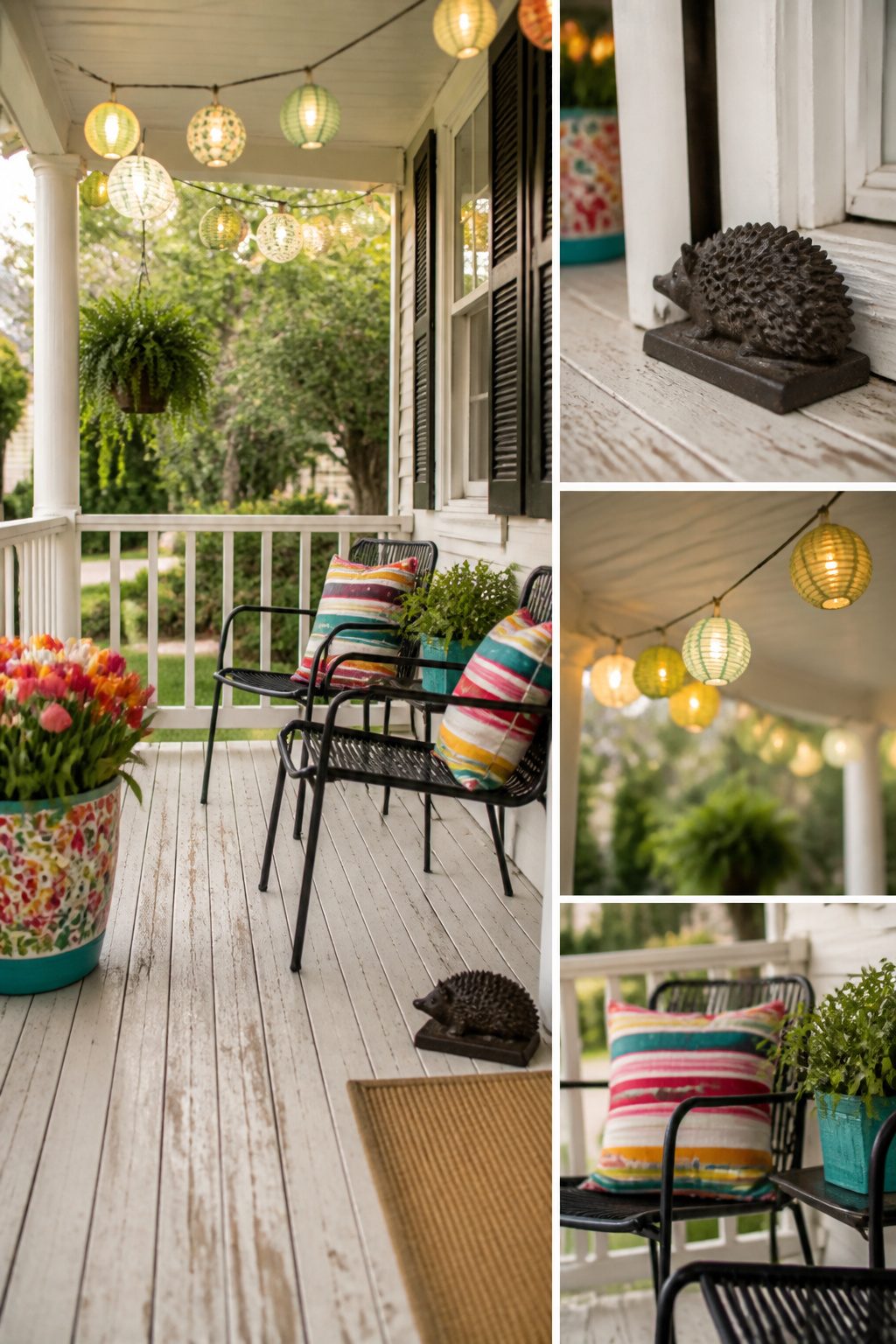
A four-bin rotation keeps seasonal porch decor from taking over the garage. Mine runs Memorial Day to Labor Day, Labor Day to Thanksgiving, Thanksgiving to New Year’s, and New Year’s back to Memorial Day. The summer bin holds the striped outdoor pillows and a string of solar lanterns I bought for $18 at a hardware store closeout. Fall gets the plaid throw, the wooden sign I painted badly in 2020, and the fake mums that look real enough from the street. Winter is just white fairy lights, a small wreath, and the red door mat. Spring stays light: a tin planter with artificial tulips and the one item that survives every rotation, a cast-iron boot scraper shaped like a hedgehog that sits by the step year-round.
The $200 annual budget covers one new piece per season, usually something on clearance in the weeks after the holiday. I track it on a note in my phone so I do not forget and buy a second fall wreath because the first one got shoved behind the ladder.
The pumpkins taught me the hard limit. Real ones, left out through a freeze in November 2021, turned to mush inside their skins. Two collapsed on the porch boards and one rolled behind the railing, where I did not find it for a week. The smell reached the sidewalk. Now the rule is simple: real gourds go to the compost the night before the first frost date, no exceptions.
Color Palettes That Hold Up
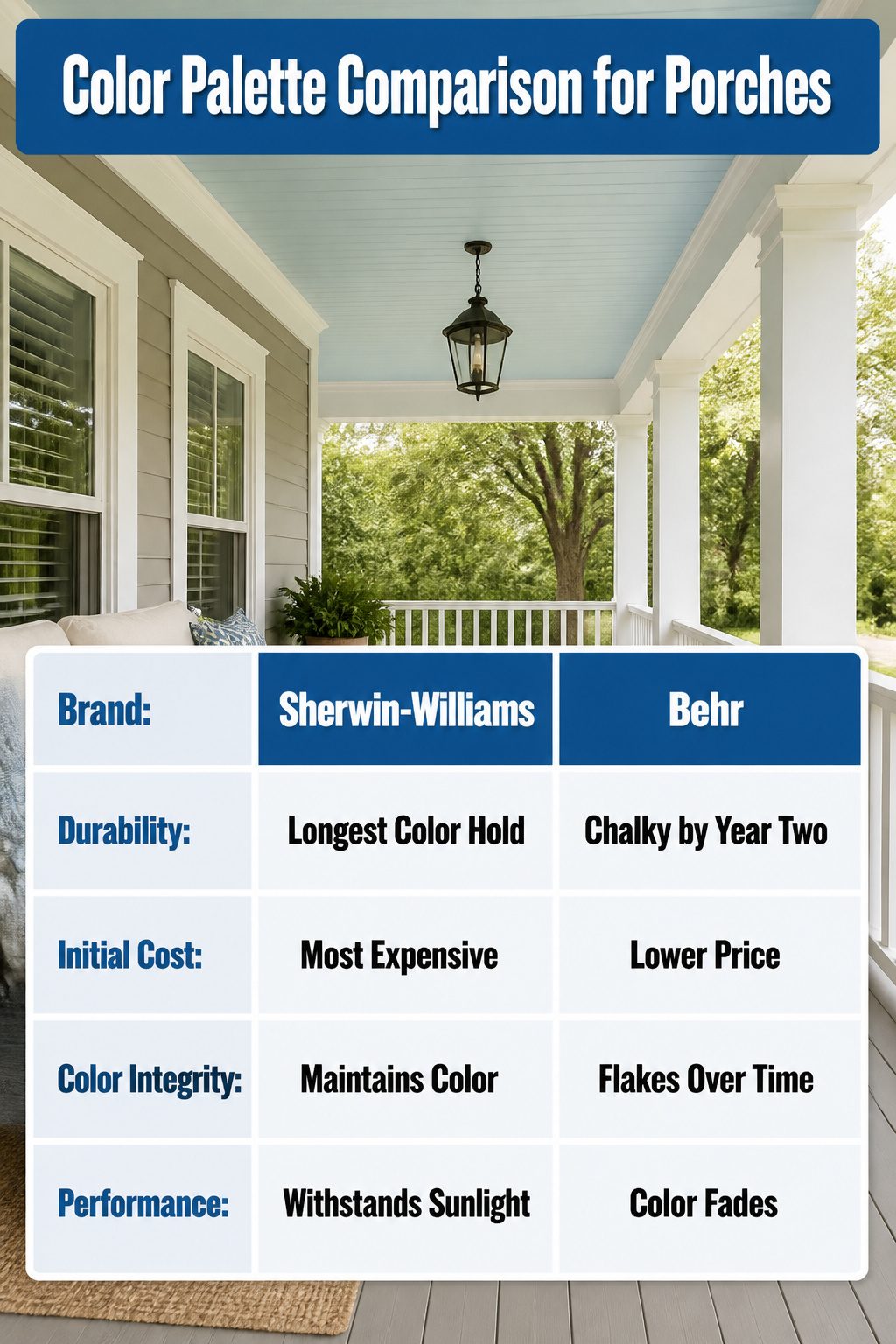
Haint blue works against wasps because they read it as sky and leave the nest alone. I have tried three brands on porch ceilings over the years. Sherwin-Williams Atmospheric held color the longest; Behr’s version went chalky by year two; Benjamin Moore’s fell somewhere between, though it cost the most per gallon. The difference only shows up after a full summer of direct afternoon light, so the two-foot test square matters more than the swatch you carry home.
My trim is Benjamin Moore Simply White 2143-70, chosen because it matched my siding in overcast light without turning pink at sunset. The touch-up problem came later. The original batch was a year old when I needed to cover a scuff, and the new can sat half a shade cooler. Now I buy an extra quart and write the date on the lid.
I started with coastal blues and crisp whites, the palette every magazine spreads across a beach house porch. On my inland lot it looked like a theme park gift shop. Muted greens and warm grays read as intentional instead. The gray I settled on, a sort of weathered cedar tone, lets the haint blue ceiling do the work without shouting.
Furniture I Have Replaced and Why
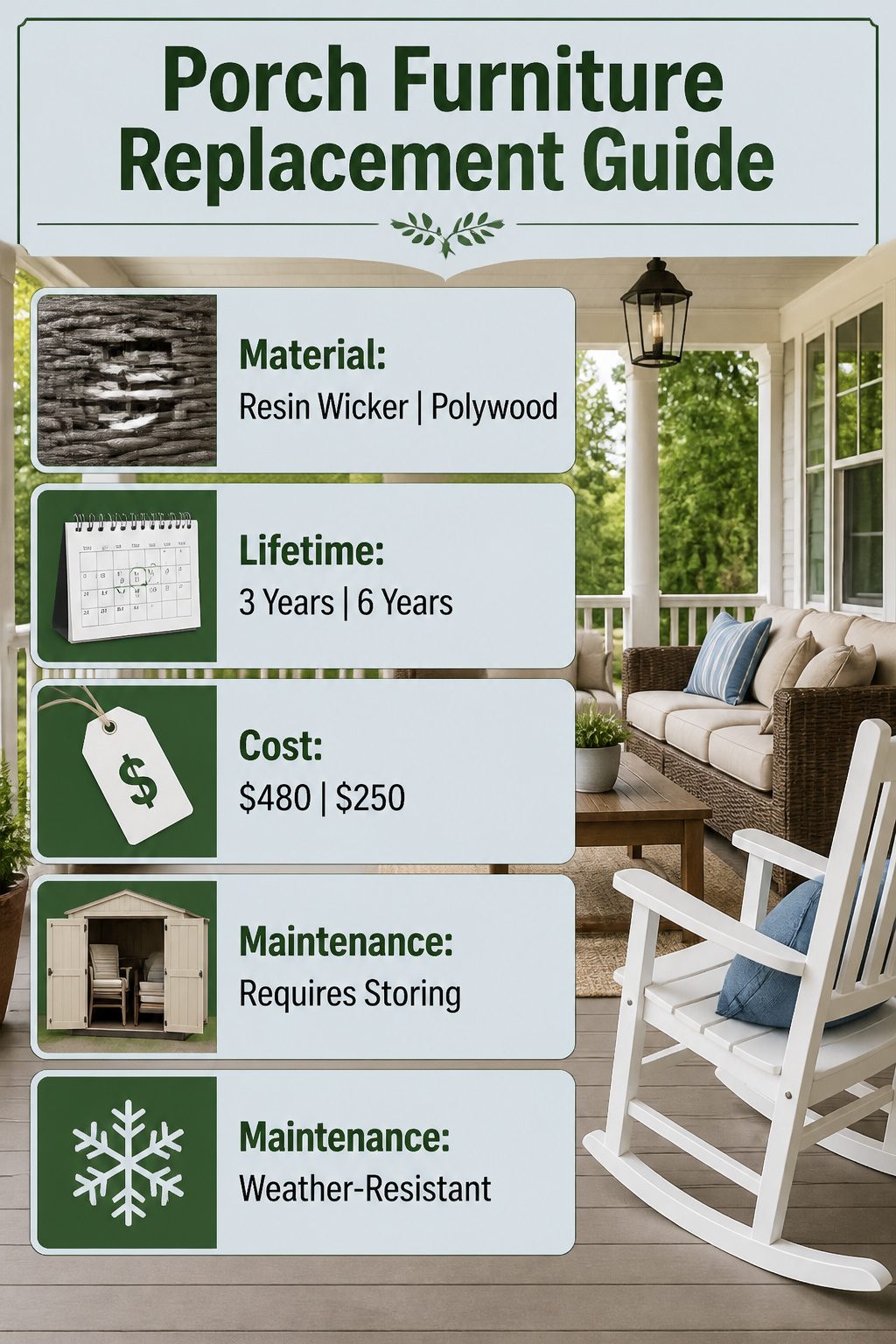
Resin wicker held up for three years before the weave split and the aluminum frame started showing through like bones. I had paid $480 for a West Elm lookalike set that looked identical in the listing; the $180 IKEA Äpplarö I tried next lasted about the same two seasons, which taught me that outdoor furniture in zone 6 is a subscription, not a purchase.
The pine rocking chair rotted at the arms first, dark and soft where my hands rested every evening. Polywood was the replacement, and six years later it still sits there with the same grain molded into the plastic, no worse for the winters. I do not love the weight of it, or the slight give that feels nothing like wood, but I do not have to drag it to the garage each October either.
I now buy porch furniture assuming I will replace it, and I budget accordingly. Weather-resistant means it buys you time, not immunity. The question is how many seasons you get per dollar, and whether the thing failing annoys you or merely arrives.
What Seasonal Decor Actually Costs
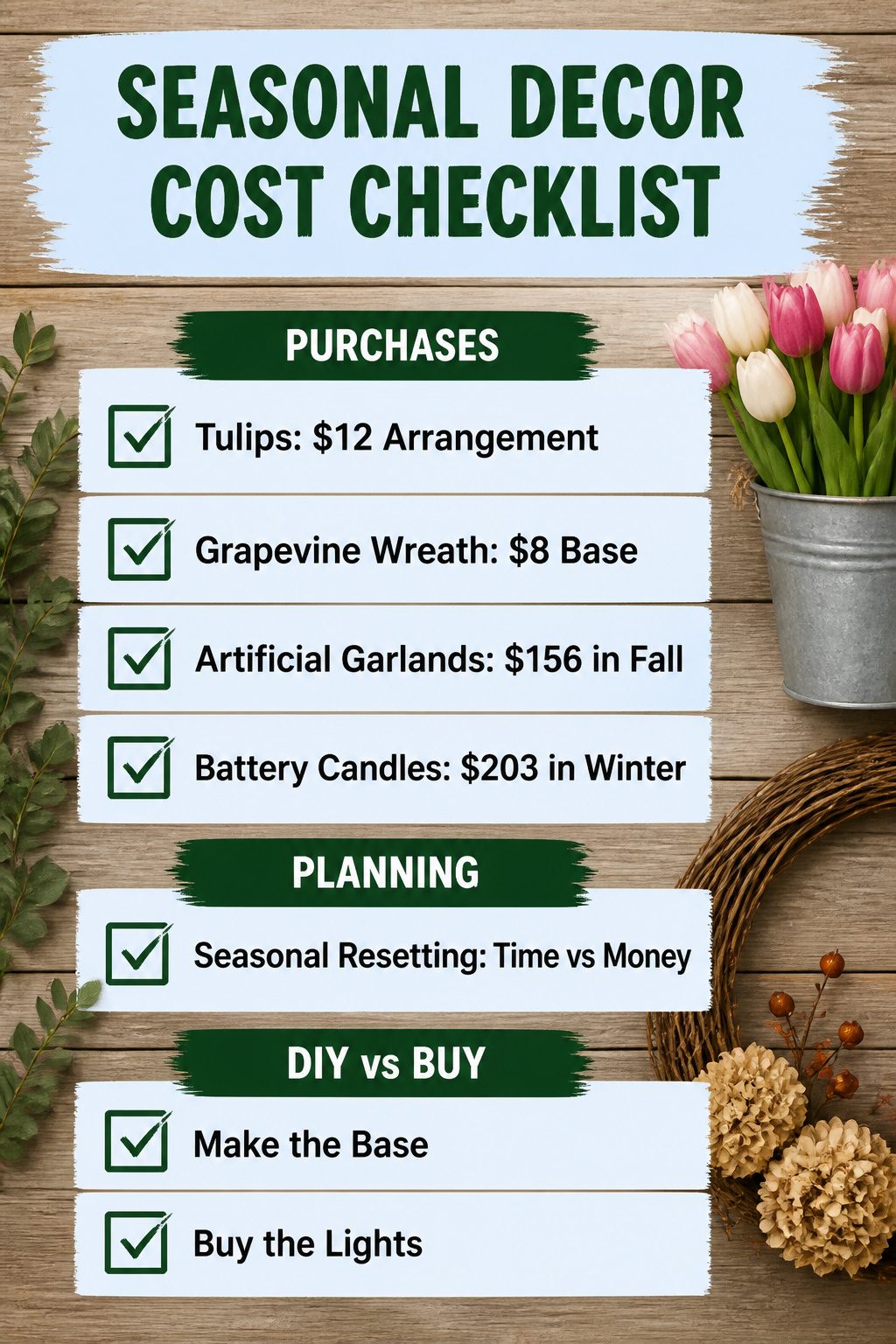
Fresh-cut tulips in a galvanized bucket look great on a spring porch until day four, when the stems go soft and the water turns. That $12 arrangement taught me the same lesson a $40 one would have: weather destroys anything left outside, so the quality threshold is lower than it looks. My 2023 spending ran $87 in spring, $134 in summer, $156 in fall, and $203 in winter, with the jump coming from artificial garlands and battery candles that had to survive rain and frost.
The real split is time, not money. A grapevine wreath base costs $8 and a finished one runs $45, but winding in your own bittersweet or dried hydrangeas takes about an hour. I make the base, buy the lights, and skip anything that needs daily attention. The calculation that matters is how many weekends you want to spend resetting the porch versus living on it.
Reading a Porch’s Architecture
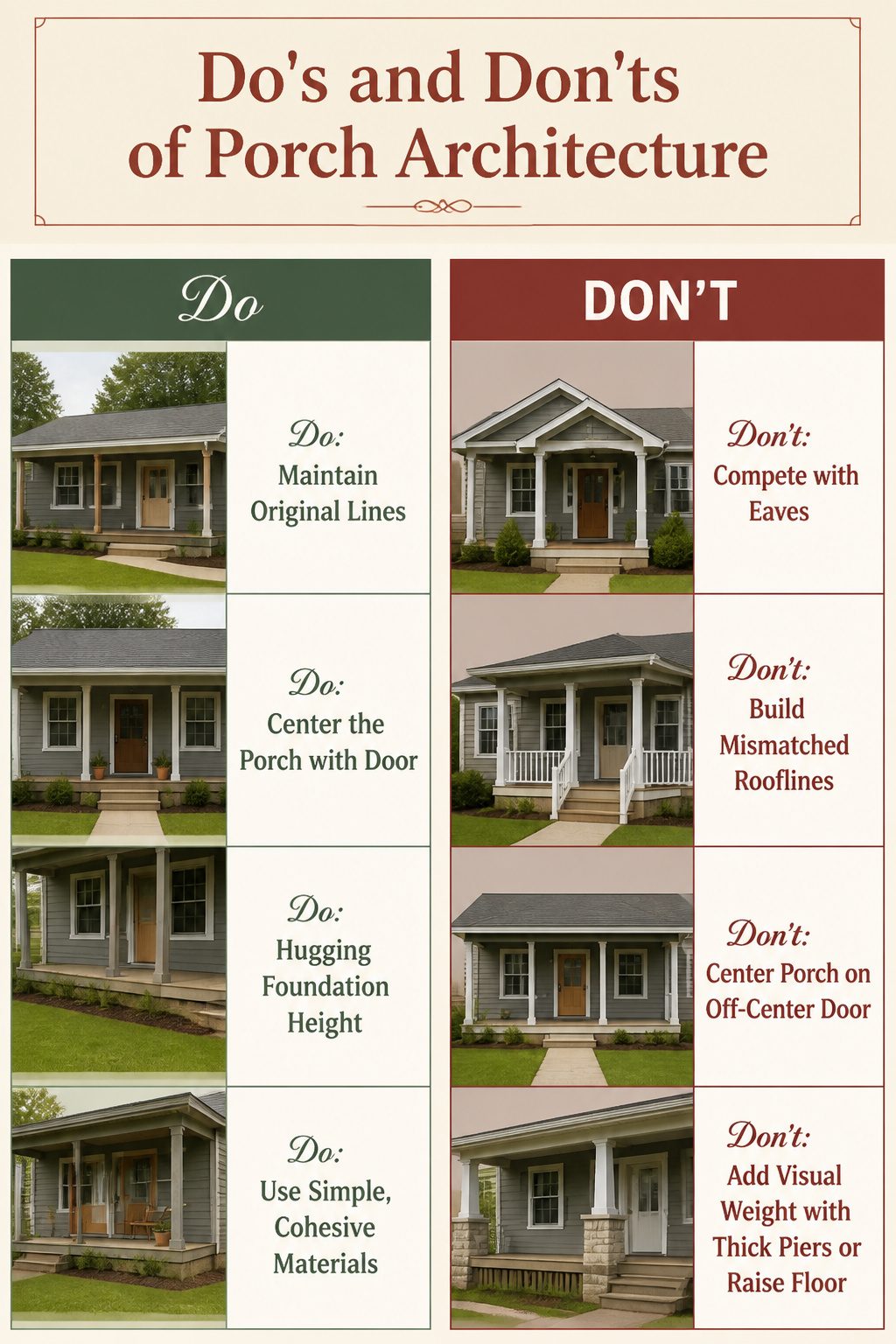
A porch either continues the lines your house already established, or it fights them. That single question cut through every style board I scrolled through when I started this. My 1986 ranch has a low roofline, a front door shoved to one side, and a slab foundation that sits maybe eight inches above the lawn. Nothing about it reads Southern graciousness, and the first pretty porch I fell for, a deep wraparound with slender columns and a haint-blue ceiling, would have looked like a costume dropped onto the wrong set.
The roofline is usually what betrays the mismatch. A gabled porch on a flat-faced ranch pulls the eye sideways and competes with the existing eaves. A shed roof that slopes away from the house, lower and simpler, lets the original architecture stay in charge. Door placement matters almost as much. A centered porch on an off-center door creates a lopsided walk that never feels right; in that case, an asymmetrical design, maybe a small roof extension to one side, works with the asymmetry instead of pretending it away.
Foundation height is the detail I underestimated. A low ranch like mine cannot carry the visual weight of thick piers or a raised floor without looking like it is wearing platform shoes. The porch needs to hug the ground the way the house does. When fighting the architecture actually works, it is because the contrast is total and intentional, a modern glass box against a brick Victorian, say. Halfway fights just look confused. My porch ended up a simple shed roof, cedar posts I stained gray to match the siding, no skirting. It is not the pretty porch I first wanted. It is the pretty porch this specific house will accept.
Frequently Asked Questions
What are some dreamy porch design ideas?
The prettiest porches treat the space as a room you enter rather than a platform you cross. Pull seating into the center, even if it costs walkway space, and keep sightlines open with slatted furniture or cable railings instead of heavy spindles. Haint blue on the ceiling softens shadows and makes white trim pop, while a fan centered over the chairs, not the roof outline, anchors the usable floor as a real living area.
How can I decorate my porch for different seasons?
A four-bin rotation keeps decor from taking over the garage: Memorial Day to Labor Day, Labor Day to Thanksgiving, Thanksgiving to New Year’s, and New Year’s back to Memorial Day. Budget $200 annually for one new clearance piece per season, and track spending on your phone to avoid duplicates. Real gourds go to compost the night before first frost; left through a freeze, they collapse and rot.
What makes a porch feel like a living room?
Furniture facing inward, not toward the street or yard, turns a porch into a room people actually use. The author learned this after setting chairs against railings created a waiting area no one sat in. A ceiling color that lifts the space, seating grouped for conversation, and a view framed toward something worth looking at, like an oak tree rather than a driveway, complete the effect.