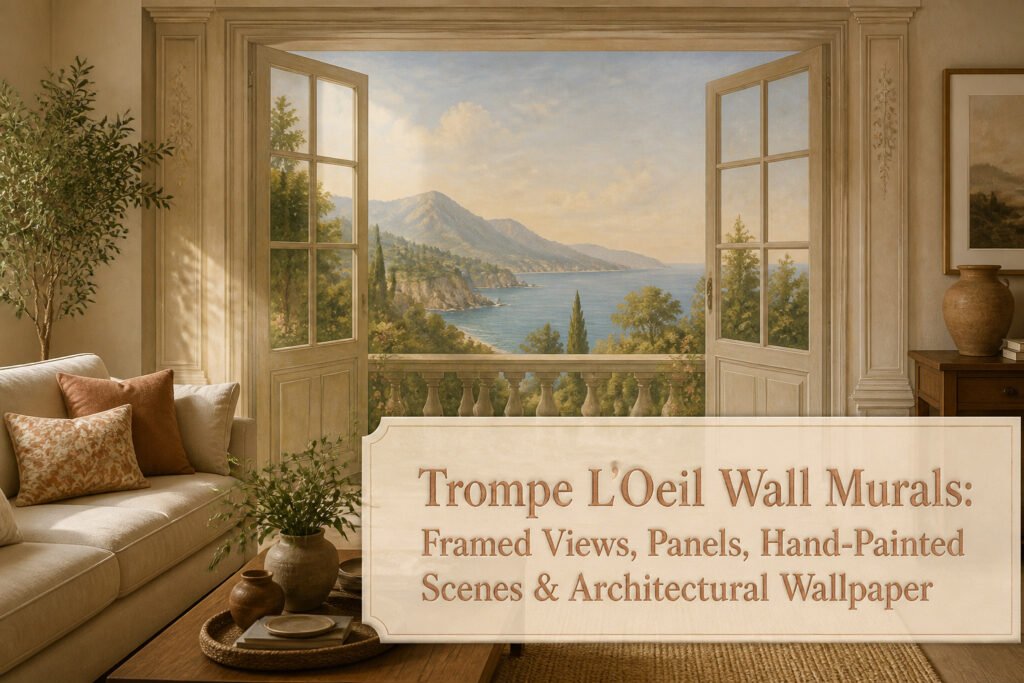
Trompe l’oeil wall murals are painted or printed scenes that trick the eye into seeing depth, architecture, or open views where none exist. The illusion holds only if the light source in the painting matches the light in your actual room; mismatch them and the flatness shows through immediately. Caroline Lizarraga builds hers by painting the frame’s shadow first, before the landscape, so the two light sources lock together.
Framed Trompe L’Oeil Landscape Murals

A painted frame around a landscape scene does more than decorate the wall; it builds the lie. The frame casts shadows, suggests depth, and turns flat plaster into what reads, across the room, as a window opening onto somewhere else. Iksel’s D-Dream mural works this way in the Kensington apartment Mehmet and Dimonah Iksel share: the Palermo architectural borders, hand-painted after the micro marble mosaics of Monreale Cathedral, hold a tropical view of palms and birds that is deliberately not realistic. The frame borrows from Byzantine and Islamic ornament, the landscape borrows from everywhere, and together they convince the eye that the sitting room has gained a view it never possessed.
Caroline Lizarraga takes a different path with her hand-painted landscape work. Where wallpaper repeats, her scenes are one-off, and the frame she paints is often simpler, a plain molding or a broken pediment that does just enough to separate the wall from the "outside." The effect survives at a distance because she paints the frame’s shadow first, before the landscape, so the light in the scene and the light in the room match.
For a renter, the frame is where the money goes if you are hiring it done, because the landscape itself can be simpler, more atmospheric, and still read as depth once the eye accepts the window. Painted frames also repair more easily than printed ones; a scuff on a molding line takes an hour to touch up, where matching a printed shadow means replacing the whole strip. If you are working over a weekend with a few hundred dollars, a single framed view on one wall, painted or papered, gives more illusion per square foot than wrapping the whole room.
Trompe L’Oeil Decorative Panels
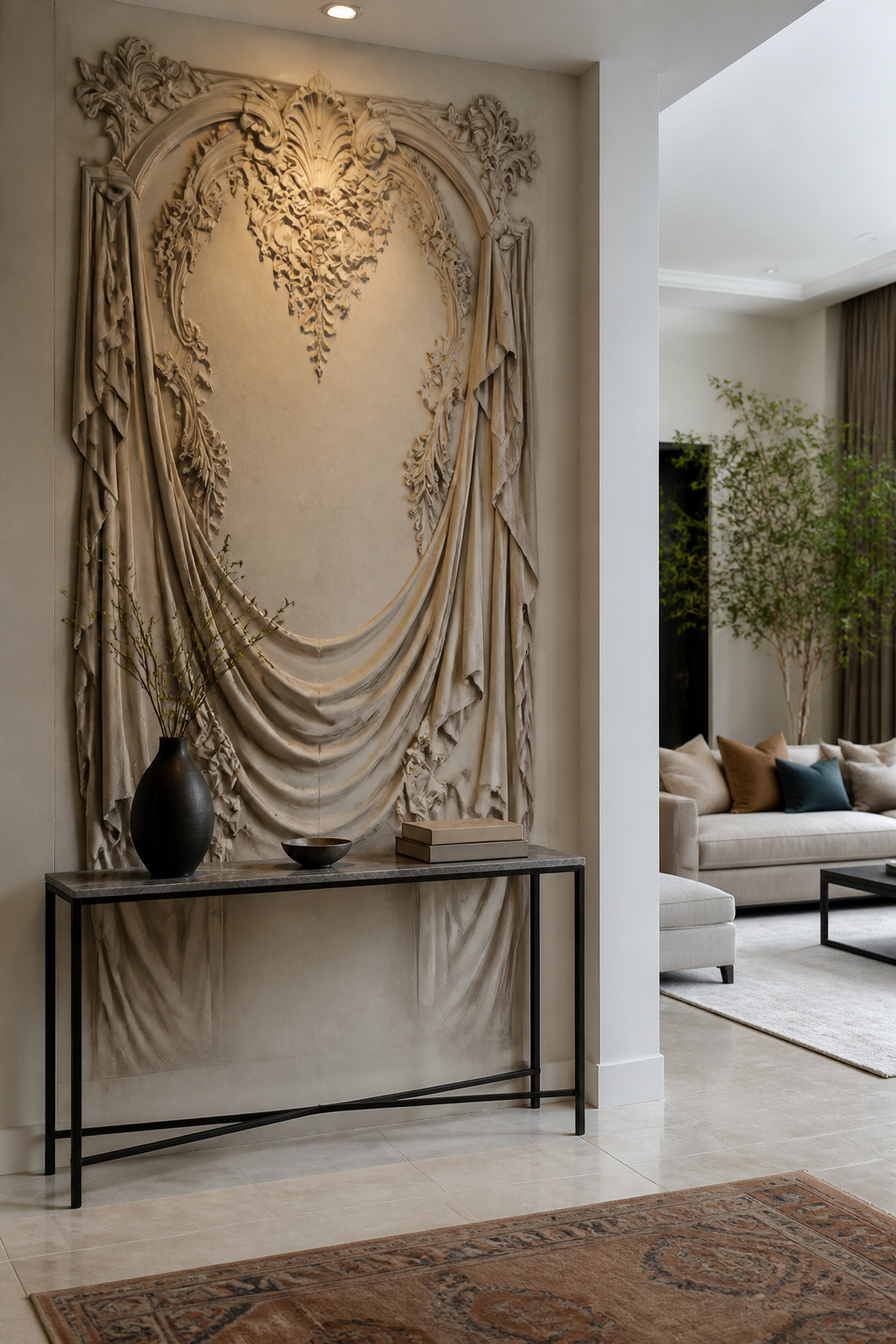
Standalone panels that mimic carved moldings, draped fabric, or half-open doors give you the illusion without the commitment of a full wall. I like them for exactly that reason. You can lean one against a wall on a narrow console, prop it on a shelf, or hang it like art and take it with you when the lease ends.
The scale is what separates these from framed pieces. A framed landscape might run 24 by 36 inches and read as a window on the wall. A decorative panel can run the full height of a door, 78 inches or more, and start to trick the eye into reading it as an actual architectural feature. The frame, if there even is one, is painted on, so the edge dissolves into the scene instead of stopping it.
Panels work best where a full mural would fight the room’s real architecture. A narrow strip between two windows, the back of a recessed niche, the flat panel of a hollow-core door you are not allowed to replace. I have seen renters use two identical panels flanking a bed in place of a headboard, or one tall panel behind a toilet where moisture rules out wallpaper. The trick is lighting. Without a focused light source from above or the side, the shadows in the painted scene flatten out and the illusion dies. A cheap clip light from the hardware store, aimed at a 30-degree angle, does more for the effect than spending more on the panel itself.
Hand-Painted Trompe L’Oeil Murals
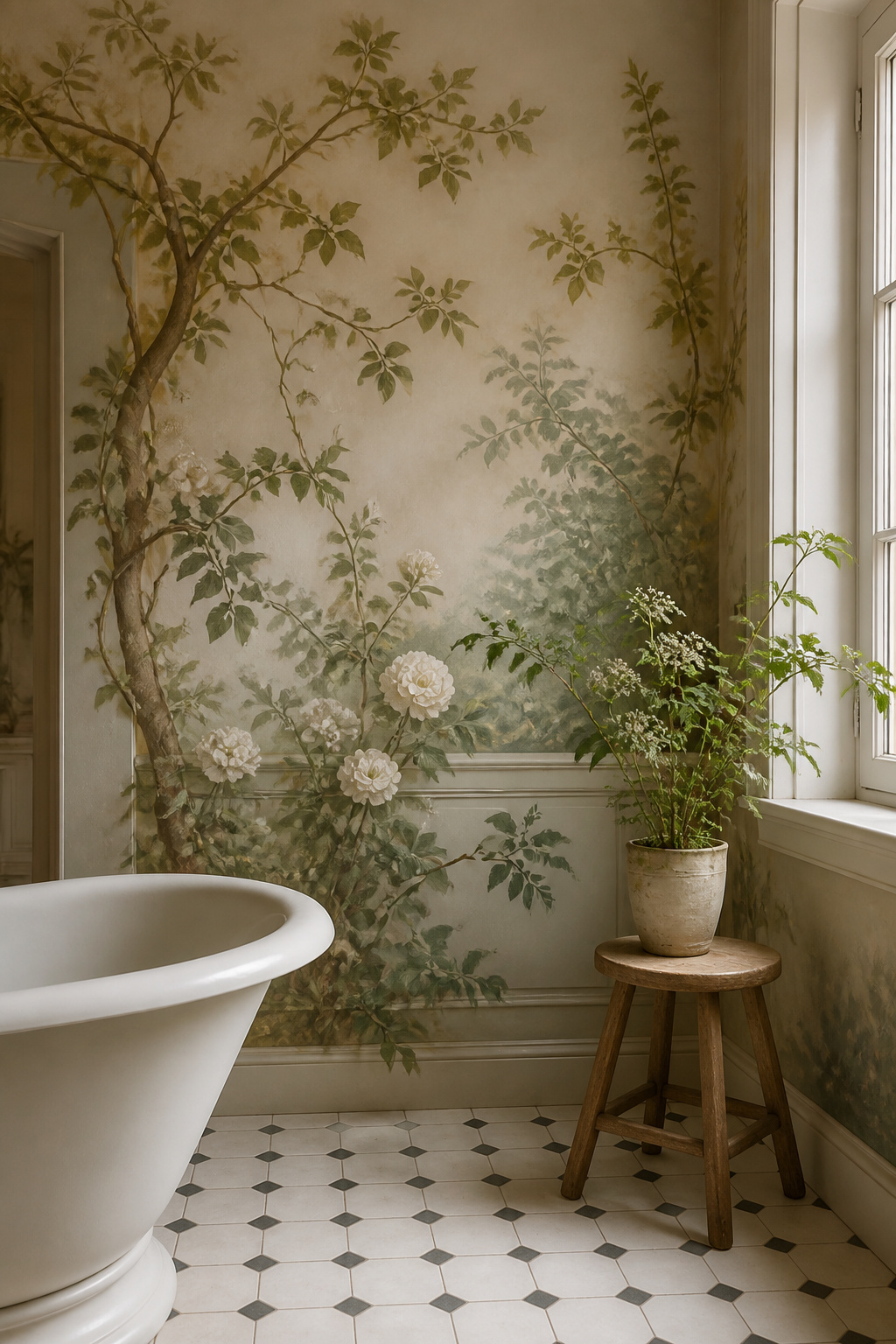
A hand-painted trompe l’oeil mural is the most direct way to trick the eye, and the hardest to pull off. The paint goes straight onto the wall, built up in layers of light, shadow, and perspective until a flat surface reads as depth you could step into. San Francisco decorative artist Caroline Lizarraga works this way, and her powder room tree mural shows what the medium does that nothing else can: she matched the Northern California fog outside the window, then tucked in small birds to stand for the children in the house. Those personal details are possible because every inch is mixed and placed by hand.
The barrier is real. You are hiring not just labor but years of training in how light falls across imaginary architecture. Prep, priming, the full painting schedule, and final sealing can stretch across weeks, and the cost reflects that. For a renter or a first-home owner running a weekend project on a few hundred dollars, this is the option most out of reach. The skill is specific, the timeline is long, and fixing a mistake means painting over days of work. If the budget is tight and the lease is short, the hand-painted route is worth admiring in someone else’s house.
Trompe L’Oeil Wallpaper That Imitates Architecture

Peelable and traditional wallpapers that imitate marble, wood paneling, or moldings are the most accessible entry point for a weekend DIYer who wants architectural detail without the structural work. The 18th- and 19th-century bourgeois homes that first popularized these papers were solving the same problem: the look of expensive materials at a fraction of the cost, applied in hours rather than weeks. Modern printing makes the illusion far more convincing, since photography can capture real marble or stucco in minute detail and repeat it across a roll.
The flattening of craft into something repeatable cuts both ways. You lose the slight irregularities that sell a hand-painted scene, but you gain customization on dimensions and color that a solo painter cannot match. Several companies now offer made-to-measure panels, and some will combine borders with center patterns so the "molding" you choose actually wraps your specific wall geometry. For a renter, the peelable versions mean the grandeur comes off again when the lease ends, which is the real test of whether a weekend project was worth it.
Custom Trompe L’Oeil Designs

Custom trompe l’oeil wall murals sit in a useful middle space that most people miss. Off-the-shelf wallpaper comes fixed in color and repeat; fully hand-painted work means hiring an artist for weeks and paying accordingly. A tailored digital design splits the difference.
The process starts with wall measurements, not guesswork. You send the exact dimensions, note any corners or architectural quirks, and pick a palette that actually matches your room. The studio returns a digital mockup scaled to your wall. That preview matters more than you’d think. I have seen friends skip this step and end up with a Renaissance arch that visually collides with their actual doorway rather than extending it.
Approval locks the file, and digital printing handles the rest. The quality has reached a point where marble grain or distant mountain haze reads as dimensional from across the room. Some studios partner with museum archives, so historical scenes or specific artworks become options you would not find in a catalog.
Bespoke sizing is the detail that makes the illusion hold. A standard roll forced around a corner breaks the perspective; a print cut to your exact wall keeps the architecture continuous. Most projects land in the few-hundred-dollar range, not the thousands that hand-painting demands, and ship in days rather than months.
What Trompe L’Oeil Means and Where It Comes From
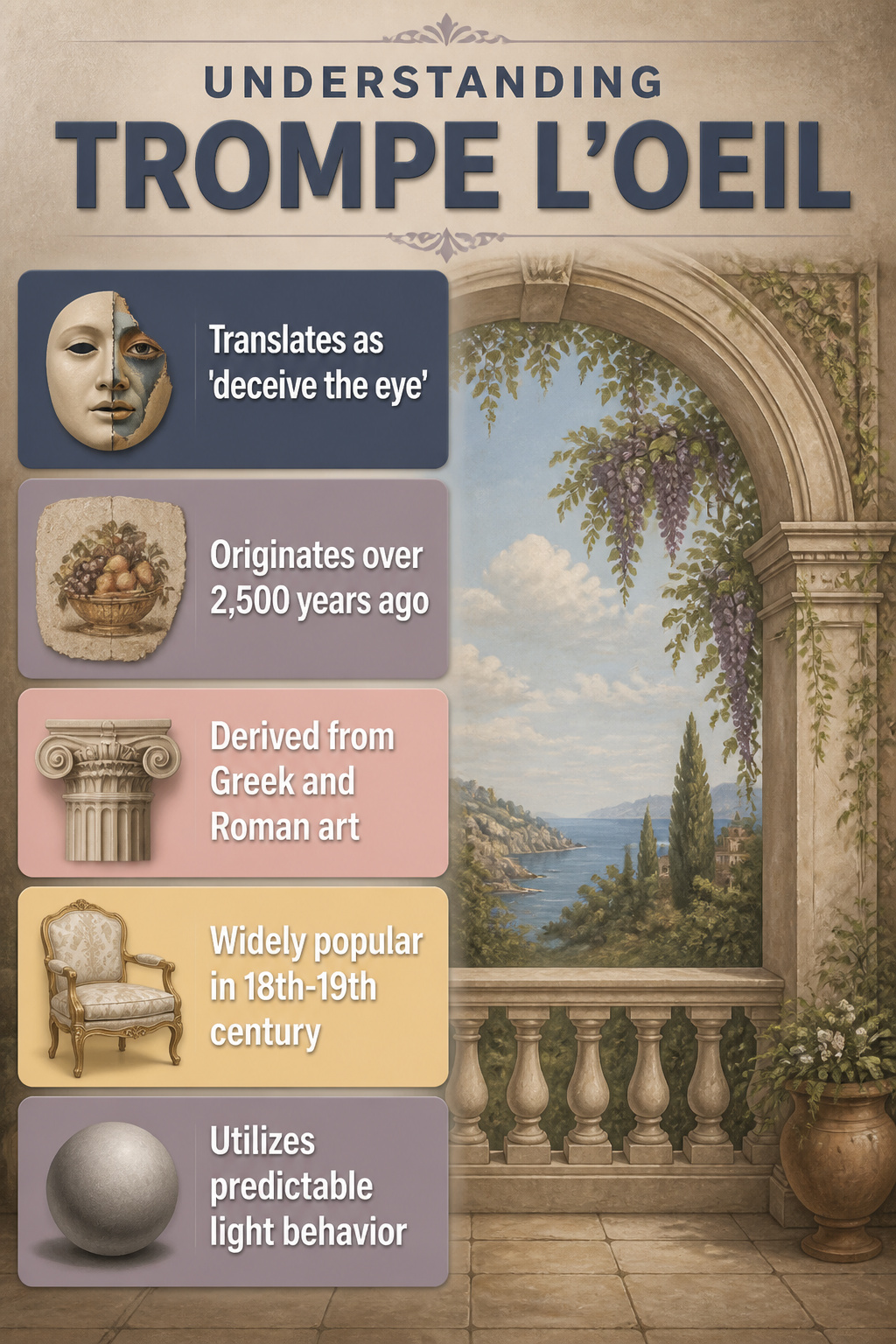
The phrase trompe l’oeil translates directly from French as "deceive the eye," and the technique has been doing exactly that for roughly two and a half millennia. Greek and Roman wall painters were already at it; surviving murals in Pompeii, dated around AD 70, show still lifes convincing enough to make a viewer reach for painted fruit. The famous contest between Zeuxis and Parrhasius, recorded from around 464 BC, turns on the same principle: Zeuxis painted grapes so lifelike that birds pecked at them, but Parrhasius won by painting curtains so believable that Zeuxis tried to pull them back.
The term itself only entered use in 1800, when Louis-Léopold Boilly exhibited a painting under that title at the Paris Salon. By then the method had already carried through Renaissance ceilings, where painted architecture opened imaginary skyward spaces, and into 18th- and 19th-century European interiors. Wallpaper production made trompe l’oeil widely available to bourgeois homes, imitating marble, paneling, and tapestry at a fraction of the cost.
The trick persists because human vision relies on predictable light behavior: shadows fall consistently, parallel lines converge at expected angles, and surfaces reflect light in familiar ways. Painters who match those cues hijack the same mental shortcuts that let us navigate actual rooms. Digital printing now reproduces scenes in minute detail, but the underlying mechanism, exploiting how the eye expects the world to look, has not changed since those Roman walls.
How Artists Build the Illusion
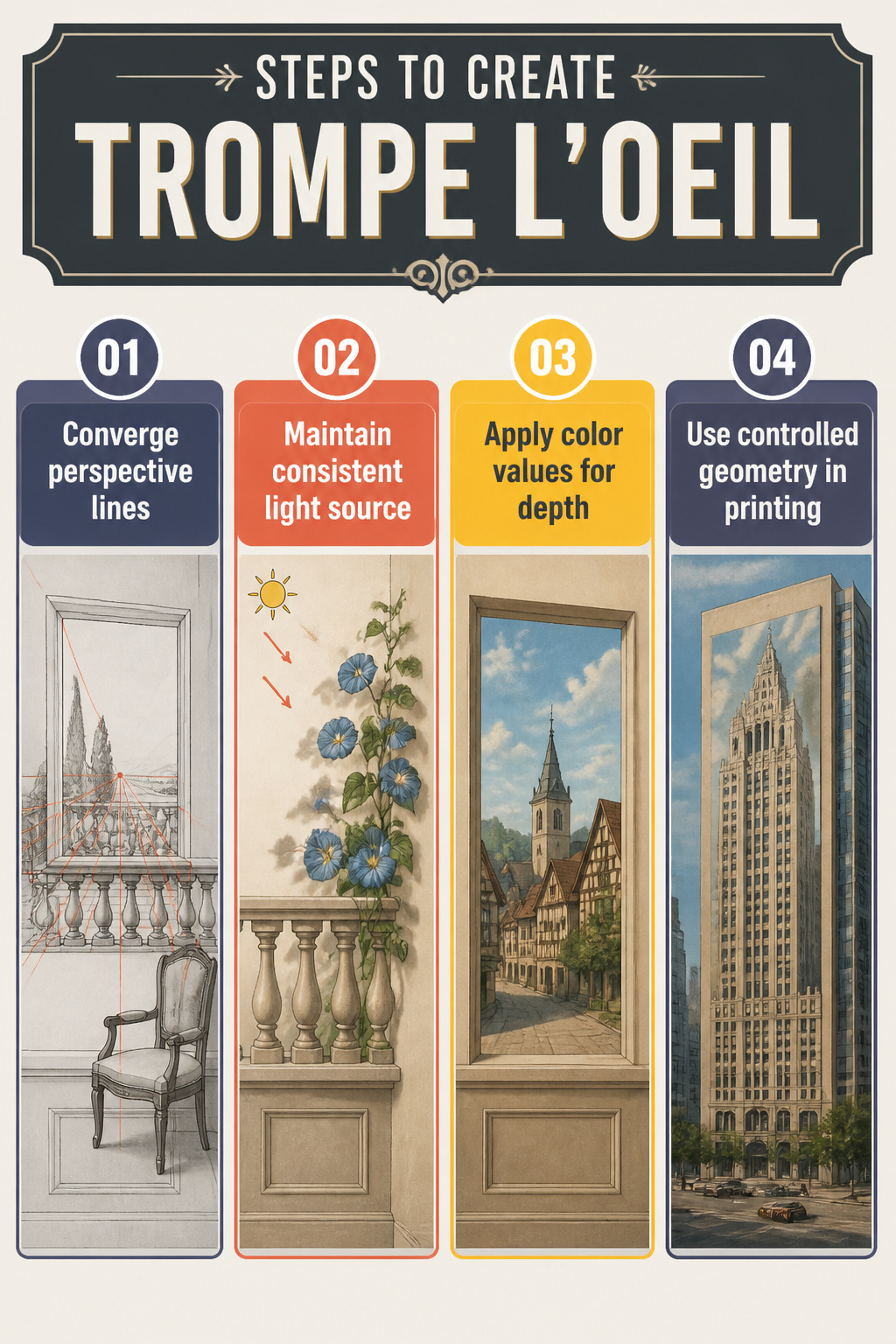
The eye buys the trick in four stages, and every stage has to hold or the whole thing collapses. First, the perspective lines have to converge exactly where a real scene would, whether that scene is a stone balustrade receding past a chair rail or a window opening onto a 1950s German village street. The artist fixes a single viewing point and never cheats it. Second, the light source has to stay consistent across every painted surface. If the morning glory vine casts a faint shadow to the left, every balustrade shadow falls left too, at the same angle and softness. Third, color values do the heavy lifting on depth. Cooler, lighter tones push back; warmer, darker ones pull forward. A painted sky behind a false window reads as distance because the value shift is abrupt enough to feel like atmosphere, not like a wall.
Printed wallpaper follows the same rules without the hand. The 16-story Chicago mural by Richard Haas that quotes the Chicago Board of Trade Building two miles south works because the printer locked the perspective and shadow logic into the repeat. Digital designers now build these scenes in layers, painting shadows onto separate plates so the factory can register them precisely. The difference is only in execution. What fools you is the same controlled geometry, whether the pigment was laid by a brush in 1981 or by a print head last month.
Why Trompe L’Oeil Is Back in Rooms Now
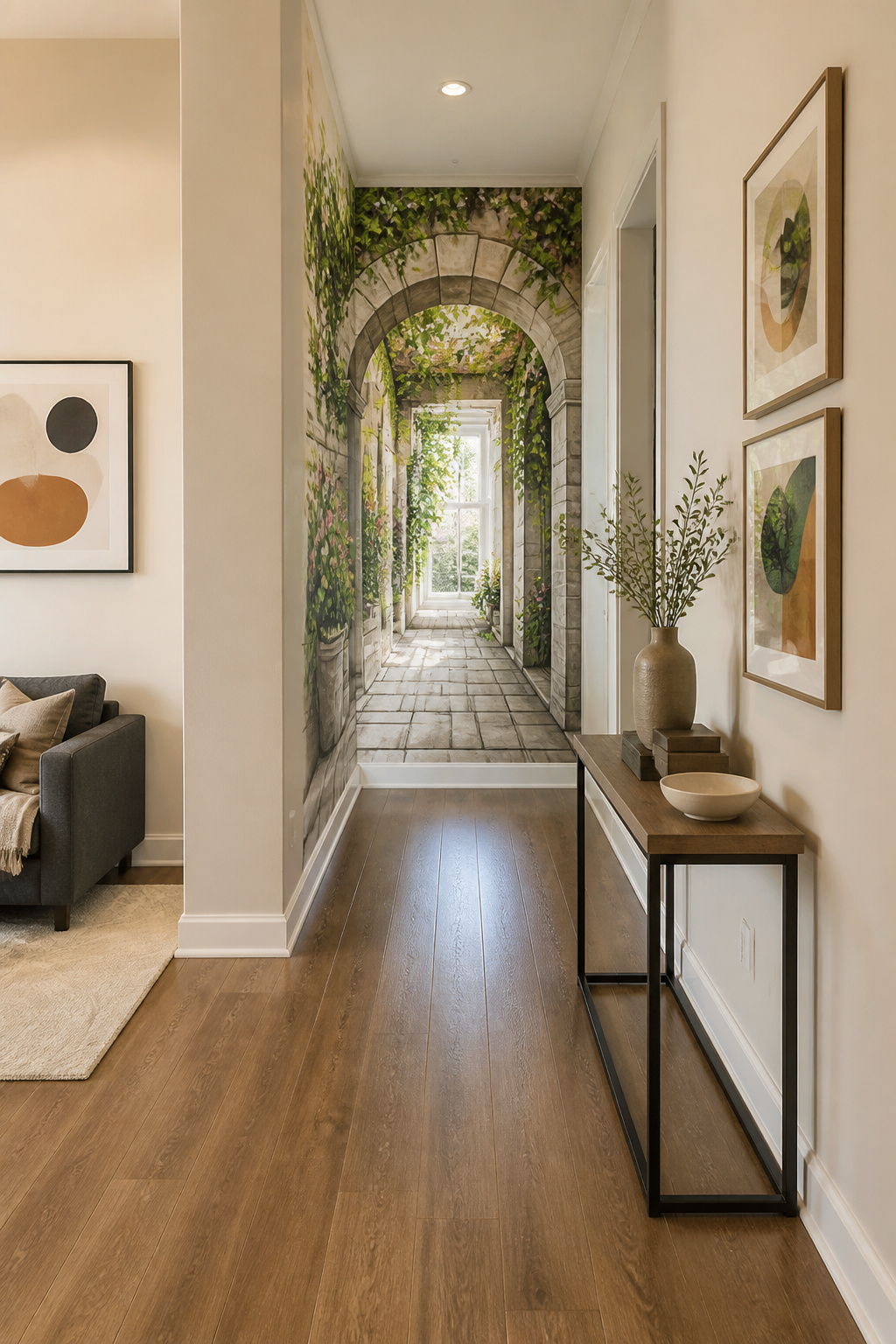
Trompe l’œil wall murals are having a moment in contemporary interiors, and the timing makes sense for anyone stuck with plain walls they cannot change structurally. A rental lease or a first-home budget rules out adding actual windows, arches, or molding, but a printed or hand-painted illusion delivers the visual drama without the permit or the contractor. The appeal is partly whimsy, partly escape: a narrow hallway becomes a passage through a Renaissance arch, a windowless bathroom opens onto a mountain vista. Decorative artist Caroline Lizarraga put it well:
"Sometimes, a house doesn’t have an exciting view, architecture, or even a window, but you can add a striking visual element with the depth, beauty, and detail of trompe-l’œil."
That is the practical case for renters and new owners alike. You spend a Saturday positioning panels or smoothing wallpaper, maybe $200 to $800 depending on scale, and the room reads as architecturally richer without a single structural alteration. The 3D receding landscapes and faux architectural details trick the eye into perceiving space where none exists, which matters when your actual square footage is fixed and your timeline is one weekend before Monday calls you back to work.
Frequently Asked Questions
What is trompe l’oeil?
Trompe l’oeil is a French phrase meaning "deceive the eye," an artistic technique that creates the optical illusion of real objects, scenes, or architectural features on a flat surface. The method has been used for roughly two and a half millennia, from Roman wall paintings in Pompeii to modern digitally printed wallpapers, and it works by matching how human vision expects light and shadow to behave.
How can I use trompe l’oeil in my home?
You can use trompe l’oeil through framed landscape murals that read as windows, standalone decorative panels that mimic carved moldings or draped fabric, hand-painted murals applied directly to walls, or peelable and traditional wallpapers that imitate marble, wood paneling, or architectural moldings. Each option fits different budgets and commitment levels, from weekend DIY projects with a few hundred dollars to commissioned hand-painted work that stretches across weeks.
Can I customize trompe l’oeil designs?
Yes, many companies offer custom trompe l’oeil designs tailored to your exact wall dimensions and color preferences. The process starts with your measurements and a digital mockup scaled to your wall, which lets you preview how the scene will interact with real doors, corners, or windows before anything prints. Some studios also partner with museum archives, so historical scenes or specific artworks become options beyond standard catalogs.