
A pretty laundry room doesn’t require a renovation budget. It requires knowing which tradeoffs actually matter: peel-and-stick wallpaper holds up near a washer but fails behind a poorly vented dryer; a $3 thrifted ceramic canister outperforms matching sets if you mix the textures right. The detail that separates finished rooms from staged ones is the cabinet line, not the appliance inside it.
1. Attractive Storage Solutions
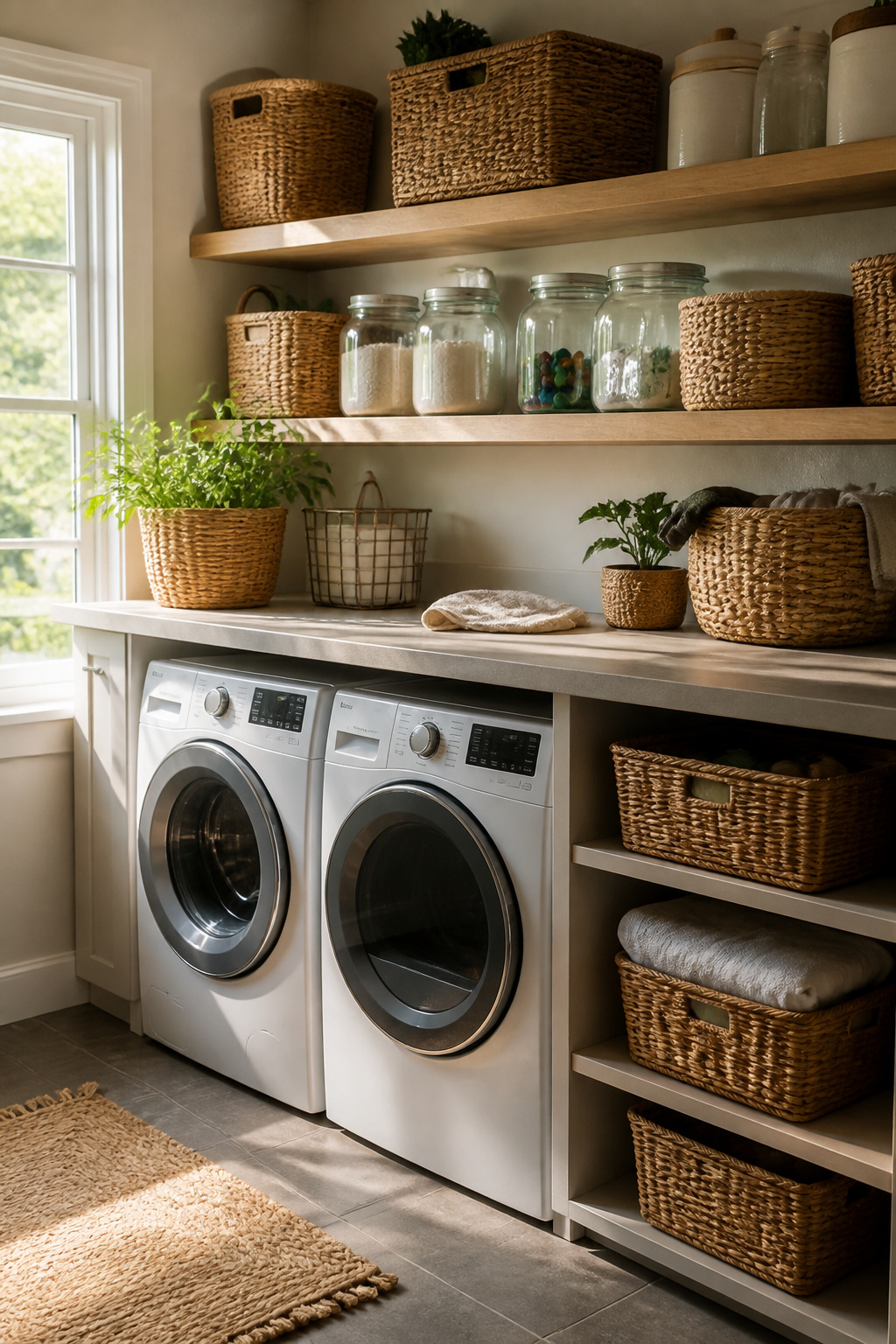
Woven baskets, glass jars, and ceramic canisters keep laundry essentials organized while adding visual interest, and three separate design references I came across all pointed to the same combination. The materials matter more than the container style. Seagrass and rattan baskets soften the utilitarian look of detergent bottles and dryer sheet boxes. Clear glass jars work best for pods and powder, letting you see the supply level without lifting a lid. Ceramic canisters hide the less attractive stuff, like stain pens and stray socks waiting for their mates.
Open shelving is where these pieces earn their keep. Behind closed doors, any plastic bin does the job. On a visible shelf, the container becomes the decor. I would skip the matching set look, personally. Mixing a few vintage ceramic pieces with newer woven shapes keeps it from feeling staged. The cost stays reasonable, too. Most of my canisters came from thrift stores and estate sales, running $3–8 each, while the baskets were Target finds under $15. The glass jars were old pasta sauce containers, labels soaked off.
2. Quality Suds and Scents
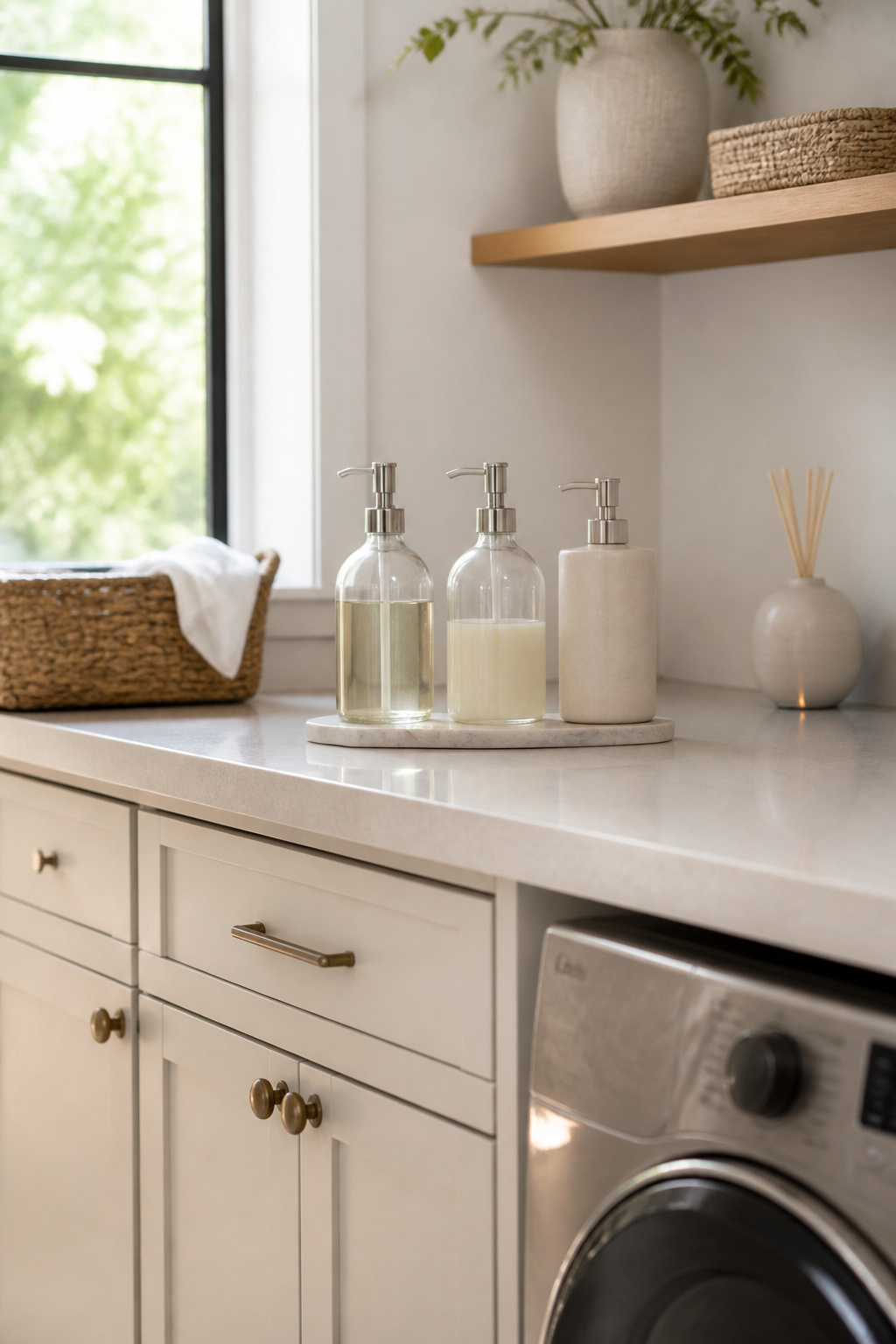
The bottles and boxes we use every week sit out more often than we admit, so their packaging matters as much as any vase. I started leaving my detergent on the counter after I switched to one in a glass bottle that actually looked deliberate there. Fabric softener in a ceramic dispenser reads as intentional, not leftover.
For scent, the Pura x Studio McGee fragrance collection works as a plug-in diffuser you control with an app. Their Wild Sage reads clean and calm without the heaviness that makes a small laundry room feel crowded. I set mine to run only during the hours I’m actually in there, which keeps the scent from going flat.
The real win is that nothing has to hide. A shelf with matching bottles and one small diffuser looks styled rather than stored, and you skip the step of hauling supplies in and out of cabinets every Saturday.
3. Greenery Goes a Long Way
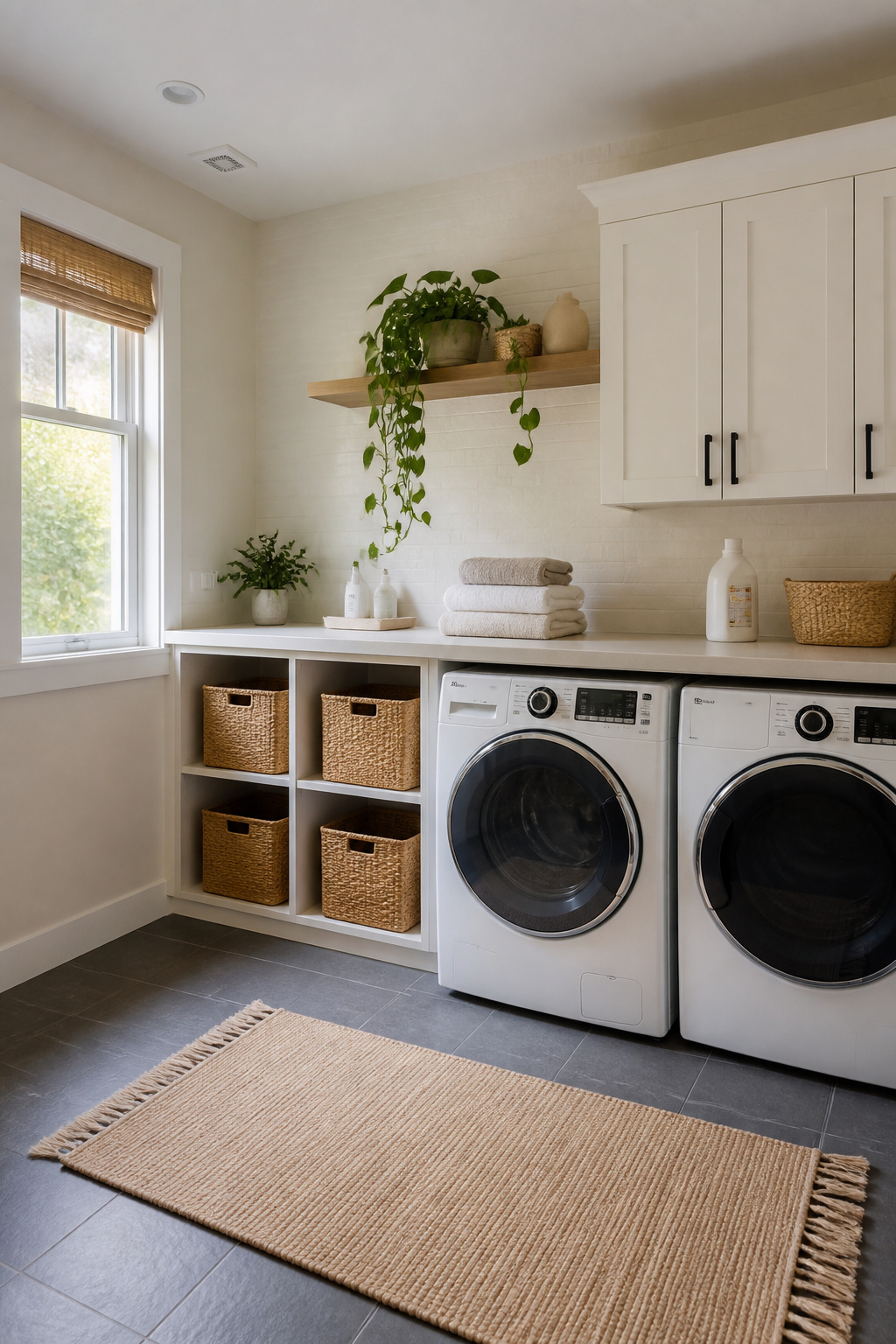
A trailing vine on an upper shelf does more for a laundry room than most built-in upgrades. Three separate lines of reasoning back this up: the visual softness against hard appliances, the stress reduction that comes with living plants in utilitarian spaces, and the way greenery signals a finished, intentional room rather than an afterthought.
Low-light survivors and humidity-tolerant picks are the ones that last here. Pothos, snake plants, and ZZ plants handle the fluorescent-to-windowlight range most laundry rooms offer, plus the steam spikes that come with every dryer cycle. I have watched a pothos droop dramatically after a hot wash day then perk back by morning; that flexibility matters more than showy blooms in this space.
Placement runs three practical routes. A small potted plant beside the detergent tray puts green at eye level while you sort. Windowsills work for anything getting real light, though the glass intensifies afternoon sun enough to scorch leaves in south-facing rooms. Hanging near the sink or washer takes advantage of humidity but needs a hook rated for wet-location weight; water and soil together run heavier than dry potting mix alone.
Faux stems in a ceramic vase solve the problem entirely if your laundry room has no window at all. The organic feel registers the same way, and zero maintenance beats a slow decline you feel guilty about every load.
4. Elevate with Art

Framed prints warp fast in a room that steams every load. I learned this the hard way with a thrifted botanical print that curled at the corners inside two months. The paper backing had trapped moisture against the wall. Metal or acrylic frames with sealed backs hold up where wood and open mats fail. For cheap pieces that look intentional, I now hunt estate sales and print digital downloads on heavyweight matte paper myself. A $12 frame from a big-box store and a $3 print beats waiting for "laundry art" to go on sale. The humidity mistake most people make is hanging too soon after the dryer’s running; let the room air out ten minutes or the glass fogs behind the frame anyway. Small pieces, 8 by 10 or 11 by 14, read better in narrow laundry spaces where a large canvas fights the machines for wall. My current setup is three small frames in a vertical line above the folding station, spaced about four inches apart. They have been straight for a year now, which is longer than that first print lasted by a factor of six.
5. Wallpaper and Patterns

Wallpaper turns a laundry room from a space you endure into one you notice, and the question is less about pattern than about what kind you can live with. Peel-and-stick wallpaper has improved to the point where it holds up in the steam and temperature swings near a washer, though I would not run it inside a shower enclosure. Traditional wallpaper with a proper vinyl or scrubbable coating still wins for longevity if your dryer vents poorly or the room lacks a fan.
The place to take the risk is the wall you face while folding, the one spot where you actually stand still. Designer Nicole Blough used a soft patterned paper from Spoonflower to keep a laundry room light and fresh, and that approach works because the pattern sits at eye level where it earns its keep. A ceiling or the wall behind machines is higher stakes; moisture collects there, and a seam lifting in a corner you cannot reach is a problem you will ignore for months.
I learned the hard way that bold pattern needs breathing room. A swirling floral wallpaper paired with graphic Moroccan floor tile can work, as Jennifer Overweel demonstrated, but the mix succeeds because the trim and baseboards stayed a single quiet color. In my own attempt, I crowded two strong patterns with no neutral ground, and the room felt like a fabric store on Saturday morning. One pattern per sightline is the safer rule; let the second pattern live on the floor or the window, never both.
6. Integrated Appliances and Hidden Storage
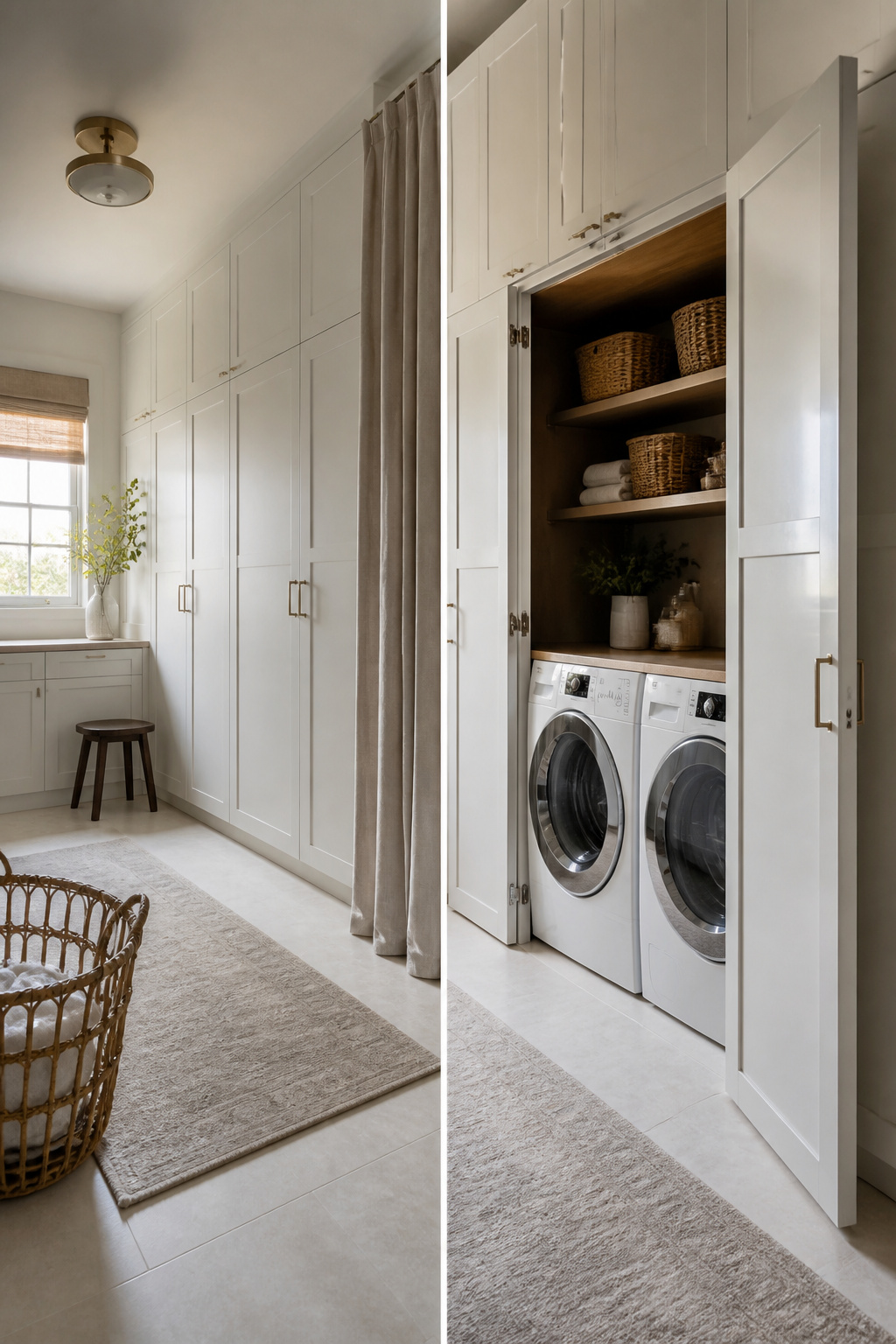
Panel-ready washers and dryers sit flush behind cabinet fronts so the whole wall reads as built-in furniture, not a utility corner. The catch is the upcharge: the appliances themselves cost more, and you need custom panels made to match your cabinets. For a rental or a first home you might leave in five years, the payback on that spend is thin. I looked into it for my own laundry closet and stopped when the quote crossed into kitchen-renovation territory.
Concealed storage works the same way on a smaller budget. A simple curtain on a tension rod hides the washer from the hallway; a shallow cabinet built over a front-loader swallows detergent bottles without the panel-ready price. The clean look is what matters, and you get most of the way there with ordinary cabinets and a little planning on sight lines.
7. Multi-Functional Spaces
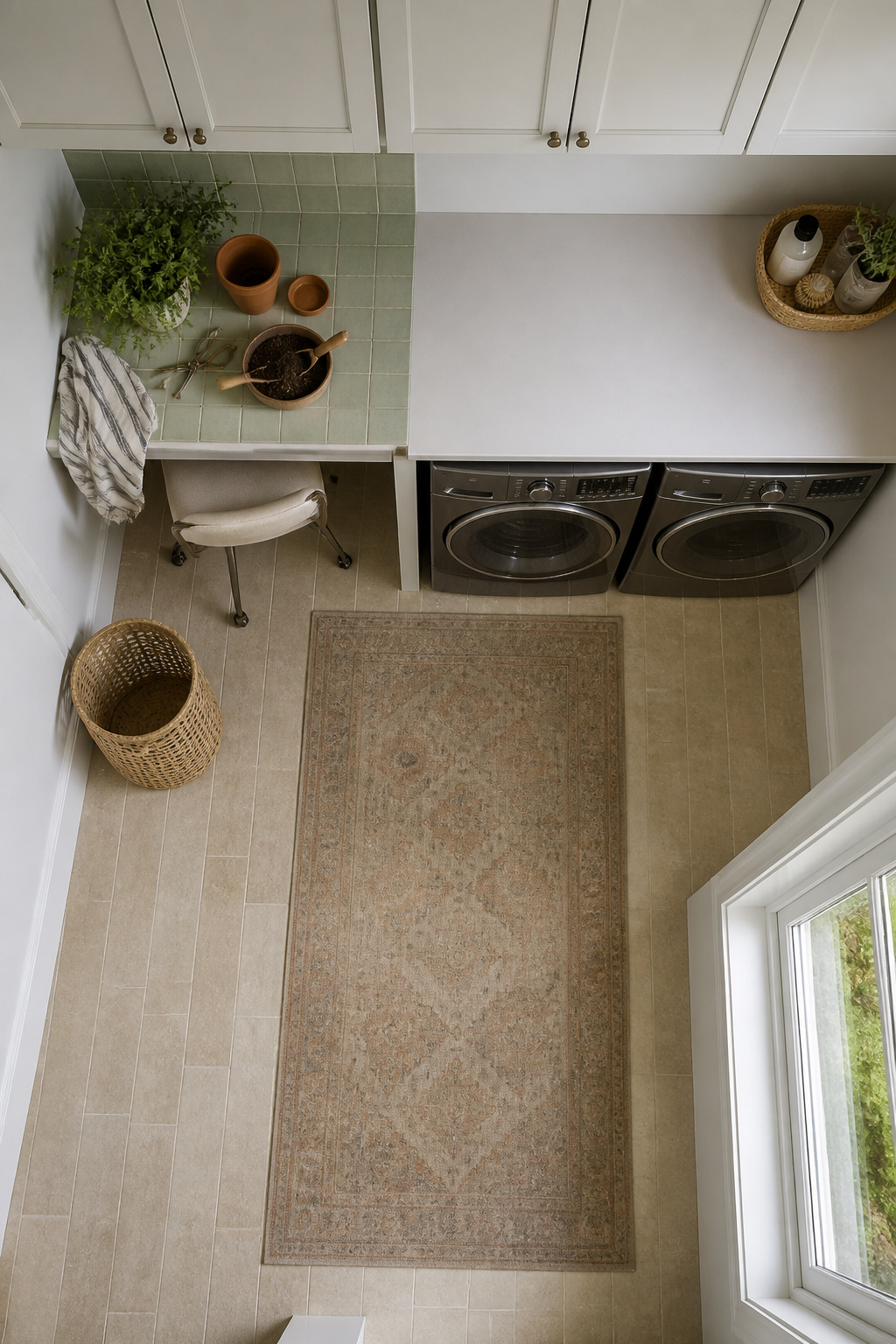
A laundry room that also handles muddy boots or gift wrap does not need to be large. It needs zones that keep the mess from swallowing the whole room.
I learned this the hard way after setting up a folding surface that was supposed to serve as both a potting bench and a gift-wrapping station. The soil and the ribbon wound up in the same drawer. The fix was splitting the counter: one end with a tiled backsplash and wipeable surface for anything wet or dirty, the other end kept clear for tasks that need a clean flat space. Studio McGee’s advice on wipeable countertops and tiled backsplashes applies here exactly, because laundry gets messy and so does potting.
Front-loading machines with a counter installed over them create that work surface without eating extra floor space. The same counter can sort clothes, hold a laptop for a home office setup, or double as a craft table if you store supplies in wall cabinets above and roll the chair away when laundry day hits. Hello Lovely Studio points out that second-floor laundry rooms are often closet-sized, but builders sometimes leave bonus space over a garage that can become a dual-purpose room with proper hookup placement.
Pet stations fit this same logic. House & Home shows a wall of white cabinets with ample counter space storing everything from cleaning supplies to pet food. The trick is assigning the pet zone to one cabinet bank and the laundry zone to another, so the dog bowl does not become your folding surface by default. Hooks beneath cabinets or on the back of a door give pet leashes or air-dry delicates a home without crossing into the clean-clothes territory.
8. Natural Light Considerations
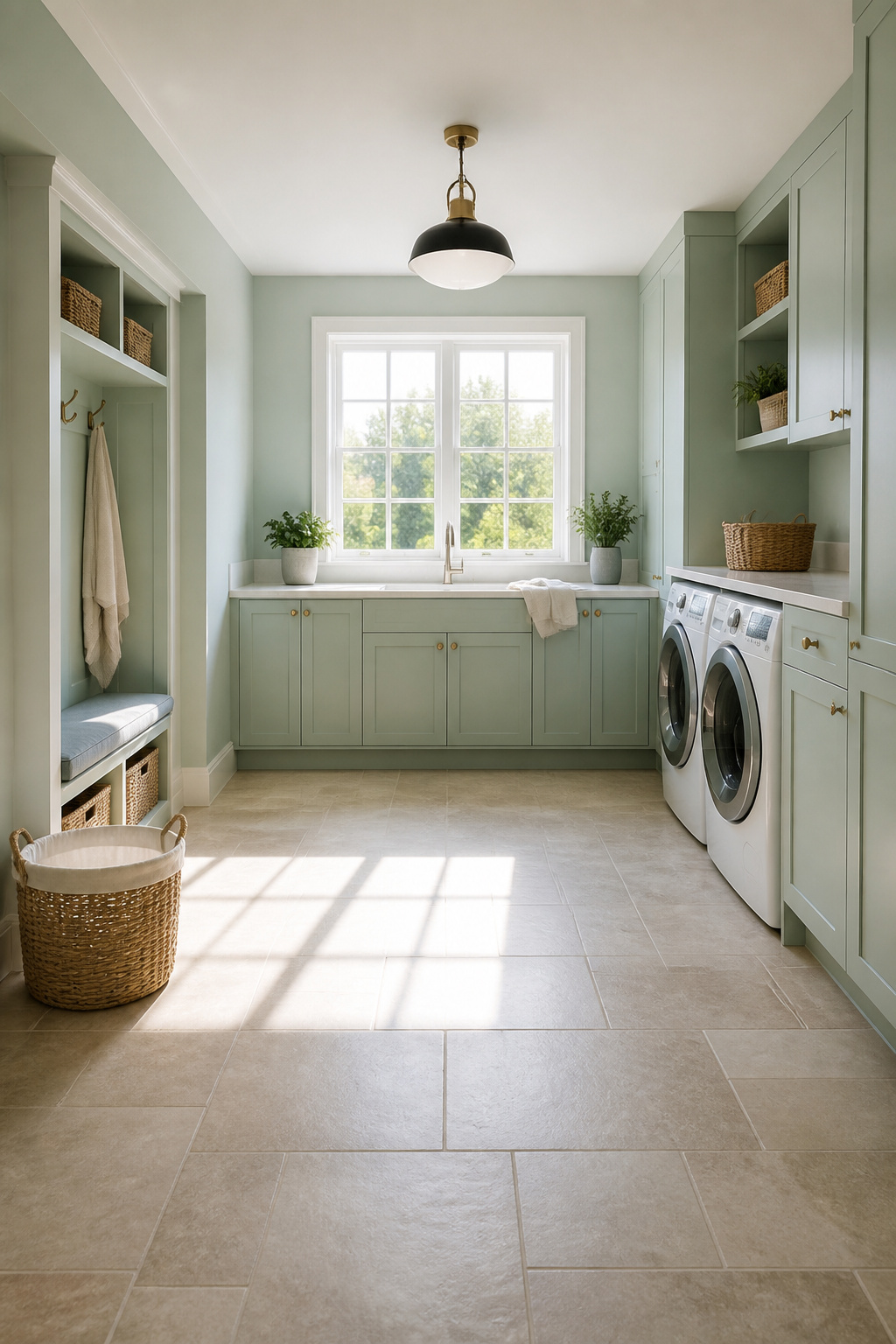
Windows in a laundry room change the whole experience of a chore you already resent. A sunlit space lets you spot stains while they are still treatable, and the view breaks up the monotony of folding the same towels again. Lauren Conner, who designs these spaces for a living, puts natural light at the top of her list for a reason: the room stops feeling like punishment and starts feeling like part of the house you actually chose.
Most renters and first-home buyers do not get to punch a hole in the wall for a window, let alone a skylight. I have lived with both setups. The basement laundry room in my first rental had one grimy window that faced a concrete well, so I learned to run loads at night just to avoid the depressing light. When I moved to a place with a window over the sink, the same task took half the mental effort.
For the windowless option, overhead fixtures alone will not save you. The fluorescent tube in that basement made everything look gray and dirty even when it was not. What worked in the next windowless space I used was swapping to daylight bulbs with at least 2300K. That color temperature mimics afternoon sun close enough that stain-checking becomes reliable again. A sculptural overhead light helps, but the bulb inside it is what determines whether you can tell a coffee spot from a shadow.
9. Unique Flooring Options
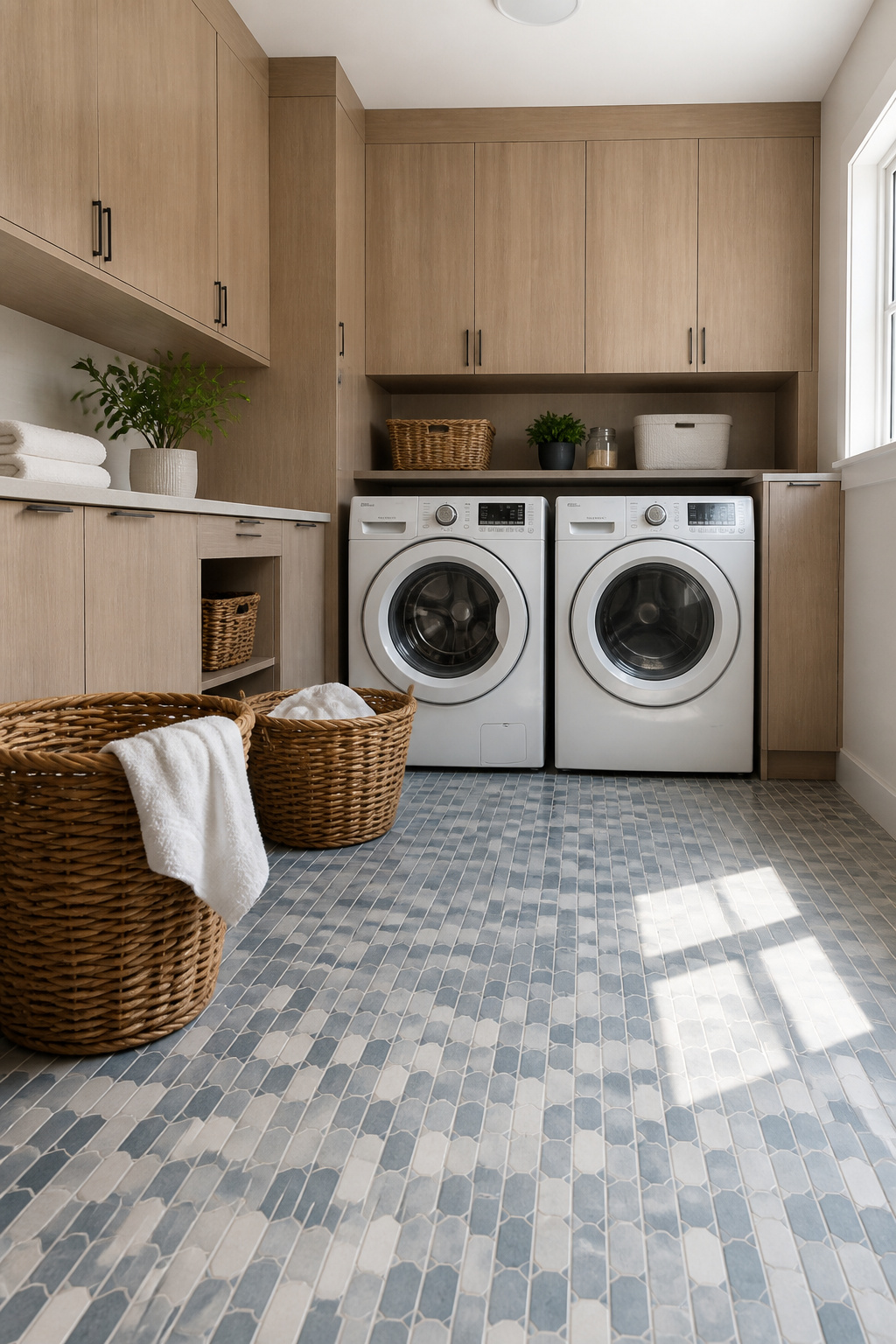
Peel-and-stick vinyl sheets handle the splashes and dropped detergent bottles well enough, but after a few years the edges curl where the washer vibrates and the pattern starts looking like a motel hallway. Upgrading to a porcelain mosaic meant accepting about $12–$14 per square foot installed instead of $3–$5 for standard vinyl, which stung until I compared replacement costs.
The Alato Beachwalk mosaic tile from The Tile Shop kept surfacing in the project threads I read through. The mesh-backed sheets install faster than penny tile, and the muted blues and grays hide lint and hard-water spots that would show on a solid surface. Two homeowners I followed both called it the one splurge they didn’t second-guess, not because it transformed the room, but because it still looked intentional after three years of wet sneakers and bleach drips. That durability at a mid-range price is where the value sits.
10. Decorative Lighting
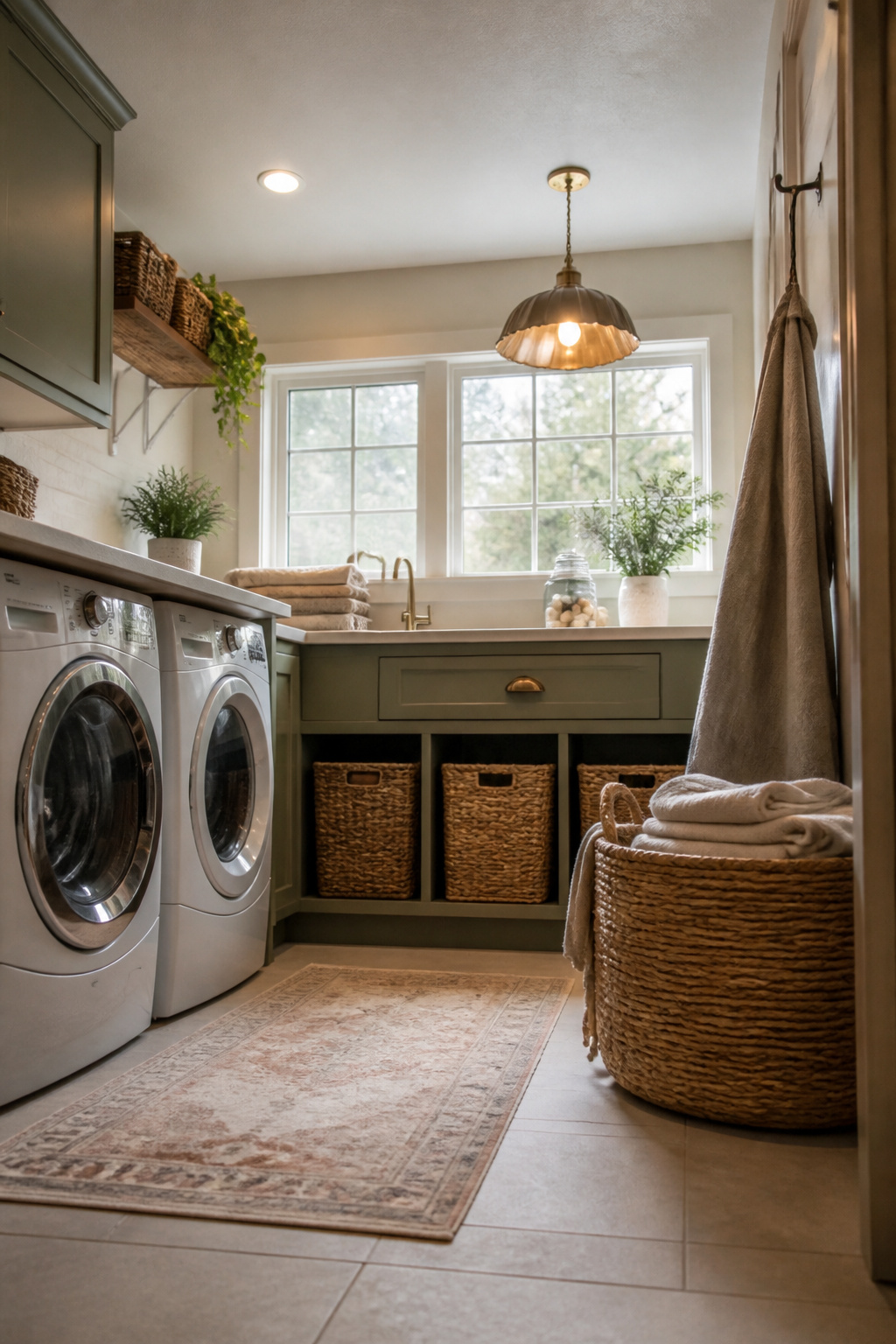
The builder-grade dome light in my last rental laundry closet did nothing but cast a flat glare across the folding table. Swapping it for a small pendant changed the whole feel of the room, even though the ceiling sat barely seven feet high. A flush mount with a little shape to it, like a scalloped metal shade or a seeded-glass bowl, gives you the same character without the head-bump risk in tight quarters.
Daylight bulbs matter here more than fixture style. I learned that after installing a warm-toned LED that made every white sock look yellowed and dingy. Sources on pretty laundry rooms consistently point to 2300K daylight bulbs for task areas; the cooler cast reads truer on fabrics and keeps the space from feeling like a back hallway after dark.
For placement, put task light directly over the folding surface or sink where you actually handle clothes. A sconce beside the washer helps spot stains before the load goes in. Keep the overhead fixture for general fill, not the main event. In my narrow galley space, a single Gramercy-style double sconce mounted between the washer and dryer gave enough side light for sorting without competing with the low ceiling for attention.
11. Custom Cabinetry
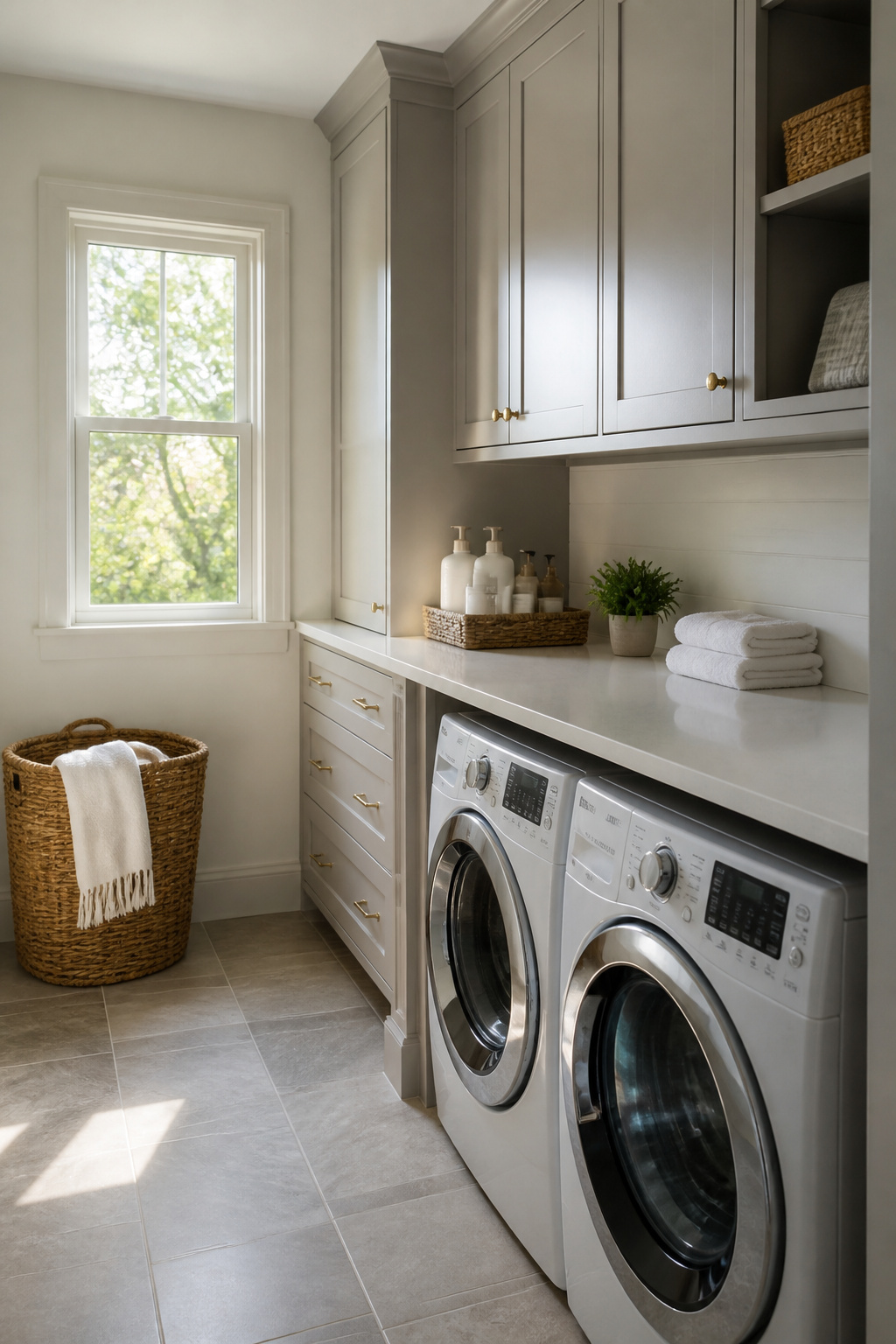
Built-in cabinets turn a laundry room from a closet with machines into a room that actually works, but the jump from stock to custom is where most budgets snap. Stock units from the big-box stores run a few hundred dollars and fill standard widths fine. Custom cabinetry starts around double that and climbs fast, yet it is the only way to get storage flush to the ceiling or tucked around a pedestal washer without the three-inch gap that collects lint and lost socks.
Sherwin Williams City Loft (7631) in satin on the cabinets and eggshell on the walls is the paint choice that makes a tight space read as one continuous room rather than a box crammed with boxes. I have seen the same color used both ways, and the finish difference matters more than people expect: satin wipes down after a detergent spill, eggshell hides the roller marks you will not notice until the second coat dries.
Custom sizing pays off most around the machines themselves. A counter built to the exact depth of your washer and dryer gives you a folding surface with no overhang to snag baskets. For renters, though, this is usually overkill. You are not cutting into walls you do not own, and freestanding stock cabinets on locking casters can roll out when the lease ends. The exception is a removable panel system: some cabinetmakers build face frames that screw to the wall with finish washers, so the holes patch with a dab of spackle. Ask for that detail upfront, because standard installation assumes permanent attachment.
What convinced me, reading through enough of these projects to spot the pattern, is that the pretty laundry rooms separate themselves at the cabinet line. Integrated appliances help, but the cabinet surround is what hides them.
12. Personal Touches and Decor
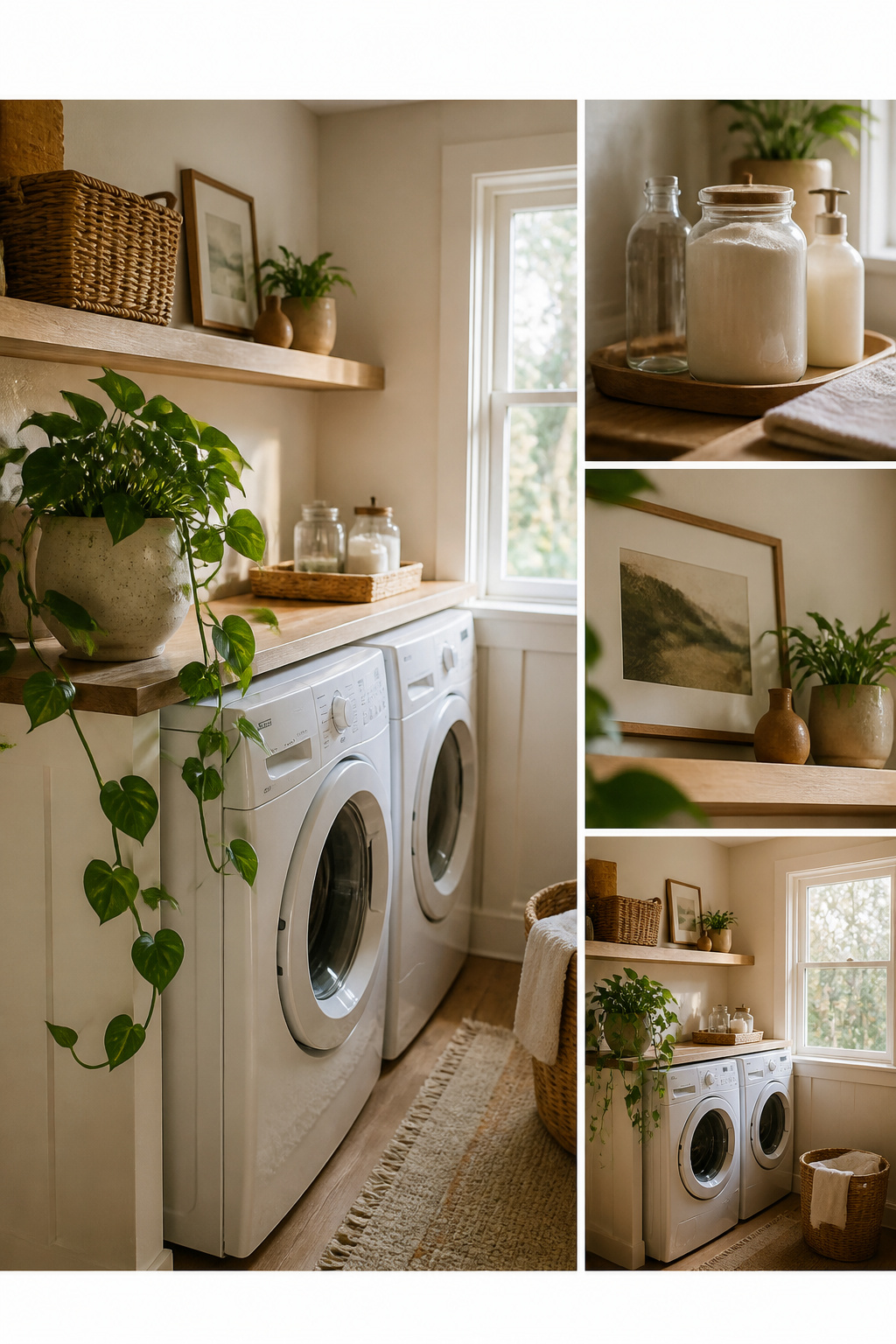
A ceramic vase with a single trailing stem on the dryer lid does more to make a laundry room feel inhabited than a full renovation ever could. The same shelf that holds detergent can carry a small potted plant or a framed print leaned against the wall, but the mistake is treating every surface as a display case. I have walked into laundry rooms where the folding table was so crowded with candles and ceramic trays that sorting a load became an obstacle course. Two or three pieces rotated seasonally, a trailing vine swapped for a dried stem in winter, keeps the space feeling tended rather than staged. What survives here matters. Steam, heat, and splashes rule out anything too precious; a low-light tolerant plant or a good faux option handles the environment better than a delicate ceramic that will chip the first time a bleach bottle tips. The detergent holder itself can be part of the gesture. A lidded jar in a finish that reads as intentional, not leftover, turns the most functional object in the room into something that belongs to the rest of the house.
13. Use of Color and Paint

Paint is the fastest way to turn a bare utility box into a room you actually notice walking past. Three separate projects I studied recently all started the same way: walls and cabinets in one color, which erases the visual breaks that make a small space feel smaller.
Farrow & Ball Green Smoke showed up in two of them, once on cabinets and walls together, once on kitchen cabinetry by the same homeowner, so the color has proven it can carry a whole room without going flat. For a lighter hand, Sherwin Williams City Loft (7631) works the same trick, satin on cabinets and eggshell on walls so the sheen does the separating instead of the hue.
Humidity matters for finish choice. Satin holds up better where dryers vent and irons steam; eggshell on walls keeps the glare down under overhead fluorescents. The mistake I keep reading about, and the one that almost got me on my own last project, is trusting the chip under store lighting. Green Smoke read almost gray on the wall I was testing, and City Loft picked up a pink undertone I never saw in the deck. Test under your actual bulbs, at night, when the room’s artificial light is all you’ve got.
14. Incorporating Pet Stations
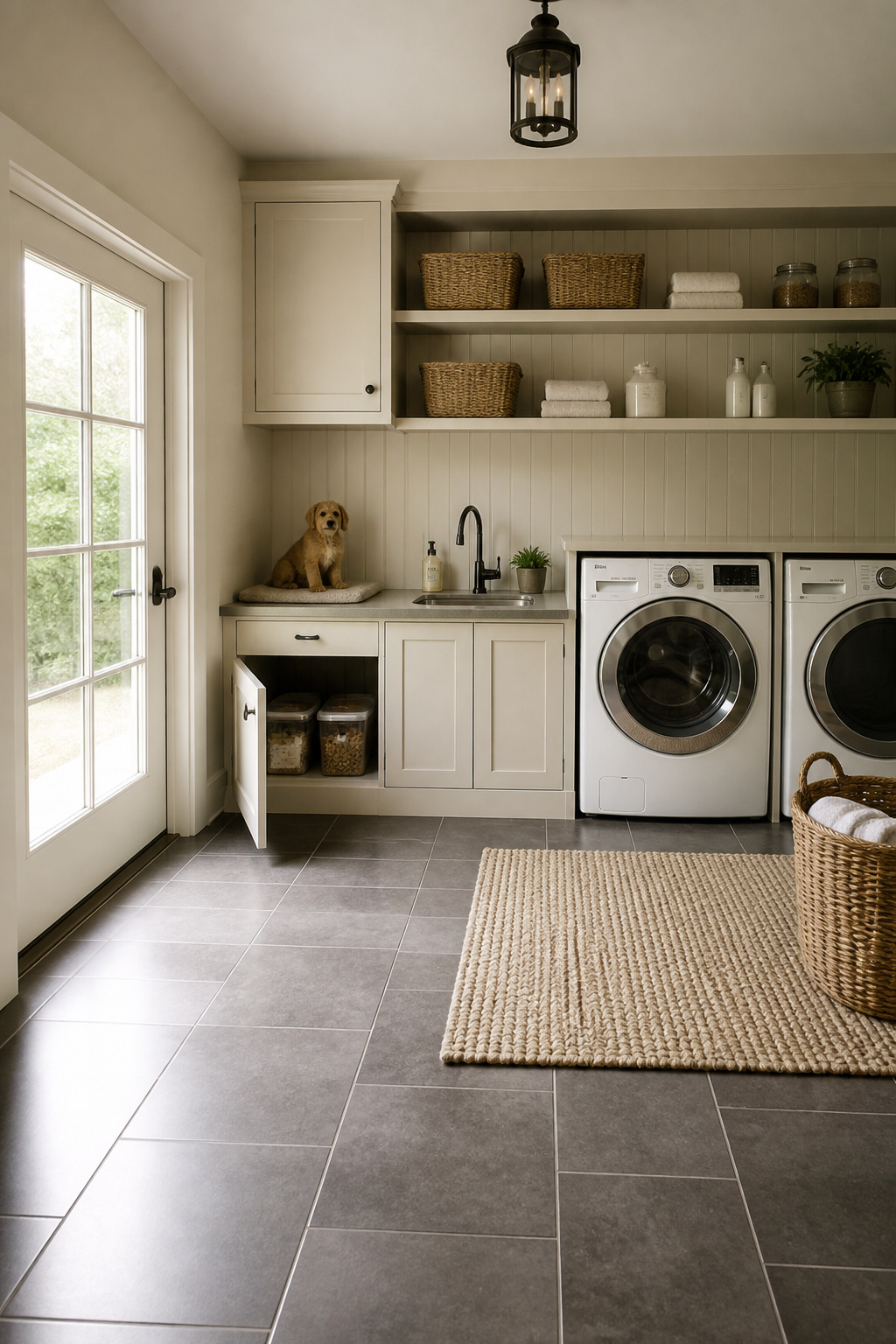
Pet stations in a laundry room only work if the mess stays on one side and the clean towels stay on the other. A dog wash tucked beside the washer needs a floor that drains, or you are mopping between every load of laundry. The height of a litter box hideaway matters more than the finish: too low and the cat ignores it, too high and you are lifting a pan past folded sheets. I have seen cabinets that pull double duty, with a lower drawer for kibble and the upper shelf for detergent, but the food odor lingers near fabric. The better split keeps pet functions at the room’s entry and laundry storage along the back wall, so dirty paws never cross paths with clean laundry. A utility sink near the door handles the rinse-off before the dog reaches the tub, and a pull-out step under the counter saves your back without stealing floor space.
15. Practical Drying Solutions

A foldable drying rack mounted to the wall keeps floor space clear and still handles a full load of delicates. I have seen the bi-fold kind from IKEA and a few hardware brands that pull out like an accordion and tuck flat against the tile when the socks are done. The mistake is mounting it at eye level directly behind the washer, which sounds convenient until you are leaning over wet clothes with the door swung open into your shoulder. Patti Wilbourne of PWD Studio notes that a laundry room needs enough clearance to turn in a full circle with a basket, and that rotation test applies to anything you install. If the wall beside the machines is shallow, a rod across the back of the door or hooks beneath an upper cabinet gives you hanging space without the swing-out conflict. For renters, a tension rod between cabinet sides or a rolling rack that stores under a counter works without drilling into the landlord’s drywall. The brass and Lucite hardware I have seen in finished rooms looks sharp, but a plain wooden rod painted to match the wall does the same job for the price of a coffee and an hour of drying time.
Smart Storage Deep-Dive
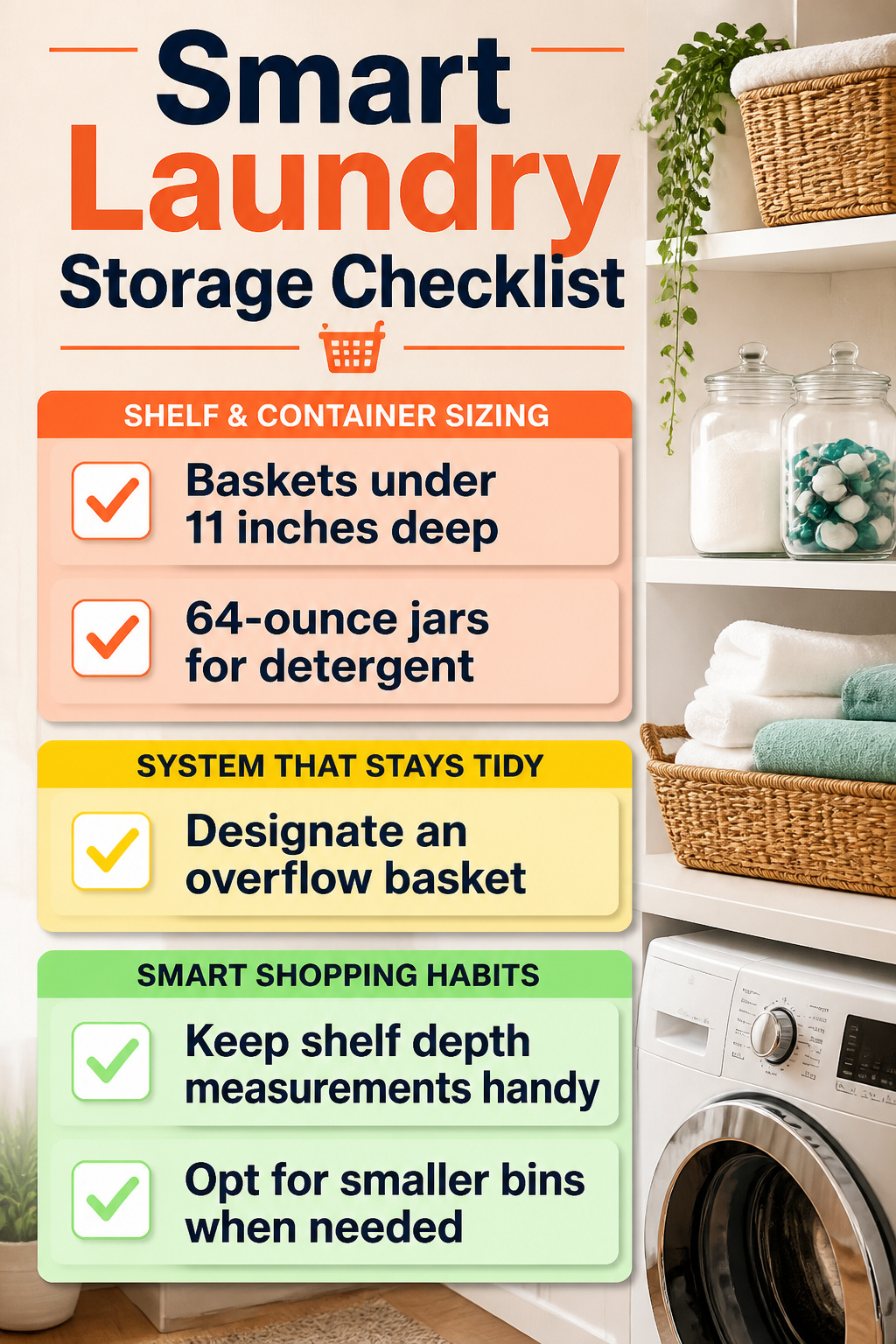
A basket looks generous in the store and then hangs two inches past your shelf edge. I learned that the hard way with a set of wire bins I had to return. Standard 12-inch shelves need baskets under 11 inches deep front to back, and 16-inch shelves can take the full 15-inch laundry bins that actually hold a full detergent load. Measure your shelf depth, then subtract an inch for pulling them in and out without scraping paint.
Glass jars for pods or powder run into the same problem. A 64-ounce anchor jar is beautiful and useless if the base overhangs. I keep a folded index card in my bag with my shelf depths written on it; thrift store and Target runs go smoother when I check against that number instead of eyeballing.
The system falls apart about three weeks in if you have to think to maintain it. I leave one basket permanently empty. That is where the single socks and the stain stick live until Saturday. Without a designated overflow spot, the tidy jars become a countertop pile by Wednesday.
Decorative Elements That Last
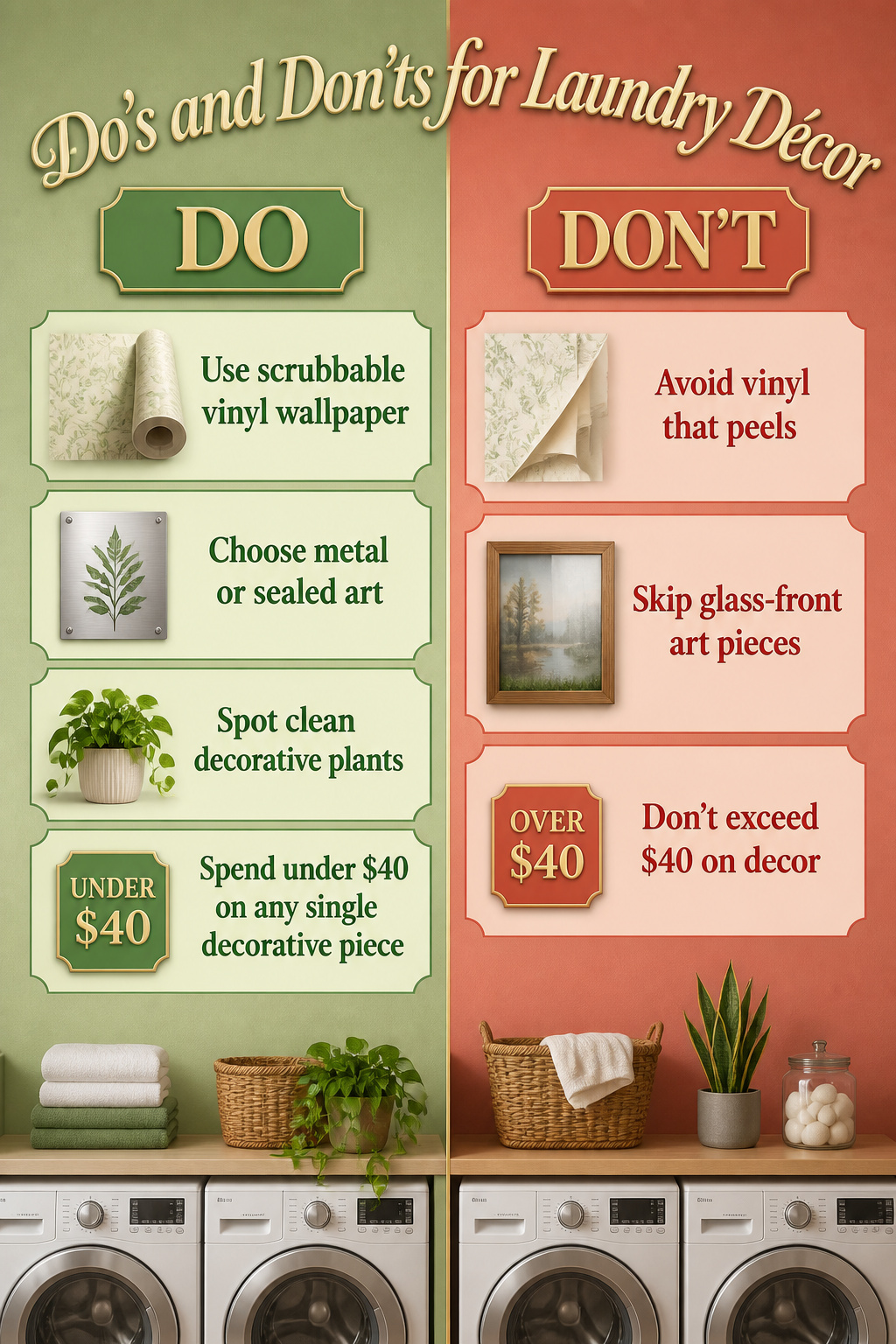
Vinyl wallpaper with a scrubbable coating runs about $30–$60 a roll and handles the humidity shift better than standard paper backing, which peels at the seams within a couple of weeks. I learned that timing after watching a friend’s laundry room border curl up while her kitchen vinyl, installed the same weekend, stayed flat. For art, metal or sealed canvas beats anything with a glass front; the glass fogs behind itself and grows a faint green line at the bottom edge that does not wipe off. A small metal print, 8 by 10 inches, costs roughly $15–$25 and survives years. Plants are the trickiest. Pothos and snake plants handle the humidity but the lint film on leaves means you are wiping them down every two weeks or they stop photosynthesizing in that particular gray way. Spend under $40 on any single decorative piece until you know it will last a month of actual loads: the heat and vibration shift things you would not expect, and the first month tells you whether a choice is pretty or pretty and functional.
When One Room Does Three Jobs
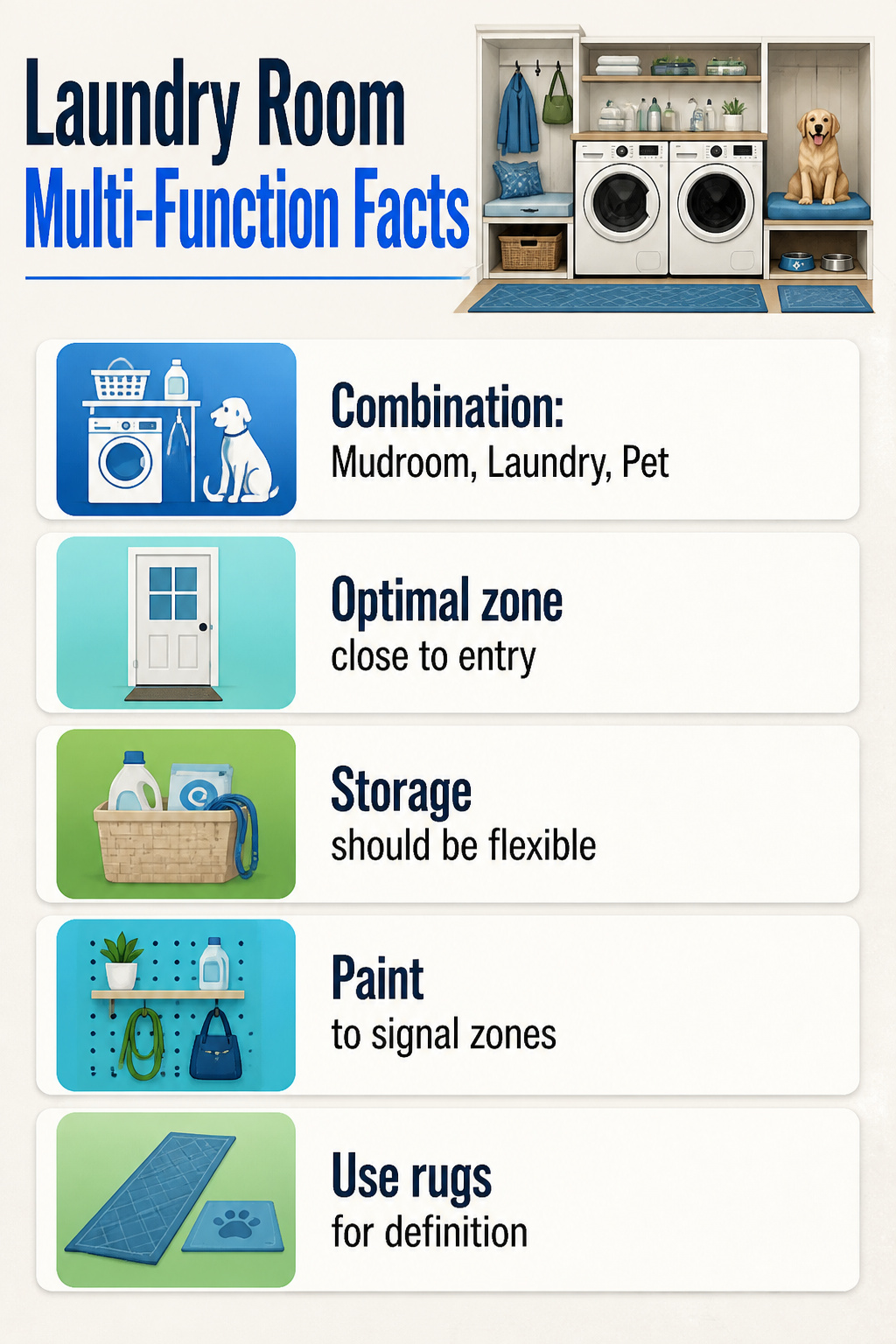
The mudroom-laundry-pet station combo is the setup that breaks most laundry rooms, because three jobs in one footprint means three times the clutter fighting for the same hooks and shelves. I spent a long time studying how people actually use these rooms before I understood that the zone that wins is the one closest to the door you enter through. If the washer sits between you and the coat rack, wet clothes from a rainy walk will drip across clean laundry every time.
Storage that flexes between uses matters more than storage that looks perfect for one. A bench with a hinged top can hold leashes and poop bags today, detergent pods tomorrow. The same basket corrals muddy boots or carries folded towels upstairs; the difference is which shelf height you park it on. I would rather have one deep shelf I can reach from both sides than two shallow ones that divide the wall into territories too small for anything real.
Signaling zones without walls is where paint color earns its keep. A stripe of color behind the washer reads as the laundry zone. The same color on a pegboard above the bench makes that wall feel intentional, not leftover. Rugs do the same job underfoot: a runner in front of the machines, a small mat by the door. The eye reads the shift and your feet follow, which is cheaper than framing a wall you will regret on moving day.
Light From Any Angle
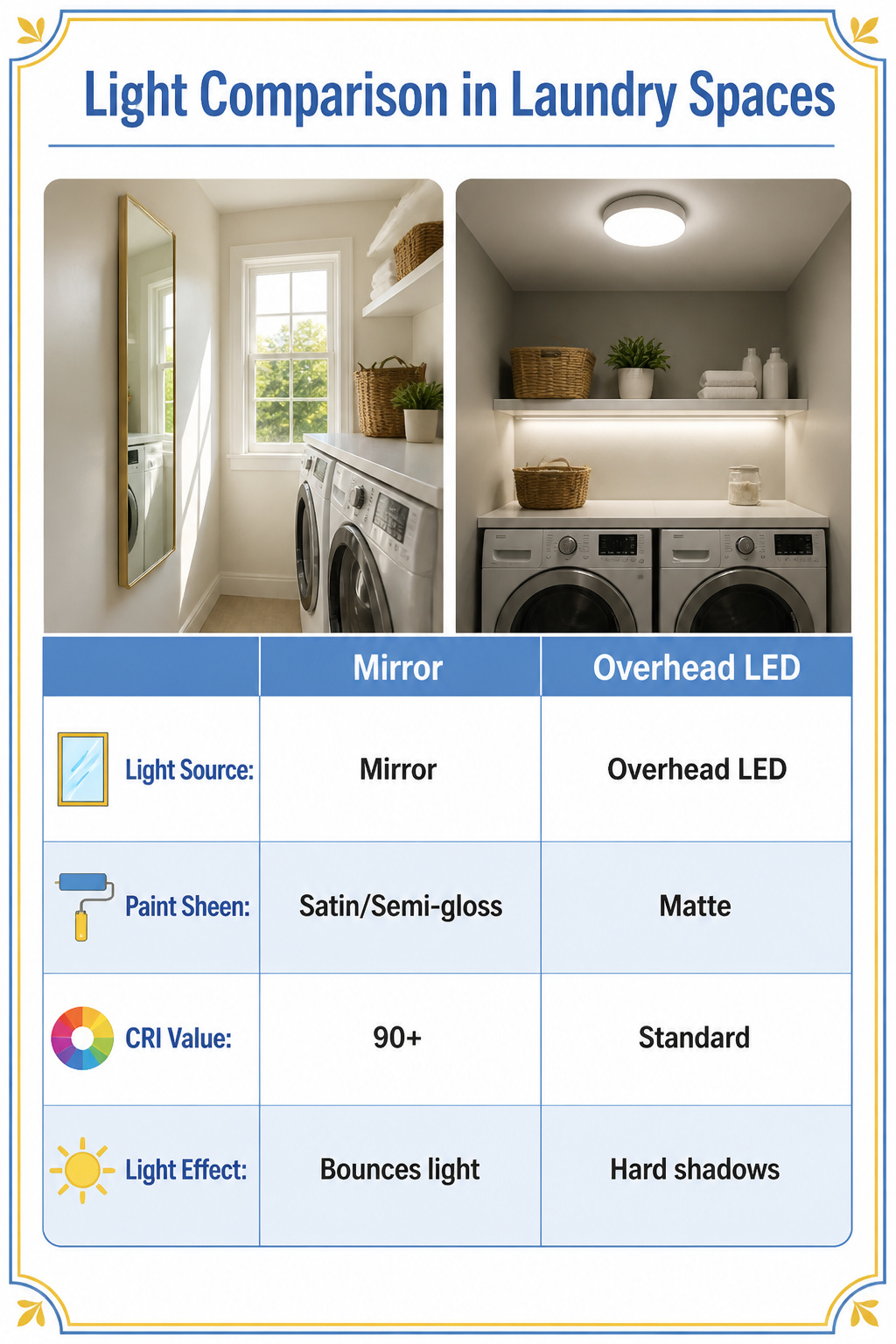
A mirror hung opposite the window bounces daylight back into the corners where the washer blocks it. In my last rental, the only window sat behind the door, so I mounted a cheap full-length mirror on the wall facing it and the room felt like it had doubled its hours of usable light. Paint sheen matters more than color for this trick: satin or semi-gloss on the walls catches what matte finishes swallow. I learned that after painting a closet laundry nook in eggshell and watching the same bulb look dimmer than it had on the sample card.
When there is no window at all, skip the standard overhead fixture. A flush-mount LED with a high CRI, around 90 or above, renders fabric colors accurately so you are not guessing whether that stain lifted. I swapped a boob light for one in my basement laundry corner and stopped carrying whites upstairs to check them. Strip lighting under a shelf works too, but only if it is diffused; bare LED tape throws hard shadows that make the room feel like a workshop.
Frequently Asked Questions
How can I make my laundry room more functional?
Build in dedicated zones for folding, hanging, and steaming so the mess never swallows the whole room. Front-loading machines with a counter installed over them create work surface without eating floor space, and a utility sink plus receptacle for trash rounds out the basics. Patti Wilbourne of PWD Studio also recommends leaving enough open floor to turn in a full circle while holding a laundry basket.
What are some decorative ideas for laundry rooms?
Hang art in metal or acrylic frames with sealed backs, since paper-backed pieces curl within months from steam. Add a trailing pothos or snake plant on an upper shelf for softness against hard appliances, or use a good faux stem if the room has no window. Wallpaper on the wall you face while folding turns a space you endure into one you notice, though peel-and-stick holds up only if your dryer vents well.
How do I maximize natural light in my laundry room?
Design the layout around any existing window, placing the sink or folding station where the light falls so you can spot stains while they are still treatable. If you are stuck windowless, swap to daylight bulbs with at least 2300K; that color temperature mimics afternoon sun closely enough that stain-checking becomes reliable again. A sculptural overhead fixture helps, but the bulb inside it is what determines whether a coffee spot reads as a shadow.