
A wallpaper mural trees design turns a single wall into a continuous landscape that recedes visually, making small rooms feel larger and busy spaces calmer. The catch is that the effect depends entirely on choosing the right density and light level for your space, misty birch scenes for dark rooms and denser greens where you want energy. Most ship as multi-panel scenes around 118 by 94 inches, with printed vinyl starting near $62.50 and heavier substrates climbing past $590.
Forest Murals
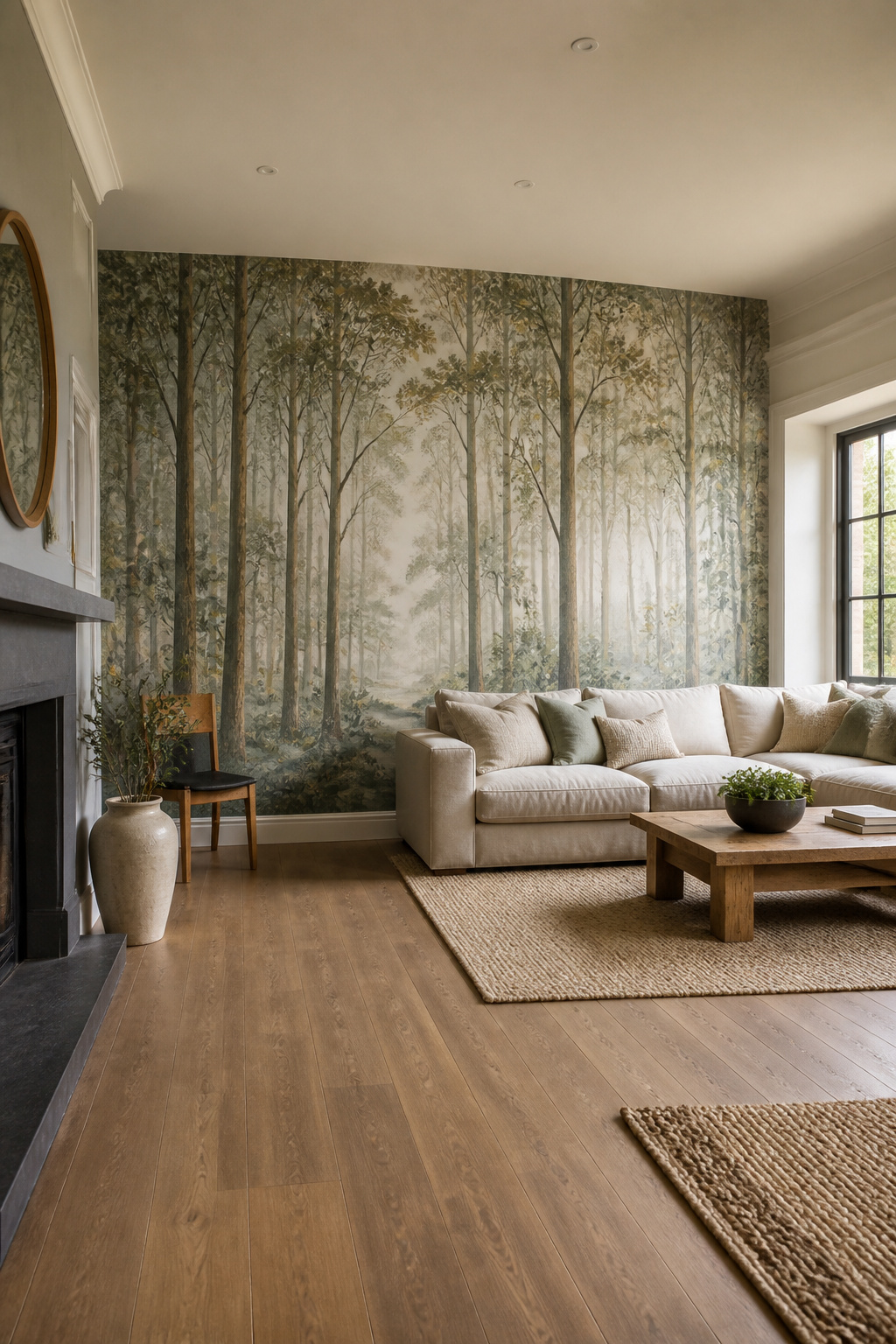
A forest mural turns one wall into a window that recedes. The depth pulls the eye past the furniture, so a living room reads larger than its footprint and a bedroom settles into something quieter than the street outside. Most come as one continuous scene across several panels, not a repeating pattern, which matters if you want the trunks to feel like they keep going rather than loop back on themselves.
The assembled size I keep seeing is around 118 inches by 94 inches, though some makers cut to your exact wall. Price spreads wide, from about $62.50 up past $590 depending on whether you are getting a printed vinyl or something heavier. I would not pay the top of that range for a rental, but the entry end holds up fine for a weekend install you might peel off in three years.
Mood shifts with density. Misty, open woodland reads calm; denser green pushes more energy. If your room is small or the light is limited, the lighter Scandinavian-style birch scenes keep things from going cave-dark. A darker forest silhouette, say tall pines in graded greys on white, sits between those poles and works when you want the trees present without the color taking over.
Tropical Tree Murals
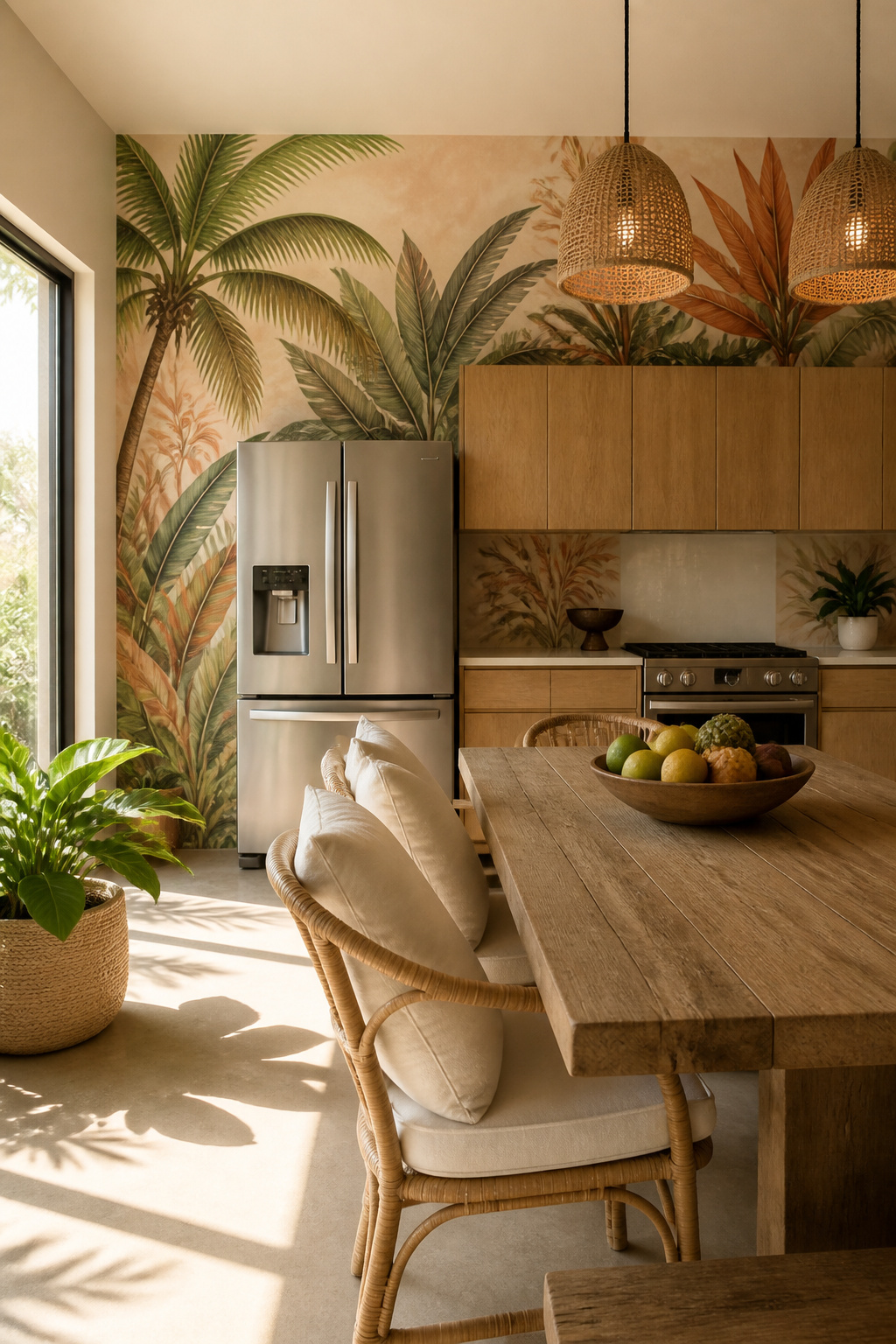
Tropical tree murals hit different than the forest kind. Where a birch or misty woodland scene pulls the room inward, palms and broad-leafed flora push the wall open toward light and heat. I keep seeing these in two palettes now: one warm and restrained, with pale yellow, golden brown, grey, cream and terracotta against a light grey ground; the other greener, with shades of green, grey, yellow and terracotta on a creamy-beige backdrop. Both come in 6 panels at $62.50, same size and price structure as the rest of the line.
The mood shift matters more than the subject. Forest murals work in bedrooms and reading corners because they quiet the space. Tropical scenes need rooms that already get decent daylight, or they flatten into wallpaper rather than atmosphere. A bathroom with a window, a kitchen breakfast wall, or a rental sunroom where you cannot change the actual view outside, these are where the palm version earns its keep. The warmer, more neutral palette reads as vintage travel poster; the greener one feels closer to living greenhouse. Either way, the scale is the same six-panel format, so the decision is color first, placement second.
Birch Tree Murals

Birch forest murals carry a lighter palette that keeps a small room from feeling boxed in. Where a dense forest scene draws the walls inward, the white bark and soft natural tones of birch designs open the space back up. That visual breathing room is what convinced me to try one in a narrow hallway I had been stuck on.
The continuous landscape print matters here more than it might in a larger room. Because the scene does not repeat in a pattern, the eye travels along the trunks without hitting a seam that would break the illusion of depth. In a tight space, that uninterrupted vertical line does the work of a window you do not have.
Scandinavian-style interiors lean into this already, but the effect is not limited to that look. A birch mural works wherever you need the calm of a tree scene without the weight of darker greens or fog. The mistake is assuming lighter means boring. The detail in the bark texture, the slight variation in tone between trunks, gives the wall enough interest that you do not need to layer much else around it.
For a renter or a first project, this is the safer bet. The palette stays neutral enough that existing furniture does not fight it, and if you hang it on one wall only, the room still feels like yours rather than a showroom built around the mural.
Misty Forest Murals

Misty forest murals run on a palette of cool smoke grays, soft charcoal, and pale misty off-white that does the work of calming a room without you having to think about it. The lighter, open areas of mist at the center of the design keep the wall feeling airy even across broad spaces, while the darker pine details near the edges frame the room naturally so you do not need additional artwork fighting for attention.
Placing this style behind a low sofa or reading area lets the tall trunks and mist-filled canopy stretch upward without interruption from tall furniture. Rooms with generous daylight get the most from the design; the delicate tonal gradations between foreground needles and distant fog read clearly only when light hits them. For surrounding walls, a crisp or slightly cool off-white keeps the whole space luminous, or you can ground it with baseboards in deep slate gray that mirror the darkest branches. The effect is meditative rather than decorative, which is why these murals land most often in bedrooms and dedicated quiet spaces rather than high-traffic areas where the subtlety gets lost.
Artistic Tree Murals

Abstract tree murals trade photoreal bark and leaves for color fields, brushstroke texture, and shapes that suggest a canopy without mapping every branch. I noticed this distinction most when I was helping a friend paper her rental studio: the forest mural she first ordered felt like a window into someone else’s woods, but the watercolor-style piece she swapped it for felt like her own mood on the wall. These interpretations work best where you want atmosphere without a specific place, which makes them natural fits for bedrooms, creative spaces, or any room where the wall should read as art first and scenery second.
The gap between abstract and realistic matters practically too. A photoreal forest demands enough wall width to feel immersive; a stylized tree in three colors can hold a narrow powder room or the single visible strip beside a doorframe. Custom sizing becomes more useful here than with photographic prints, because the artist can adjust the scale of the forms to your wall rather than cropping a fixed photograph. I have seen this save a project when a standard 8-foot panel would have cut a tree trunk awkwardly in half. The tradeoff is lead time: a made-to-order mural adds days or weeks against something shipped from stock. For renters, that extra wait pays off only if the colors are exactly right for furniture you already own.
Photographic Tree Murals
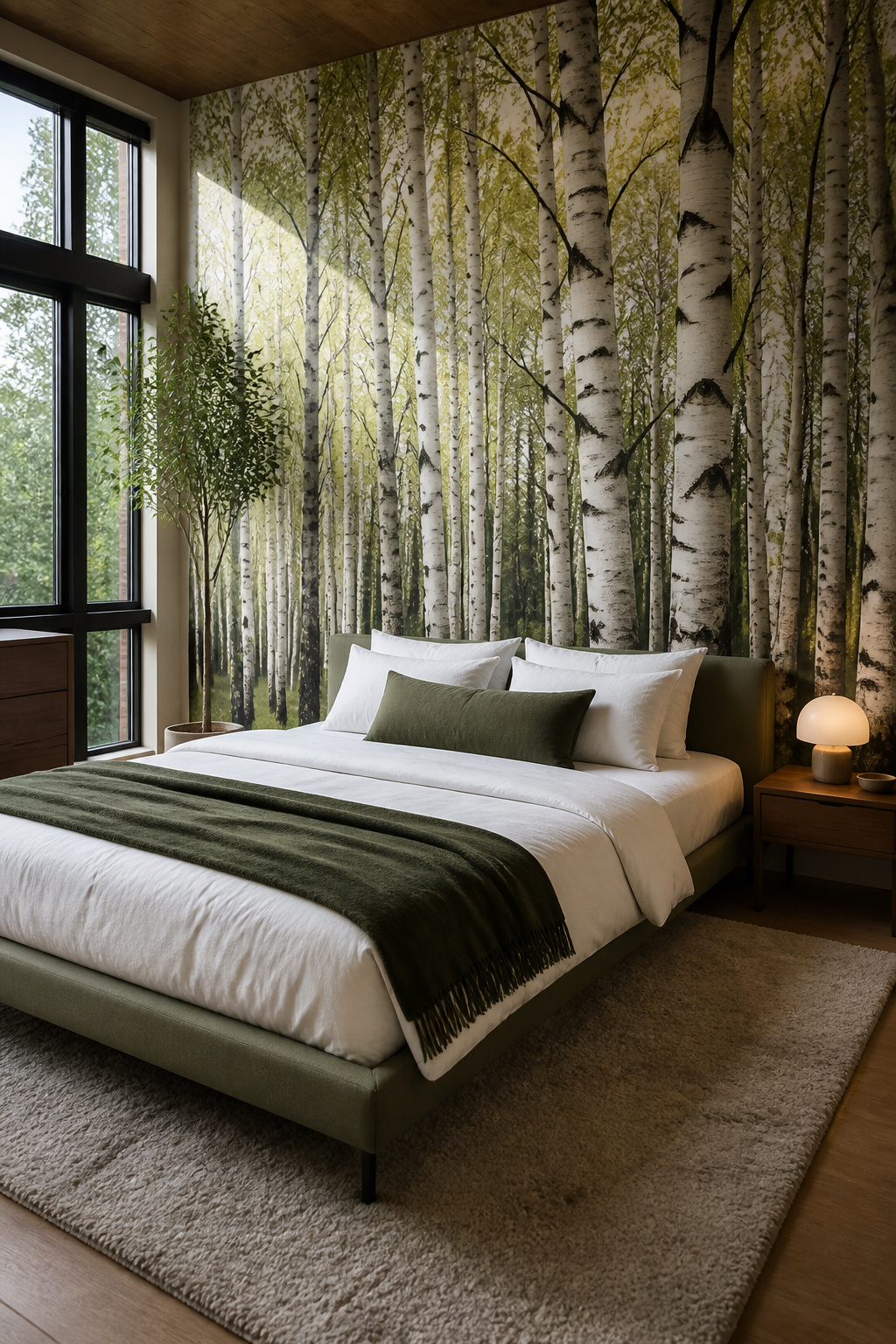
Photographic tree murals print from high-resolution files, and the difference shows up the moment you stand in the room. A birch grove with actual bark texture or morning mist catching real light gives a depth that illustrated alternatives flatten out. Custom photographic versions ship in 2–5 days, which is the tradeoff for that specificity: the image gets cropped and scaled to your exact wall dimensions after you order, not pulled from a warehouse shelf.
I spent a while comparing the two approaches for a bedroom project last year. An illustrated forest mural can read as intentional design, almost like a hand-painted scene. The photographic kind reads as atmosphere. The risk with photo realism is scale: a tree trunk blown up to ten feet wide can look more National Geographic than restful. Cropping matters here. Most suppliers let you preview the crop before the file goes to print, and that step is worth the extra day of turnaround.
PVC-free papers with a subtle physical texture, the kind several makers use, help the photographic ink settle in a way that softens the digital edge. Without that tooth, a photo mural can go glossy and flat, more billboard than forest floor.
Measuring Your Wall

- Start with the widest width and the tallest height your wall allows, measured in three places: left edge, center, and right edge for width; left, center, and right for height. Ceilings slope, corners bow, and baseboards eat into the space more in one spot than another.
- The smallest of your three width measurements is the number you send to the printer. Same for height: the shortest measurement wins. Ordering to the maximum instead of the minimum leaves you trimming wallpaper into a gap that shows the old paint underneath.
- I write both numbers down with a note about which wall they belong to. Mural companies size in inches, not feet, so I convert right then and avoid ordering a 12-foot panel when I meant 144 inches.
- Add two inches to both final numbers if the mural arrives in panels. That overlap is your insurance against the wall not being square; you trim it off after hanging, not before. Skip this buffer on a single-sheet peel-and-stick product, or the extra material bunches at the edges.
Material Options

Non-woven, PVC-free, and peel-and-stick each handle differently on the wall, and the choice matters more than the print itself.
- Non-woven murals arrive in numbered panels and go up with standard paste. The material stretches slightly during install, which forgives a wall that is not perfectly flat. Graham & Brown pairs their heavy-weight coated version with Solvite All Purpose Wallpaper Adhesive, one pack covering roughly 4.5 rolls. Their fast-mix formula keeps the prep quick.
- PVC-free options skip the vinyl backing entirely. Photowall prints these made-to-order in Sweden, and the absence of PVC changes how the paper breathes. Good for bedrooms or living rooms where off-gassing matters to you. Less scrubbable than a coated finish, so keep it out of the direct-splash zone near a sink.
- Peel-and-stick carries a matte finish and peels back up when your lease ends. Wallism marks theirs renter-friendly but notes the catch: no texture on the wall underneath, or every bump telegraphs through. Ceilings are off the table for this one. The install is faster, yet the removal is only clean on smooth drywall or a primed surface.
For a hallway or kids’ room, the durable coated paper wins. For a temporary change in a rental with flat walls, peel-and-stick saves the weekend.
Where Tree Murals Work

Living rooms give a tree mural the wall width it needs. The panoramic composition stretches across an uninterrupted surface, and the atmospheric depth does something most wall coverings don’t: it pushes the back wall visually backward. I noticed this first in a friend’s apartment where a foggy forest scene sat behind a low sofa. The tall trunks rose without interruption, and the mist-filled canopy kept the center light enough that the room felt larger than its 12-foot depth, not decorated into a smaller box.
Bedrooms turn that same depth into calm. A forest or tropical design behind the bed replaces the usual flat headboard wall with layers of foliage that recede. The eye reads distance instead of enclosure, which matters in the smaller bedrooms most renters and first-home owners actually have.
Offices benefit from the restoration angle. Natural imagery lowers stress in a space where stress collects, and the continuous landscape print keeps the scene intact rather than breaking it into a repeating pattern that would read as busy. The lighter birch tones work here if you need to preserve brightness for video calls; the darker pine details at the edges frame the space without closing it in.
Placement matters more than room type. Generous daylight lets the tonal gradations between foreground needles and distant fog read clearly, so put the mural where morning or afternoon light hits it directly, not in a windowless corner where the depth flattens to mud.
Ordering Samples
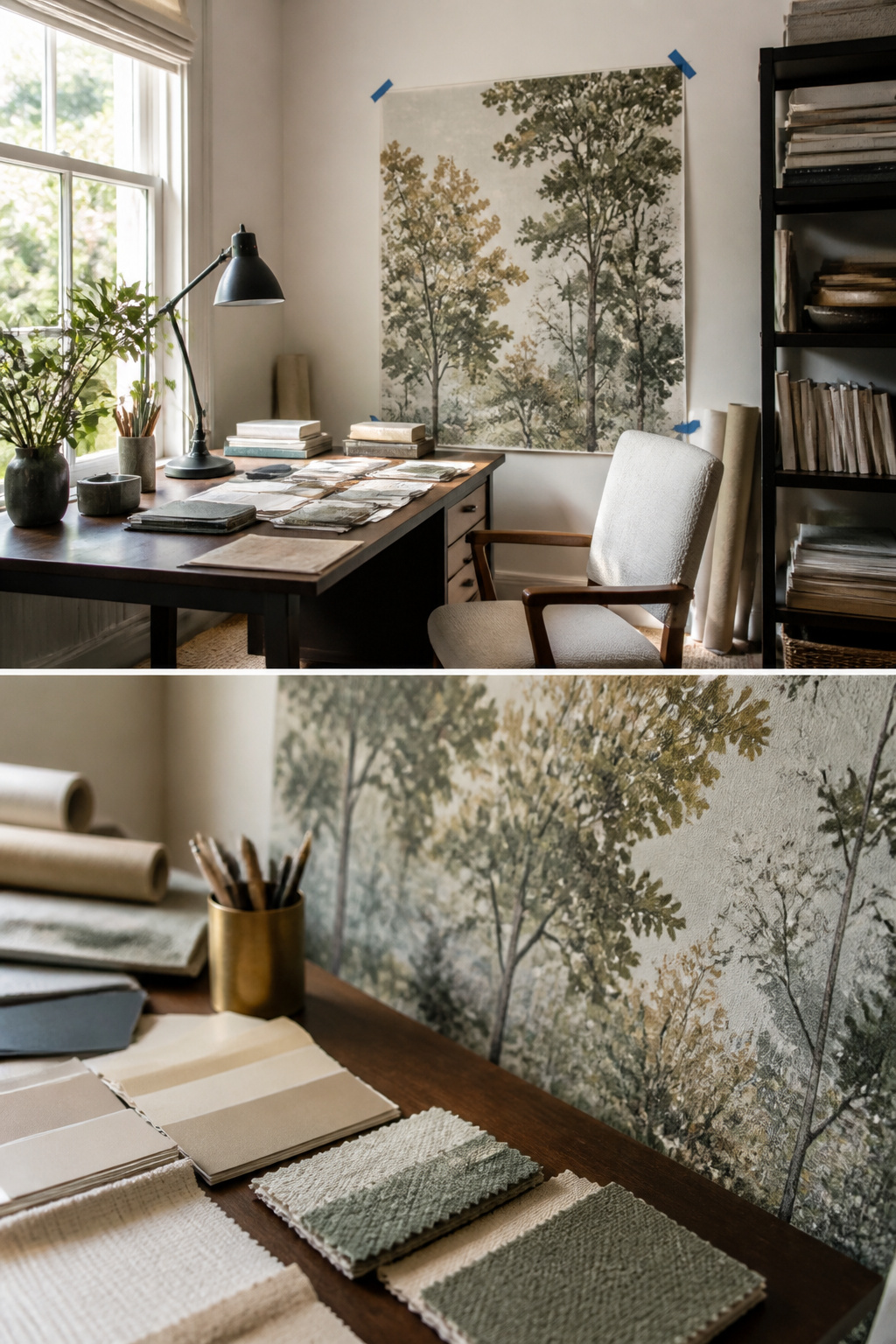
Most companies selling wallpaper mural trees will send a small swatch of the exact scene and material before you commit to the full order. The cost is usually low enough that ordering two or three finalists makes sense, especially when you are torn between a dense forest and a misty canopy. I have learned to tape each sample to the wall where the mural will actually live and check it across a full day, morning to evening, because the greens and grays shift dramatically under warm lamplight versus window light. The texture matters too. A satin finish catches glare in a bedroom, while a matte surface reads softer and hides wall imperfections better. If you are considering peel-and-stick, cut a corner of the sample and stick it, then peel it back after an hour to see whether the adhesive lifts paint or leaves residue. That test on your own wall beats every product description.
Frequently Asked Questions
What are the benefits of a forest wall mural?
A forest mural turns one wall into a receding window that makes a living room read larger than its footprint and a bedroom settle into something quieter than the street outside. The depth pulls the eye past furniture, while the natural imagery lowers stress and promotes a connection to nature. Most come as one continuous scene across several panels, so the trunks feel like they keep going rather than looping back on themselves.
How do I measure my wall for a mural?
Measure the widest width and tallest height in three places each: left, center, and right for width; left, center, and right for height. Send the printer the smallest of your three width measurements and the shortest of your three height measurements, because ceilings slope and corners bow. Add two inches to both final numbers if the mural arrives in panels, so you have overlap to trim after hanging.
Can I order a sample of the mural?
Most companies selling wallpaper mural trees will send a small swatch of the exact scene and material before you commit. Tape each sample to the wall where the mural will live and check it across a full day, because greens and grays shift dramatically under warm lamplight versus window light. If you are considering peel-and-stick, cut a corner and stick it, then peel it back after an hour to see whether the adhesive lifts paint or leaves residue.